The mythology of crypto mining is usually told in one currency: money.
Hash rates become revenue projections. Difficulty adjustments become margin calculations. Hardware upgrades become capital expenditures. Even the language of decentralization has been quietly colonized by yield.
But imagine a different archetype.
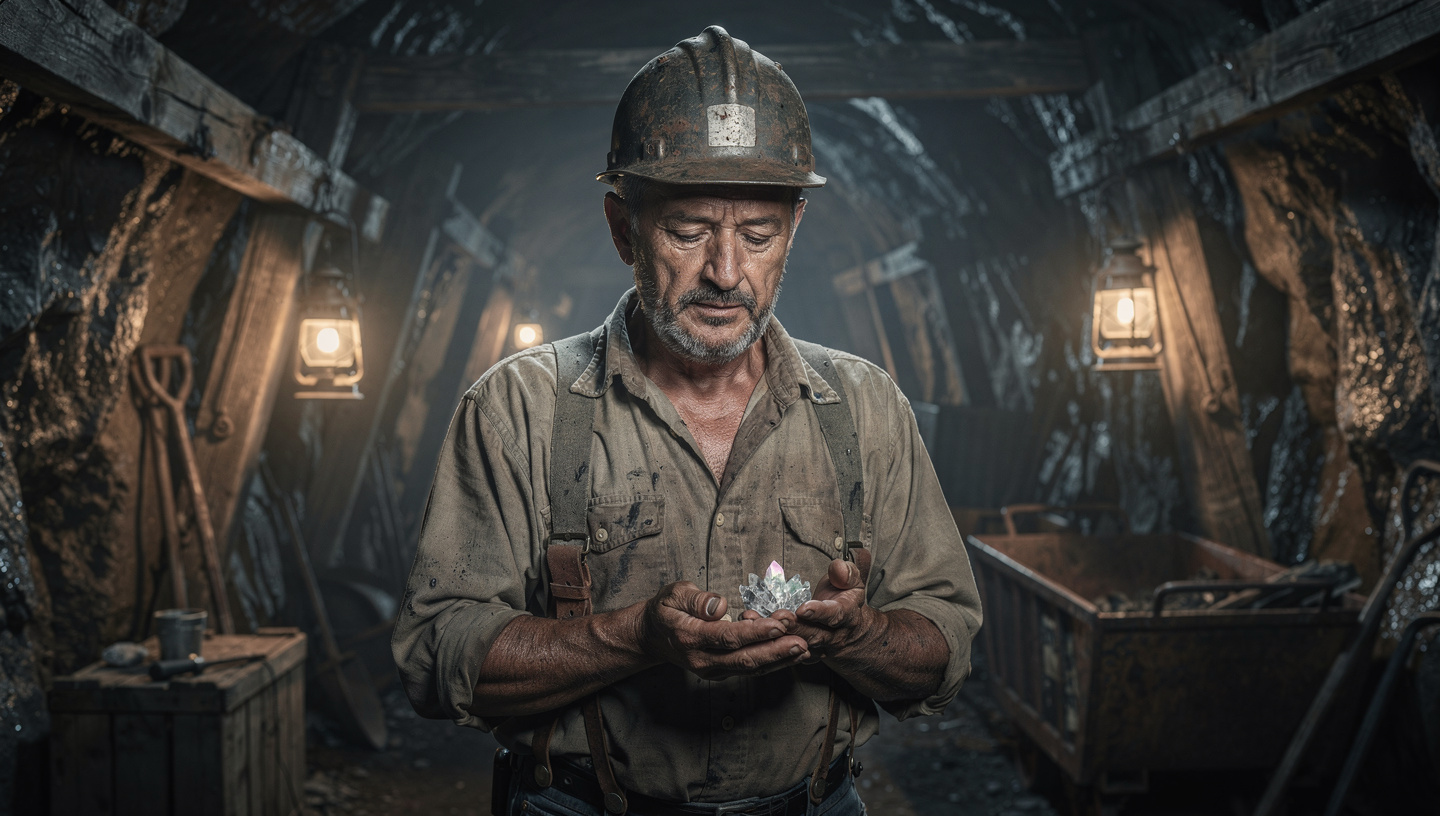
Not the miner chasing block rewards or arbitraging electricity costs—but the miner who stayed long after profitability evaporated. The one who continued validating blocks when ASICs became obsolete, when fees collapsed, when the market stopped caring.
This is not a story in the literary sense. It is a speculative, research-oriented thought experiment: a philosophical and technical exploration of what happens when crypto mining is stripped of its financial incentive and what remains is something closer to civic infrastructure.
In this fiction category analysis, the “miner” becomes a conceptual figure—an operator who discovers that the true value of distributed systems was never profit, but participation.
1. Mining as a Social Technology (Not a Business Model)
Crypto mining is typically framed as an economic activity: expend energy, receive coins. But structurally, mining is something else entirely.
At its core, mining performs three functions:
- State validation – confirming transactions are legitimate.
- Consensus enforcement – ensuring the network converges on a single history.
- Temporal ordering – turning unordered broadcasts into a cryptographically sequenced ledger.
These are not financial primitives. They are social primitives.
They answer questions every civilization has had to solve:
- Who gets to write history?
- How do we agree on truth without a central authority?
- What makes a record tamper-resistant across time?
Long before blockchains, societies used temples, courts, and archives. Crypto introduced a new answer: probabilistic consensus backed by computation.
The miner is not merely extracting value. The miner is operating a distributed clock.
Once you see this, the economic framing starts to look narrow.
2. The Early Idealism Layer
The earliest crypto participants did not join for yield farming or leveraged derivatives. They joined because something unprecedented was happening: money was becoming a protocol.
Figures like Satoshi Nakamoto and Hal Finney were not building a get-rich-quick scheme. They were exploring whether trust itself could be automated.
Mining, in that context, was an act of alignment with a philosophical project:
- Sovereignty without states
- Verification without institutions
- Scarcity without central banks
Profit was incidental. Participation was primary.
The modern mining industry—warehouses of specialized hardware, energy arbitrage strategies, financial hedging—emerged later. It professionalized what began as a volunteer network.
And something subtle was lost.
3. When Mining Stops Paying
Now we enter speculative territory.
Imagine a future cycle where:
- Block rewards approach zero.
- Transaction fees collapse due to layer-2 scaling.
- Regulatory pressure compresses margins.
- Energy prices rise permanently.
From a purely rational economic standpoint, mining should stop.
But it doesn’t.
A small subset of operators remain online.
Why?
Because some systems persist even after incentives disappear. Amateur radio operators still transmit despite no commercial payoff. Archivists preserve data no one reads. Open-source developers maintain libraries for years without compensation.
These are not markets. They are cultures.
In this fiction category framework, the miner who stays becomes something closer to a digital steward.
4. The Miner as Infrastructure Custodian
When profit leaves the equation, mining changes character.
It stops being extractive and becomes preservational.
The remaining miners are no longer competing for rewards. They are maintaining continuity:
- They keep historical blocks accessible.
- They ensure forks resolve.
- They defend against entropy.
At that point, mining resembles:
- Running DNS root servers
- Hosting Tor relays
- Seeding archival torrents
It becomes public infrastructure.
And like all infrastructure, its value is invisible until it fails.
The miner who finds meaning here realizes something important: decentralization is not a feature you buy. It is a practice you maintain.
5. Energy, Entropy, and the Thermodynamics of Trust
Much criticism of crypto focuses on energy consumption.
The critique is technically valid but philosophically incomplete.
Every trust system consumes energy:
- Banks operate data centers.
- Courts maintain buildings and staff.
- Governments fund armies and bureaucracies.
Crypto merely externalizes that cost into electricity.
Mining converts energy into order. Specifically, it converts raw entropy into an ordered, append-only history.
This is not waste by definition. It is a form of thermodynamic accounting.
The miner who stops caring about profit begins optimizing differently:
- They colocate with surplus renewables.
- They repurpose waste heat.
- They treat uptime as more important than ROI.
Mining becomes ecological engineering rather than industrial extraction.
6. The Quiet Shift from Incentives to Identity
Here is the critical transition.
At scale, networks survive on incentives.
At maturity, they survive on identity.
The miner who remains does not ask:
“How much will I earn?”
They ask:
“What does this network represent?”
They see the ledger as:
- A historical artifact
- A censorship-resistant memory
- A shared global timestamp
Running a node becomes a form of digital citizenship.
This mirrors how early internet infrastructure evolved. Universities and hobbyists kept servers online not because it paid, but because it mattered.
Meaning replaces margin.
7. Mining After Capitalism (Speculative Economics)
In this fictional future, mining is no longer priced by markets alone.
It is supported by:
- Municipal cooperatives
- Academic institutions
- Digital preservation grants
- Community energy projects
The economic model shifts from profit extraction to cost-sharing.
Miners operate like librarians.
They are funded because society decides continuity is worth maintaining.
Blockchains become archives rather than casinos.
This is not utopian. It is structurally consistent with how mature infrastructures stabilize.
8. The Miner’s Psychological Transformation
The most interesting change is internal.
Early-stage miners optimize for speed, efficiency, and dominance.
Late-stage miners optimize for resilience, diversity, and longevity.
Their metrics evolve:
- From hash rate to uptime
- From revenue to redundancy
- From growth to durability
They begin thinking in decades instead of quarters.
They understand that the network does not need them individually—but it needs someone.
So they stay.
9. Meaning as a Byproduct of Participation
The miner who finds meaning discovers something unintuitive:
Value emerges from contribution, not extraction.
By maintaining consensus, they become part of a global, permissionless institution.
No badge. No title. No paycheck.
Just presence.
They are simultaneously anonymous and indispensable.
This is the quiet power of decentralized systems: they allow individuals to matter without being visible.
10. Implications for the Future of Crypto
If this trajectory holds, crypto bifurcates:
Track A: Financialization
Speculation, derivatives, tokenized assets, high-frequency arbitrage.
Track B: Protocol Preservation
Slow, steady, culturally embedded infrastructure.
Most attention remains on Track A.
But Track B is where durability lives.
The miner who chooses meaning over profit implicitly aligns with Track B. They become part of the substrate rather than the market.
11. Why This Matters Beyond Crypto
This thought experiment extends beyond blockchains.
It applies to any decentralized system:
- Federated social networks
- Peer-to-peer storage
- Distributed identity frameworks
All eventually face the same question:
What happens when incentives fade?
The answer determines whether the system becomes a historical footnote or a civilizational layer.
Conclusion: The Miner as a New Kind of Citizen
“The Miner Who Found Meaning, Not Profit” is not a hero narrative.
It is a structural possibility.
In this fiction category analysis, mining evolves from an economic activity into a form of stewardship. The miner becomes a custodian of shared digital reality.
They do not extract wealth.
They preserve continuity.
They do not chase upside.
They defend memory.
And in doing so, they reveal the deepest truth of decentralized technology:
Crypto was never primarily about money.
It was about building systems that survive us.
The miner who understands this no longer asks what the network can pay.
They ask what the network needs.