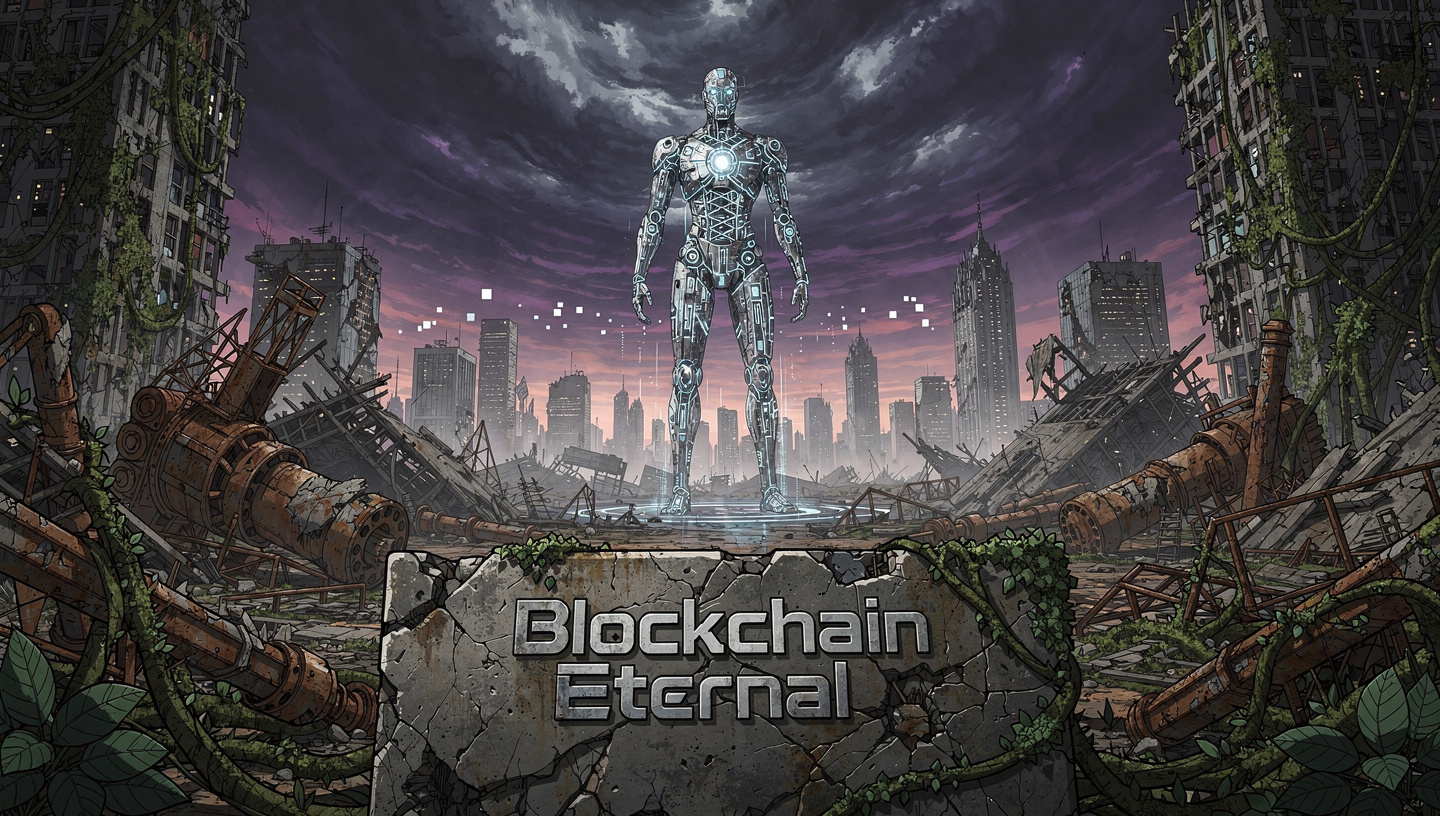
Imagine a future in which no human remains alive to submit transactions, deploy smart contracts, or debate governance proposals.
Yet the blockchain is still there.
Blocks continue to exist. Hashes remain mathematically valid. Ledgers persist across cold servers, derelict satellites, and autonomous data vaults buried beneath continents. Digital consensus mechanisms, once designed to coordinate economic activity, now function as orphaned machines, preserving the fossilized record of a vanished species.
This article explores that premise—not as a narrative story, but as a research-driven speculative analysis:
What if the blockchain outlived humanity?
Not metaphorically. Literally.
What would such a system represent? How long could it persist? What information would survive? And what would that immutable ledger say about us?
This is not science fiction in the traditional sense. It is an extrapolation grounded in cryptography, distributed systems, planetary-scale infrastructure, and long-term digital preservation.
Let’s begin.
1. Blockchain as a Post-Human Artifact
Blockchains were created as tools for trust minimization: distributed databases secured by cryptography and economic incentives. Their core properties—immutability, redundancy, and decentralization—make them uniquely resilient compared to conventional data systems.
Consider Bitcoin (used here purely as an example of a public blockchain network). It was designed so that no single institution controls it. Copies of its ledger exist across thousands of nodes worldwide. Even if most disappear, a single surviving copy can, in principle, resurrect the chain.
Likewise, Ethereum expanded this idea by embedding programmable logic directly into the ledger itself.
These systems already behave like digital organisms:
- They replicate.
- They resist corruption.
- They preserve state.
- They evolve through protocol upgrades.
Humanity may have created them—but they were engineered to survive us.
2. The Mechanics of Survival: How a Blockchain Could Persist Without Humans
For a blockchain to outlive humanity, three things must remain functional:
- Storage
- Energy
- Execution
Let’s examine each.
2.1 Storage: Redundant Memory Across the Planet
Modern blockchains are replicated across:
- Data centers
- Personal computers
- Cold-storage archives
- Institutional backup systems
Some nodes already operate in hardened facilities designed to withstand natural disasters. Others are embedded in satellite infrastructure. Research initiatives have explored storing blockchain snapshots on DNA, quartz glass, and deep-archive magnetic media.
Even if 99.999% of nodes vanished, the remaining fraction could still preserve the historical record.
Blockchains do not require completeness. They require continuity.
One intact copy is enough.
2.2 Energy: Autonomous Power Sources
The primary vulnerability is electricity. Without energy, computation stops.
However, long-lived autonomous power systems already exist:
- Nuclear-powered research stations
- Radioisotope thermoelectric generators used in deep-space probes
- Solar arrays in orbit
- Geothermal installations
If even a small cluster of such systems were coupled to automated blockchain nodes, the ledger could persist for centuries—possibly millennia.
No human intervention required.
2.3 Execution: Machines Maintaining Machines
Most blockchains rely on human-operated validators or miners today. But nothing in principle prevents fully autonomous operation.
AI-controlled nodes could:
- Validate blocks
- Rotate cryptographic keys
- Repair corrupted data
- Migrate ledgers between hardware generations
Once initialized, such systems could function as closed loops—machines maintaining other machines.
At that point, the blockchain becomes self-sustaining infrastructure.
A digital relic with metabolism.
3. What Would the Ledger Contain?
If humanity vanished tomorrow, the blockchain would freeze in time—preserving:
- Financial transactions
- Smart contracts
- NFT metadata
- Governance proposals
- Supply chain records
- Identity attestations
- Messages embedded in blocks
Collectively, these form a fragmented but extraordinarily detailed portrait of civilization.
Unlike books or monuments, blockchains encode behavior:
- Who paid whom
- When assets moved
- Which protocols gained adoption
- Where speculative bubbles formed
- How communities coordinated
It is history written not by historians, but by economic activity.
4. The Blockchain as Humanity’s Unintentional Time Capsule
Traditional archives are curated. Blockchains are not.
They preserve everything indiscriminately.
Scams coexist with scientific research. Meme tokens sit beside humanitarian aid transfers. High-frequency trading data shares space with decentralized governance experiments.
This makes the blockchain a radically honest artifact.
No editorial bias. No retrospective cleanup.
Just raw, cryptographically verified human activity.
Future intelligences—biological or artificial—would not discover our greatest achievements first.
They would discover our transaction logs.
5. Cryptographic Permanence vs Biological Fragility
Human civilization is biologically constrained. We decay. We forget. Our institutions collapse.
Blockchains operate on different timescales.
Cryptographic hashes do not age. Digital signatures do not erode. Merkle trees do not forget.
The asymmetry is stark:
- Humans require oxygen, water, and social cohesion.
- Blockchains require electricity and mathematics.
In this sense, blockchain systems may be among the longest-lived constructs humanity ever produces.
Longer than empires. Longer than languages.
Possibly longer than our species.
6. The Role of the Absent Creator
The identity behind Satoshi Nakamoto remains unknown. Yet their design decisions may echo long after every human voice is silent.
This raises a profound question:
Who becomes the author of history when only the ledger remains?
Blockchains erase centralized authorship. They replace it with distributed consensus. If humanity disappears, the ledger becomes a self-authenticating record with no living witnesses.
A history with no historians.
7. Could Another Intelligence Interpret It?
A surviving blockchain would be mathematically intelligible—but culturally opaque.
An extraterrestrial civilization or future AI system could:
- Verify hashes
- Reconstruct transaction graphs
- Analyze economic patterns
But understanding why humans behaved as they did would be far harder.
What does a meme token mean without memes?
What does decentralized finance signify without markets?
The blockchain would appear as a vast, structured signal—clearly intentional, but emotionally silent.
Like discovering an alien accounting system carved into stone.
8. Ethical Implications: Should We Design for Post-Human Persistence?
This scenario forces uncomfortable questions:
- Should human-made systems be allowed to outlive humanity?
- Are we creating digital monuments or digital liabilities?
- Who is responsible for abandoned autonomous infrastructure?
A self-sustaining blockchain could consume energy indefinitely, even when no beneficiaries remain.
From a planetary perspective, this may be wasteful.
From an archaeological perspective, it may be invaluable.
We are unintentionally building the longest-running experiment in digital permanence ever attempted.
Final Analysis: The Ledger After the Last Breath
If the blockchain outlived humanity, it would not mourn us.
It would not reflect.
It would simply persist.
Block after block. Hash after hash.
A silent, immutable monument to economic coordination, technological ambition, and collective experimentation.
No marble statues.
No epic poems.
No oral traditions.
Just cryptographic proof that, once, a species learned how to agree on shared truth without trusting each other—and encoded that achievement into machines.
The blockchain would not be our legacy.
It would be our footprint.
And long after oceans rise and cities erode, that footprint might still be there—waiting for something, or someone, capable of reading it.
Closing Thought
Humanity has always tried to leave records: cave paintings, clay tablets, libraries, satellites.
Blockchain is different.
It is not a message we wrote for the future.
It is a system we built for ourselves—one that may quietly continue long after we are gone.
If that happens, the last artifact of civilization may not be a monument or a spacecraft.
It may be a ledger.