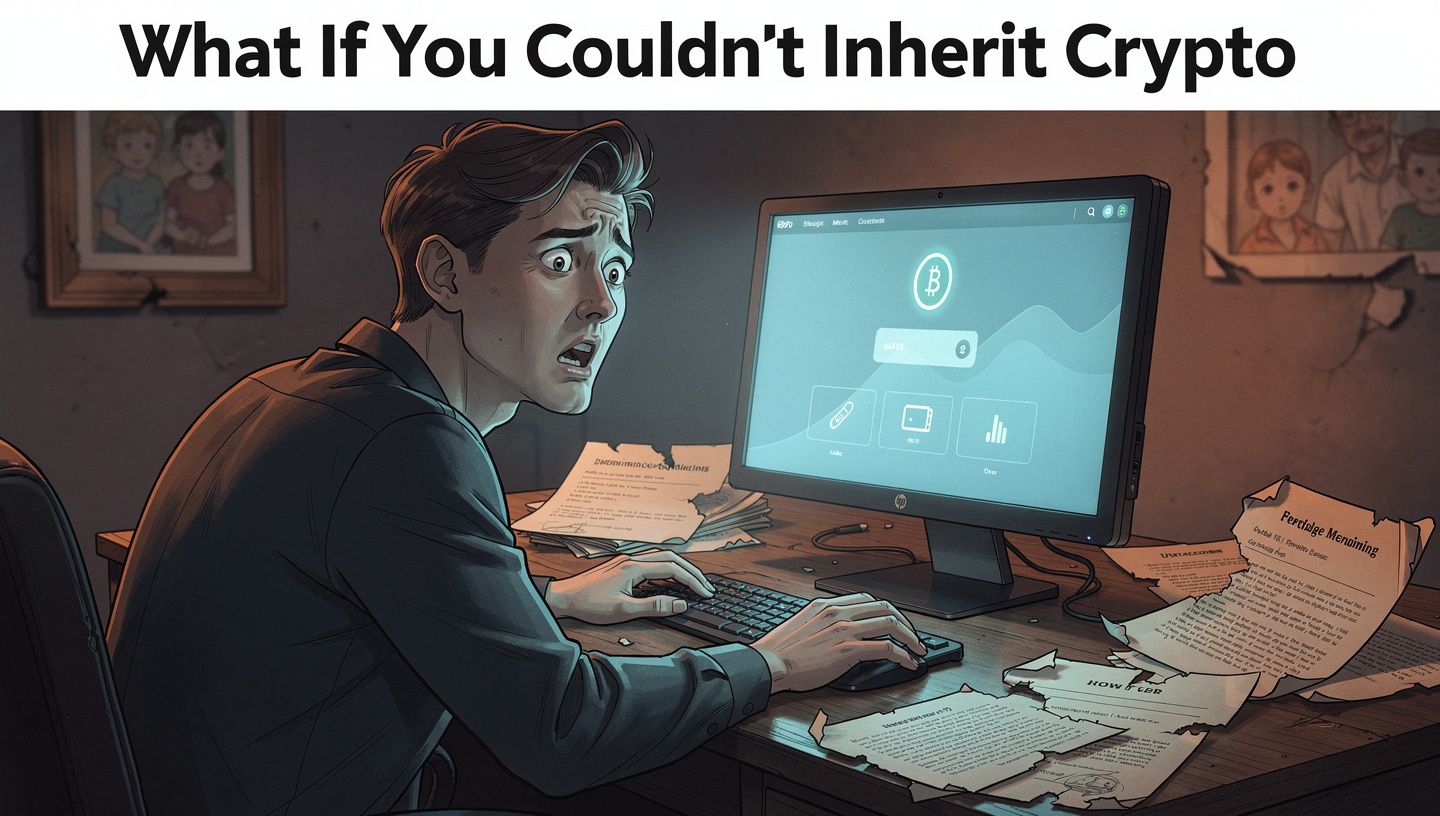
Crypto was built to eliminate trust.
No banks. No courts. No intermediaries. Just math.
That design choice produced one of the most powerful financial primitives in human history: assets that exist independently of institutions. But it also produced something far less discussed, far more uncomfortable, and increasingly unavoidable:
What happens when the owner disappears?
In traditional finance, death triggers bureaucracy. Wills activate. Probate courts engage. Assets flow, slowly and imperfectly, but they flow.
In crypto, death triggers entropy.
Private keys do not recognize heirs. Smart contracts do not pause for grief. Blockchains do not acknowledge funerals. A wallet without its keys is not “frozen.” It is gone.
This article explores a speculative—but technically grounded—future in which crypto inheritance fails at scale. Not as a sudden apocalypse, but as a quiet, compounding loss. A civilizational leak. A structural flaw embedded directly into the ideology of decentralization.
This is not a story. It is a research-oriented thought experiment.
And it begins with a simple premise:
What if crypto cannot be inherited?
1. Ownership Without Succession
Crypto introduced a radical model of property.
You do not own assets because a registry says so.
You own them because you possess a secret.
That secret—your private key—is absolute.
Lose it, and the assets are mathematically irrecoverable.
This is often framed as empowerment. Self-custody. Sovereignty. Financial autonomy.
But sovereignty has a shadow.
In classical property systems, ownership is relational. It exists inside a legal lattice: families, contracts, courts, governments. When someone dies, that lattice redistributes assets.
Crypto deliberately removed that lattice.
A blockchain only recognizes signatures.
Not marriages.
Not bloodlines.
Not wills.
From the network’s perspective, a dead person and a silent person are indistinguishable.
Which means that inheritance is not native to crypto. It must be bolted on.
And bolted-on systems fail.
2. The Scale of Silent Loss
Even today, a significant percentage of all crypto is already inaccessible.
Early wallets created by pioneers who vanished. Users who misplaced seed phrases. Hardware wallets destroyed in fires. Keys lost to corrupted drives.
No official registry exists, but conservative estimates routinely suggest that 15–25% of all circulating crypto is permanently locked.
These are not dormant accounts.
They are cryptographic graves.
Each lost wallet slightly increases scarcity, subtly distorts supply curves, and permanently alters token economics.
Now project this forward several generations.
Assume crypto becomes mainstream wealth infrastructure. Assume families hold substantial portions of net worth on-chain. Assume billions of people participate.
Then assume something else, far more certain:
People continue to die.
If inheritance mechanisms remain fragile, crypto does not merely transfer wealth unevenly. It deletes wealth from history.
Not redistributed. Not taxed. Not inherited.
Erased.
3. A Civilization That Forgets Its Assets
Consider what happens when loss compounds over time.
Every generation leaks a fraction of total wealth into unreachable addresses.
5% per generation.
10%.
15%.
No catastrophe required. Just ordinary mortality plus imperfect key management.
After ten generations, enormous amounts of capital are mathematically sealed away.
The blockchain still records those balances.
But no one can move them.
This creates a paradoxical economy:
- Nominal market capitalization rises.
- Effective circulating supply shrinks.
- Price signals detach from real liquidity.
- Volatility increases structurally.
Markets begin to behave like systems with phantom limbs.
Visible balances that cannot act.
Liquidity becomes fragmented. Capital efficiency collapses. Entire token ecosystems become dominated by long-dead wallets that still influence supply metrics.
Finance becomes haunted.
4. The Myth of “Just Share Your Seed Phrase”
The simplest inheritance advice in crypto is also the worst:
“Just give your seed phrase to someone you trust.”
This fails in multiple dimensions:
Security Failure
Sharing keys increases attack surface. Copies proliferate. Trust becomes human again.
Timing Failure
Heirs gain access immediately, not upon death. This creates incentives for coercion, manipulation, or premature extraction.
Reliability Failure
Paper backups decay. Digital backups corrupt. Password managers get locked. Instructions get misunderstood.
Most people cannot securely manage their own keys long-term.
Expecting them to engineer post-mortem cryptographic continuity is fantasy.
5. Smart Contracts Are Not a Panacea
Some propose programmable inheritance:
Time-locked contracts. Dead-man switches. Automated executors.
These help—but only partially.
They depend on oracles. On external signals. On assumptions about uptime and intent.
Dead-man switches fail when users forget to reset them. Oracles fail when services shut down. Contracts fail when bugs emerge years later.
More fundamentally, smart contracts cannot verify death.
They can only infer inactivity.
Which means they confuse:
- Long-term cold storage with abandonment.
- Comas with silence.
- Imprisonment with absence.
- Personal choice with biological finality.
They automate based on probabilistic heuristics.
Death is not a deterministic event on-chain.
6. Legal Systems Cannot See Private Keys
Traditional inheritance relies on legal authority.
Courts compel banks. Governments enforce judgments. Institutions cooperate.
Crypto explicitly rejects this model.
If your assets are self-custodied, no court can force the blockchain to comply. There is no administrator account. No override.
A judge cannot subpoena elliptic curve cryptography.
Which means even perfectly written wills become irrelevant unless paired with key access.
Law becomes advisory.
Math remains sovereign.
7. The Emergence of Crypto Necroeconomics (Fictional Discipline)
In this speculative future, economists develop a new field:
Crypto Necroeconomics — the study of capital trapped in deceased wallets.
They model:
- Mortality-adjusted token supply.
- Inheritance friction coefficients.
- Cryptographic attrition rates.
- Posthumous liquidity decay.
They publish papers estimating “ghost capital.”
They warn of systemic fragility as dead wallets accumulate voting power in DAOs, skew staking distributions, and distort governance outcomes.
Entire protocols are partially controlled by the deceased.
Decentralization becomes temporally asymmetric.
The past gains structural power over the present.
8. Governance Collapse by Attrition
Proof-of-stake systems assume active participation.
Validators sign blocks. Delegators vote. Governance tokens shape protocol evolution.
But what happens when large portions of stake belong to owners who can no longer act?
Quorums become harder to reach.
Upgrades stall.
Attack thresholds drop as effective participation shrinks.
Security models quietly erode.
No hacker is required.
Time alone weakens the network.
9. Family Offices in a Keyless World
Wealth management firms adapt.
They offer cryptographic estate planning.
Multi-party custody. Threshold signatures. Biometric recovery.
Entire industries emerge to solve what legacy finance handled automatically.
But these systems reintroduce intermediaries.
They centralize risk.
They recreate trusted third parties under different names.
The original promise of crypto—trust minimization—collides with the biological reality of mortality.
Decentralization yields to pragmatism.
Slowly.
Reluctantly.
Inevitably.
10. The First Lost Trillion
At some point, analysts publish a report:
Over one trillion dollars in crypto is now provably inaccessible.
Not stolen.
Not frozen.
Just… unreachable.
Markets react.
Governments notice.
Academics debate whether this constitutes destruction of capital or a new form of digital archaeology.
The blockchain contains immense wealth that no living person can use.
A permanent monument to cryptographic absolutism.
11. Philosophical Implications: Property Without Continuity
Inheritance is not just financial.
It is cultural.
Civilizations persist because value flows across generations.
Land. Knowledge. Institutions. Capital.
Crypto breaks this chain.
It creates property that does not naturally survive its owner.
This is unprecedented.
Every prior economic system—feudal, industrial, capitalist—embedded mechanisms for succession.
Crypto does not.
It treats humans as transient interfaces.
Keys persist. People do not.
12. The Original Warning Was Always There
From the beginning, crypto carried this implication.
When Satoshi Nakamoto designed Bitcoin, the system was intentionally indifferent to identity.
Later ecosystems, including those stewarded by organizations like the Ethereum Foundation, expanded programmability—but retained the same core axiom:
Control equals keys.
Keys equal existence.
No keys, no rights.
That purity was celebrated.
Its consequences were postponed.
13. Fictional Futures: Three Possible Outcomes
A. The Custodial Reversal
Most users abandon self-custody.
Banks and platforms manage crypto on their behalf.
Inheritance becomes institutional again.
Crypto survives, but only as a backend.
Decentralization becomes a niche ideology.
B. The Cryptographic Family Unit
Households adopt shared key architectures.
Multi-sig becomes standard.
Families operate like micro-DAOs.
Inheritance is socialized at the domestic level.
Security becomes collective.
C. The Age of Lost Capital
Nothing changes fast enough.
Dead wallets accumulate.
Effective supply contracts.
Markets grow brittle.
Crypto becomes increasingly speculative, less useful, and eventually marginalized by systems that better integrate with human lifecycles.
14. Why This Matters Now
Most crypto discourse focuses on:
- Price
- Regulation
- Scalability
- Privacy
Inheritance barely registers.
Yet it is not a marginal edge case.
It is guaranteed.
Every user is a future estate.
Every wallet is a future archaeological site.
If crypto aspires to be long-term financial infrastructure, it must confront mortality directly.
Not symbolically.
Architecturally.
Closing: Code Does Not Mourn
Blockchains do not care who you were.
They do not record your relationships.
They do not recognize your descendants.
They only verify signatures.
If crypto cannot solve inheritance in a native, resilient, human-compatible way, it will remain what it is today:
A powerful experiment.
Not a complete civilization layer.
Because money that dies with its owner is not wealth.
It is a cryptographic artifact.
And a world that cannot pass its value forward is not decentralized.
It is discontinuous.