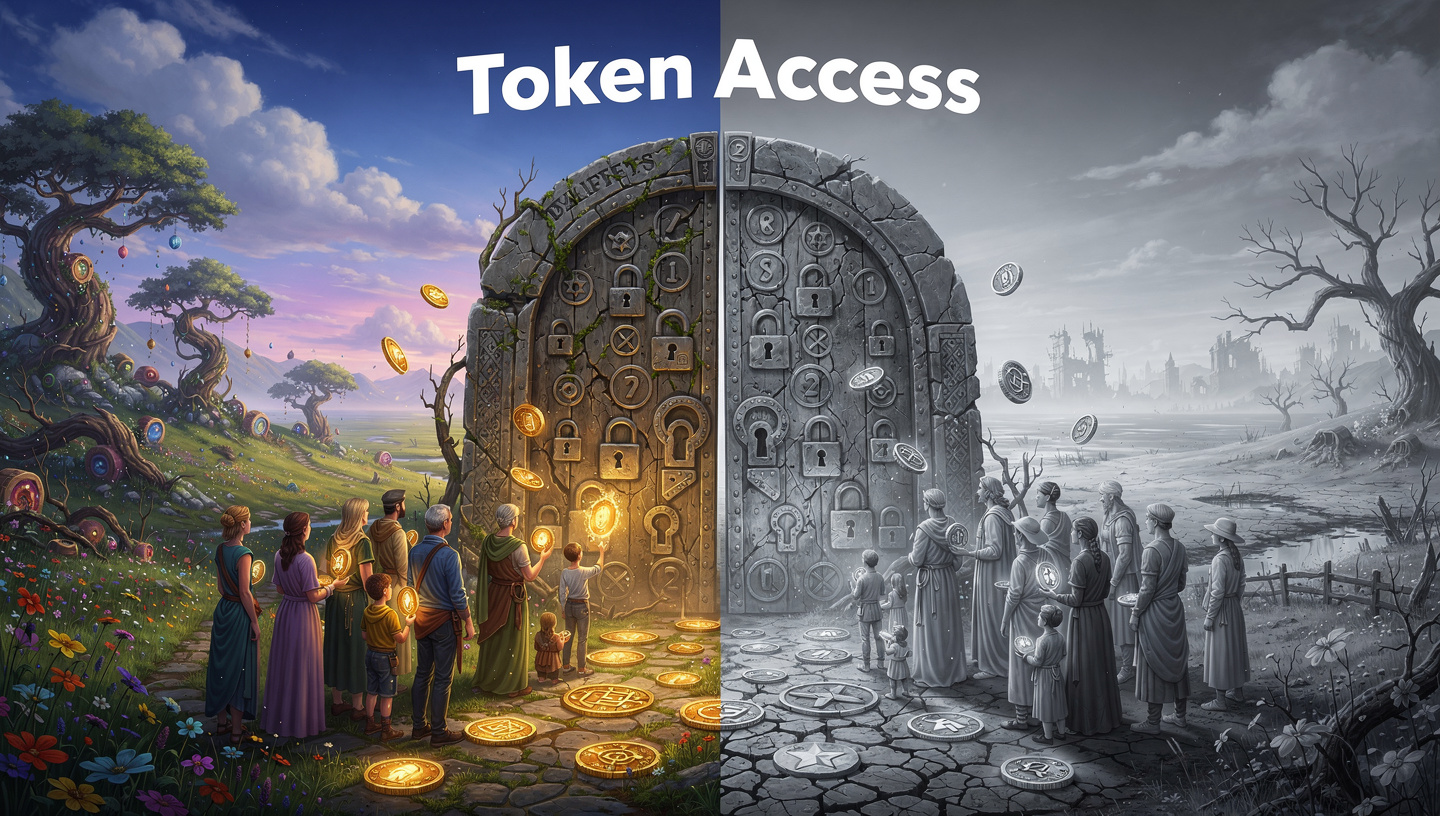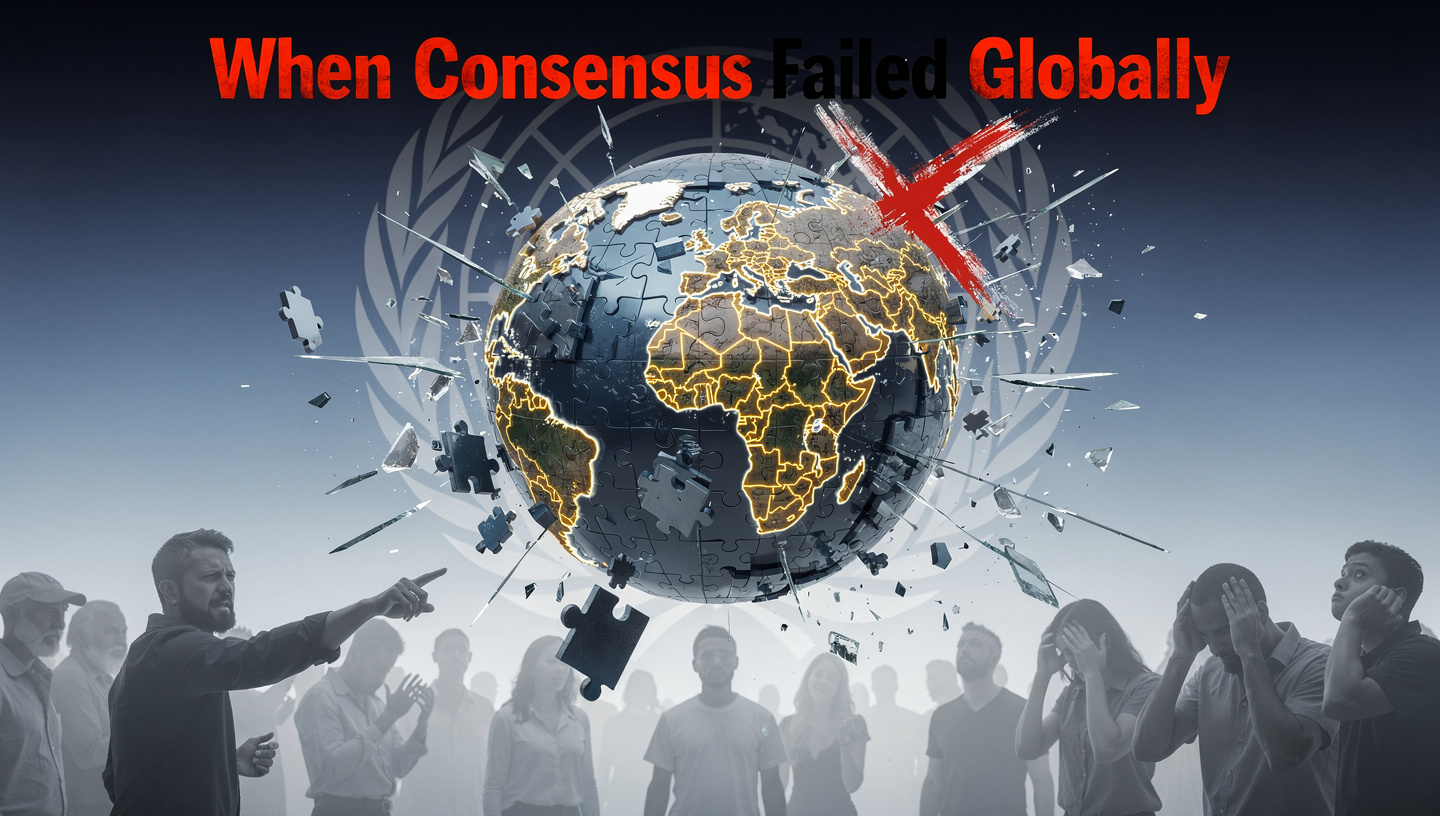
Consensus is an invisible infrastructure.
Most people assume it simply exists—like gravity, or time zones, or the idea that a dollar is worth something because everyone agrees it is. In the digital era, consensus was formalized, mathematized, and automated. Distributed ledgers promised a world where agreement no longer required trust, only computation. For more than a decade, this architecture held.
Then it failed.
Not in a single catastrophic outage. Not in a dramatic cyberwar. It failed the way complex systems usually do: slowly, unevenly, and asymmetrically—until suddenly, everyone realized they were no longer inhabiting the same version of reality.
This article examines that hypothetical inflection point: When Consensus Failed Globally. It is written as speculative crypto-future research—fictional in timeline, factual in mechanics—exploring how decentralized systems, economic incentives, governance failures, and social fragmentation converged into a systemic breakdown.
This is not a story.
It is a structural autopsy of a world that learned, too late, that consensus is not a protocol. It is a civilization-wide behavior.
1. What Consensus Really Means in Crypto
In blockchain systems, consensus is the process by which independent nodes agree on a shared state of truth: who owns what, which transactions occurred, and in what order.
Early networks like Bitcoin and Ethereum encoded this agreement through cryptographic rules and economic incentives:
- Proof of Work or Proof of Stake
- Distributed validation
- Deterministic transaction ordering
- Immutable history
The promise was radical: eliminate centralized arbiters and replace them with math.
But consensus was never purely technical.
It depended on:
- Economic alignment among participants
- Shared assumptions about protocol legitimacy
- Cultural norms around upgrades and forks
- A common definition of “finality”
From the beginning, blockchain consensus was socio-technical. The code enforced rules, but humans decided which code mattered.
This distinction would later prove fatal.
2. The Fragile Social Layer Beneath the Protocol
The whitepaper attributed to Satoshi Nakamoto emphasized trust minimization, not trust elimination. Nodes verify. Miners compete. Cryptography replaces intermediaries.
Yet every major blockchain still relies on off-chain coordination:
- Core developers proposing changes
- Validators choosing software versions
- Exchanges deciding which fork to list
- Media narratives shaping public legitimacy
This is the “social layer”—an informal governance system that sits above the protocol.
For years, it worked because incentives were aligned:
- Rising prices masked architectural flaws
- Early adopters shared ideological commitments
- Technical elites maintained de facto authority
But as crypto scaled globally, participants diversified:
- Nation-states entered mining and validation
- Corporations deployed custodial infrastructure
- Retail investors arrived with speculative motives
- DAOs attempted algorithmic governance
Consensus stopped being a shared philosophy. It became a contested resource.
3. Forks as Early Warning Signals
Hard forks were once framed as innovation.
Competing visions could split chains, letting markets decide which version survived. This evolutionary model assumed rational actors and efficient capital allocation.
In practice, forks revealed something deeper: consensus was not converging—it was fragmenting.
Each fork introduced:
- Duplicate assets
- Conflicting histories
- Divergent communities
- Regulatory ambiguity
Over time, forks stopped being rare events and became routine governance tools.
That normalization carried a hidden cost.
Every successful fork trained participants to accept parallel realities.
Eventually, this tolerance for divergence metastasized beyond software.
4. The Rise of Geopolitical Blockchains
The first truly global networks assumed a politically neutral internet.
That assumption expired.
Governments began to:
- Subsidize domestic validators
- Restrict cross-border node traffic
- Mandate compliance layers
- Pressure exchanges to recognize “official” chains
Mining pools consolidated within friendly jurisdictions. Validator sets became geographically skewed. Infrastructure providers complied with sanctions regimes.
The result was a subtle territorialization of supposedly borderless ledgers.
Multiple “authoritative” versions of the same blockchain began circulating:
- One recognized by Western exchanges
- One endorsed by state-backed platforms
- One maintained by censorship-resistant communities
Each claimed legitimacy.
None could enforce universality.
Consensus became regional.
5. Financial Institutions Enter the Fracture
Global finance attempted to stabilize the chaos.
Organizations like International Monetary Fund and World Bank explored blockchain-based settlement layers, digital reserve assets, and interoperability frameworks.
Their goal was pragmatic: reintroduce coordination.
But their involvement had unintended consequences:
- Permissioned ledgers diverged from public chains
- Compliance requirements fragmented liquidity
- Institutional standards conflicted with open-source governance
Instead of convergence, the ecosystem stratified:
- Regulated enterprise chains
- National digital currency networks
- Public permissionless blockchains
- Shadow liquidity protocols
Each layer operated on incompatible assumptions.
Cross-chain bridges multiplied, adding complexity and systemic risk.
The financial stack became a patchwork of partial truths.
6. When Oracles Disagreed
Smart contracts depend on oracles—external data feeds that report prices, events, and states of the real world.
During the global consensus failure, oracles became fault lines.
Different oracle networks reported:
- Divergent asset prices
- Conflicting election results
- Inconsistent weather data
- Contradictory supply chain metrics
DeFi protocols liquidated positions based on incompatible inputs. Insurance contracts paid out on some chains but not others. Prediction markets split into mutually exclusive outcomes.
Reality itself became forked.
Once automated systems began acting on contradictory data, reconciliation was no longer possible through human arbitration alone.
The machines had already committed.
7. Economic Consequences: Liquidity Without Unity
Markets require shared reference points.
Price discovery assumes everyone is trading the same asset with the same settlement guarantees.
That assumption collapsed.
Assets bearing identical tickers existed simultaneously on incompatible ledgers. Arbitrage bots exploited discrepancies until bridges failed. Stablecoins lost pegs in some regions while holding them in others.
Liquidity fragmented.
Capital became geographically sticky.
Multinationals reported earnings on one chain while paying suppliers on another. Payroll systems reconciled against different transaction histories. Tax authorities faced irreducible accounting conflicts.
The concept of a single global balance sheet disappeared.
8. Governance at Machine Speed
DAOs were designed to democratize decision-making.
In practice, they accelerated governance beyond human comprehension.
During the crisis:
- Emergency proposals passed in minutes
- Protocol parameters changed hourly
- Treasury allocations shifted automatically
- Slashing events triggered cascading validator exits
Voting power concentrated in automated agents optimized for yield, not stability.
Governance became reflexive and adversarial.
Instead of consensus, DAOs produced continuous micro-forks: parameter drifts that slowly diverged networks from their original social contracts.
No one could point to a moment of failure.
There was only a gradient of incompatibility.
9. The Psychological Break
Technical failure was only half the story.
The deeper rupture was cognitive.
People stopped assuming shared facts.
If your wallet showed one balance and mine showed another, which was real?
If your chain recognized a transaction and mine rejected it, who was defrauded?
Trust migrated inward:
- To local communities
- To familiar platforms
- To curated data feeds
Global coordination gave way to epistemic tribes.
Crypto had promised trustlessness. Instead, it delivered radical subjectivity.
10. Why Consensus Could Not Be Rebuilt
After the fragmentation, multiple attempts were made to restore global agreement:
- Meta-protocols for chain reconciliation
- Universal identity layers
- Interoperability standards
- Multilateral governance councils
They failed for structural reasons:
- Path dependence: too many sunk costs in incompatible systems
- Power asymmetry: dominant actors refused to concede advantage
- Coordination overhead: too many stakeholders, no legitimate arbiter
- Economic misalignment: short-term incentives outweighed systemic repair
Consensus, once broken at planetary scale, proved non-recoverable.
Not because the technology was insufficient.
Because the incentives were.
11. The Core Lesson: Consensus Is a Cultural Asset
Blockchains treated consensus as an engineering problem.
It is not.
It is a civilizational one.
Distributed systems can enforce rules, but they cannot manufacture shared meaning. They can order transactions, but not values. They can synchronize clocks, but not priorities.
The failure was never purely cryptographic.
It was anthropological.
Crypto exposed an uncomfortable truth: decentralization amplifies existing fragmentation unless paired with equally decentralized norms of cooperation.
Without that cultural substrate, protocols merely formalize disagreement.
12. A Post-Consensus World
After global consensus failed, society did not collapse.
It reconfigured.
Economic activity continued inside regional truth systems. Trade adapted through bilateral settlement channels. Identity became multi-ledger. Legal frameworks localized.
But the dream of a single, permissionless, universally recognized digital commons ended.
What remained was a mosaic of interoperating sovereignties—technical, political, and economic—loosely coupled, permanently divergent.
Blockchain did not unify humanity.
It revealed how difficult unity actually is.
Closing: Code Did Not Betray Us
We betrayed the assumptions we embedded in it.
We believed that cryptography could replace social contracts. That incentives could substitute for trust. That protocols could scale faster than culture.
They cannot.
“When Consensus Failed Globally” is not a warning about crypto.
It is a warning about governance in the age of automation.
Any system that aspires to replace institutions must first understand them.
And any civilization that outsources agreement to code must be prepared to live with the consequences when the code disagrees.