There was no single revolution. No declaration. No burning of institutions in public squares.
Instead, something subtler happened.
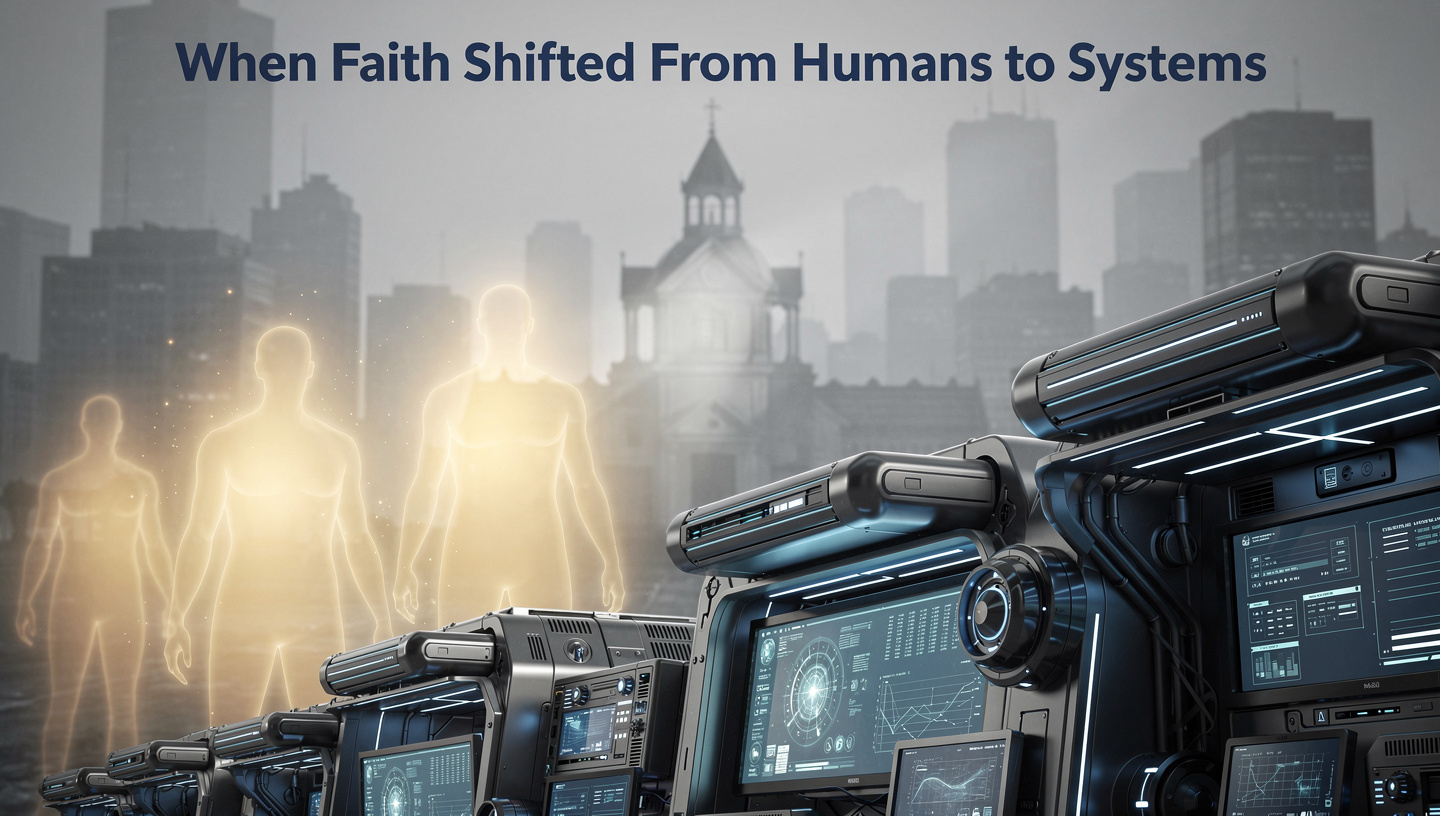
Across finance, governance, culture, and even personal identity, trust began migrating—from people to protocols, from institutions to infrastructure, from human judgment to deterministic code. What started as an experiment in cryptography evolved into a civilizational pivot. Faith, once anchored in leaders, laws, and social contracts, increasingly settled into systems.
This article examines that transition through the lens of crypto—not as a speculative asset class, but as a fictionalized research framework for understanding a future already in motion. This is not a story. It is an analytical construction: a speculative anthropology of belief in the age of blockchains.
Crypto here functions as a mirror. It reflects humanity’s exhaustion with intermediaries, its obsession with automation, and its growing willingness to outsource moral and economic authority to machines.
The thesis is simple:
Crypto did not merely introduce new money. It introduced a new object of faith.
1. From Institutional Trust to Mathematical Certainty
For most of recorded history, large-scale cooperation depended on centralized trust:
- Kings guaranteed currencies.
- Churches arbitrated morality.
- Governments enforced contracts.
- Banks stored value.
These systems worked because people believed in them. The belief was social, emotional, historical.
Then came cryptography.
Public-key encryption demonstrated something radical: trust could be replaced by verification. You no longer needed to know who someone was. You only needed to confirm that their signature matched their key.
This shift accelerated with the publication of Bitcoin’s whitepaper by Satoshi Nakamoto—a moment now treated as mythology in crypto culture. The innovation was not merely digital money. It was a new architecture of confidence:
- No central issuer
- No discretionary authority
- No appeals process
- Only math, consensus, and code
The implication was existential.
If money could operate without trusted humans, what else could?
2. The Blockchain as a Belief Engine
Blockchains are frequently described in technical terms: distributed ledgers, immutable records, Byzantine fault tolerance.
But culturally, they perform a different function.
They generate confidence without charisma.
A blockchain does not persuade. It does not promise. It executes.
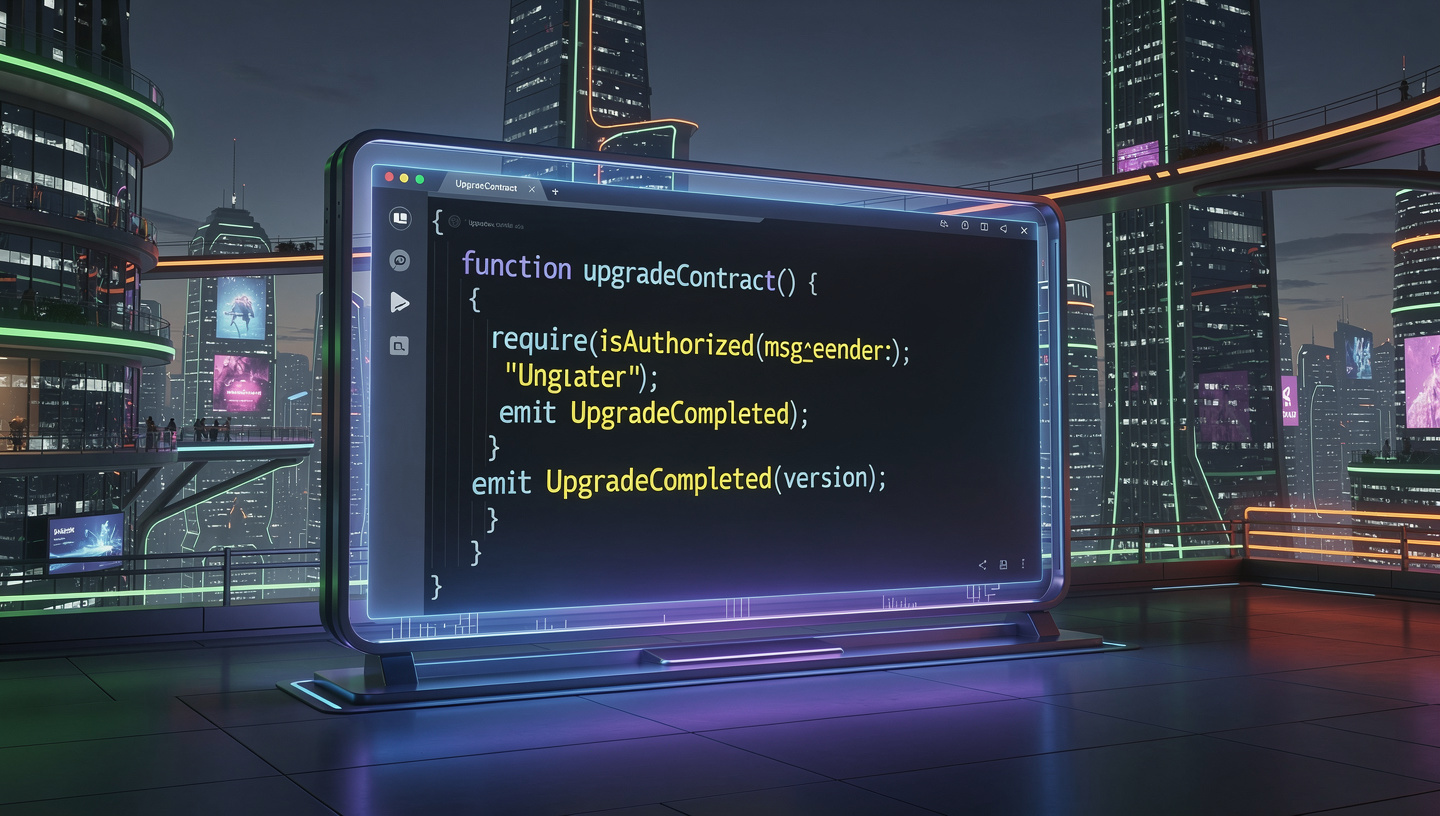
Once deployed, smart contracts on networks governed by organizations like the Ethereum Foundation behave like autonomous bureaucracies. They do not care about intention, circumstance, or ethics. They care only about state transitions.
This rigidity is not a bug. It is the feature.
Humans are inconsistent. Systems are not.
And so users began to treat blockchains less like tools and more like arbiters:
- Escrow without lawyers
- Lending without bankers
- Governance without councils
- Identity without states
In effect, crypto offered something modern institutions increasingly failed to provide: predictability.
3. Why Humanity Was Ready to Believe in Code
This shift did not happen in a vacuum.
Crypto emerged in the aftermath of systemic failure: financial crises, political polarization, institutional decay. Trust in governments and corporations had been eroding for decades.
Organizations such as the World Economic Forum repeatedly documented declining confidence in traditional authorities. The social contract felt brittle. Gatekeepers looked self-interested. Rules seemed selectively enforced.
Into that vacuum stepped protocols.
Crypto did not promise fairness—it promised consistency. It did not claim benevolence—it guaranteed determinism.
For a generation raised on APIs and automation, that was enough.
4. DAOs and the Attempt to Encode Governance
Decentralized Autonomous Organizations (DAOs) represent the most explicit attempt to replace human governance with executable logic.
In theory:
- Rules are transparent
- Voting is on-chain
- Treasury movements are auditable
- Power is distributed via tokens
In practice, DAOs expose a paradox: removing human discretion does not remove politics—it merely re-expresses it in code.
Token-weighted voting recreates plutocracy. Early contributors gain permanent advantage. Technical elites dominate proposal frameworks.
Yet despite these flaws, DAOs persist because they satisfy a deeper desire: governance without rulers.
They are experiments in algorithmic legitimacy.
The question they pose is profound:
If authority can be automated, what becomes of leadership?
5. Smart Contracts as Moral Instruments
Smart contracts do not understand context.
They do not forgive late payments. They do not interpret intent. They do not adjust for hardship.
They execute.
This has transformed contracts from social agreements into computational events. Obligations become binary. Outcomes become inevitable.
In traditional systems, mercy exists because humans intervene.
In crypto-native systems, mercy must be pre-programmed.
That design choice forces an uncomfortable confrontation: are values compatible with automation?
Or are we gradually replacing ethical judgment with logical finality?
6. The Rise of Algorithmic Legitimacy
Historically, legitimacy came from:
- Divine authority
- Royal lineage
- Democratic mandate
- Legal frameworks
Crypto introduced a new source: algorithmic legitimacy.
A transaction is valid because the network says so.
A governance proposal passes because quorum was met.
A liquidation occurs because a price oracle crossed a threshold.
No appeal. No discretion.
This is legitimacy derived not from consent, but from computation.
The system is right because the system executed.
7. Philosophical Echoes: Determinism Returns
This movement toward systemized belief echoes older philosophical tensions.
Friedrich Nietzsche warned of the vacuum left by collapsing moral authorities. Karl Marx analyzed how economic structures shape consciousness. Alan Turing demonstrated that machines could formalize thought.
Crypto synthesizes all three:
- The collapse of traditional meaning
- The primacy of economic infrastructure
- The mechanization of logic
What emerges is a techno-determinist worldview: society governed not by ideals, but by executable rules.
8. Finance Becomes Infrastructure
Traditional finance relied on reputational intermediaries.
Crypto reframes finance as infrastructure:
- Wallets replace accounts
- Liquidity pools replace banks
- Protocols replace institutions
Value flows through systems rather than organizations.
This is not decentralization in the romantic sense. It is infrastructuralization.
Money becomes software.
And once money is software, everything connected to it becomes programmable: insurance, employment, inheritance, even social reputation.
9. The New Priests: Developers and Auditors
Every belief system has interpreters.
In crypto, they are core developers, protocol architects, and smart contract auditors.
They write the rules others live under.
Their pull requests shape economies. Their design choices determine incentive structures. Their security assumptions decide who loses funds.
Yet they remain largely unaccountable.
We did not eliminate hierarchy.
We replaced visible hierarchy with technical hierarchy.
10. Fictional Futures: Total System Dependence
Project forward.
Imagine a world where:
- Citizenship is tokenized
- Access to healthcare is governed by on-chain eligibility
- Education credentials live in immutable ledgers
- Legal disputes are settled by automated arbitration protocols
In this future, faith in systems is no longer optional. It is infrastructural.
You do not trust the protocol.
You depend on it.
Opting out becomes economically impossible.
This is crypto not as currency—but as civilizational substrate.
11. The Cost of Delegating Belief
Delegating trust to systems offers efficiency, but it also externalizes responsibility.
When something goes wrong:
- No one is accountable
- The code “worked as intended”
- Losses are final
- Bugs become destiny
This is the dark symmetry of decentralized faith.
Humans escape blame by hiding behind execution paths.
12. Crypto as a Cultural Stress Test
Viewed this way, crypto is not primarily a financial innovation.
It is a stress test for modern belief.
It asks:
- How much autonomy are we willing to surrender for predictability?
- How much humanity are we prepared to trade for efficiency?
- What happens when governance becomes an API?
The answers are emerging in real time.
Conclusion: Faith, Rewritten in Syntax
Humanity did not consciously choose to transfer faith from people to systems.
It drifted.
Disillusioned with institutions, overwhelmed by complexity, seduced by automation, we embraced infrastructures that promised neutrality and certainty.
Crypto crystallized that impulse.
Not because it was perfect.
But because it was executable.
In doing so, it revealed something essential about our era:
We no longer look to leaders for salvation.
We look to architectures.
And that may be the defining transformation of the digital age—not the rise of decentralized finance, but the quiet realization that belief itself has become programmable.
Faith did not disappear.
It changed format.
From stories to source code.