Every civilization encodes its most intimate values into its institutions. Marriage, inheritance, kinship, and obligation are never merely private affairs; they are structural pillars of society. For thousands of years, these pillars were enforced by religion, family, and state. Then software arrived. And eventually, blockchains.
What happens when affection becomes executable?
When promises are reduced to deterministic logic?
When commitment is notarized by cryptography rather than witnessed by community?
This article explores a speculative—but technically grounded—future in which romantic relationships are formalized through smart contracts, emotional labor is quantified, and marriage becomes a composable financial primitive. This is not a story. It is a research-oriented fictional analysis of how crypto-native systems could reshape love, intimacy, and human partnership—drawing from real blockchain architectures, incentive theory, behavioral economics, and governance design.
Welcome to the era of Love Contracts and Algorithmic Marriages.
1. From Vows to Variables: The Technical Substrate of Digital Intimacy
Smart contracts were originally designed to automate trust in financial exchanges. Their power lies in three properties:
- Determinism – outcomes are pre-defined.
- Immutability – once deployed, logic is difficult or impossible to change.
- Permissionlessness – anyone can participate without centralized approval.
These properties work well for escrow, lending, or decentralized exchanges. Applying them to romantic relationships introduces a radical inversion: emotional commitments become enforceable code paths.
Early theorists of programmable money—including figures like Vitalik Buterin through his work with the Ethereum Foundation—frequently discussed “social contracts” as an eventual frontier of decentralized systems. While the mainstream focused on DeFi, NFTs, and DAOs, a quieter current explored personal contracts: cohabitation agreements, custody automation, and relational governance.
In this speculative future, the core primitives already exist:
- Multisignature wallets for joint assets
- Oracles for importing off-chain data (location, biometrics, calendars)
- Token-curated registries for reputation
- Zero-knowledge proofs for selective disclosure
- Decentralized identity (DID) frameworks
Love contracts simply compose these components.
Technically, nothing prevents this today. Only cultural resistance does.
2. The Love Contract: Architecture of a Programmable Relationship
A Love Contract is a smart contract that formalizes mutual commitments between two (or more) parties. Unlike traditional prenuptial agreements, it is:
- Executable in real time
- Continuously evaluated
- Integrated with financial rails
- Linked to behavioral inputs
A standard architecture includes:
2.1 Commitment Modules
These define explicit obligations:
- Minimum time spent together per month
- Shared financial contributions
- Location-based presence thresholds
- Communication cadence (e.g., response SLAs)
Each obligation maps to a condition. Each condition maps to a state transition.
Miss three weekly check-ins?
The contract automatically reduces joint spending limits.
Fail to attend agreed milestones?
Escrowed tokens begin unlocking to the other party.
Romantic accountability becomes mechanical.
2.2 Emotional Oracles
Because feelings cannot be directly measured, proxies emerge:
- Wearable-derived stress metrics
- Sentiment analysis of messages
- Facial-expression classifiers during video calls
- Periodic zero-knowledge surveys
These inputs feed weighted models estimating “relationship health.”
This is not sentiment in the poetic sense. It is telemetry.
The system does not care why affection declined—only that it did.
2.3 Tokenized Affection
Some implementations introduce Affection Tokens (AFTs)—non-transferable soulbound assets representing relational effort:
- Acts of care mint tokens
- Neglect burns them
- Governance rights inside the relationship scale with balance
Disputes over emotional labor become ledger entries.
3. Algorithmic Marriage: From Ceremony to Consensus
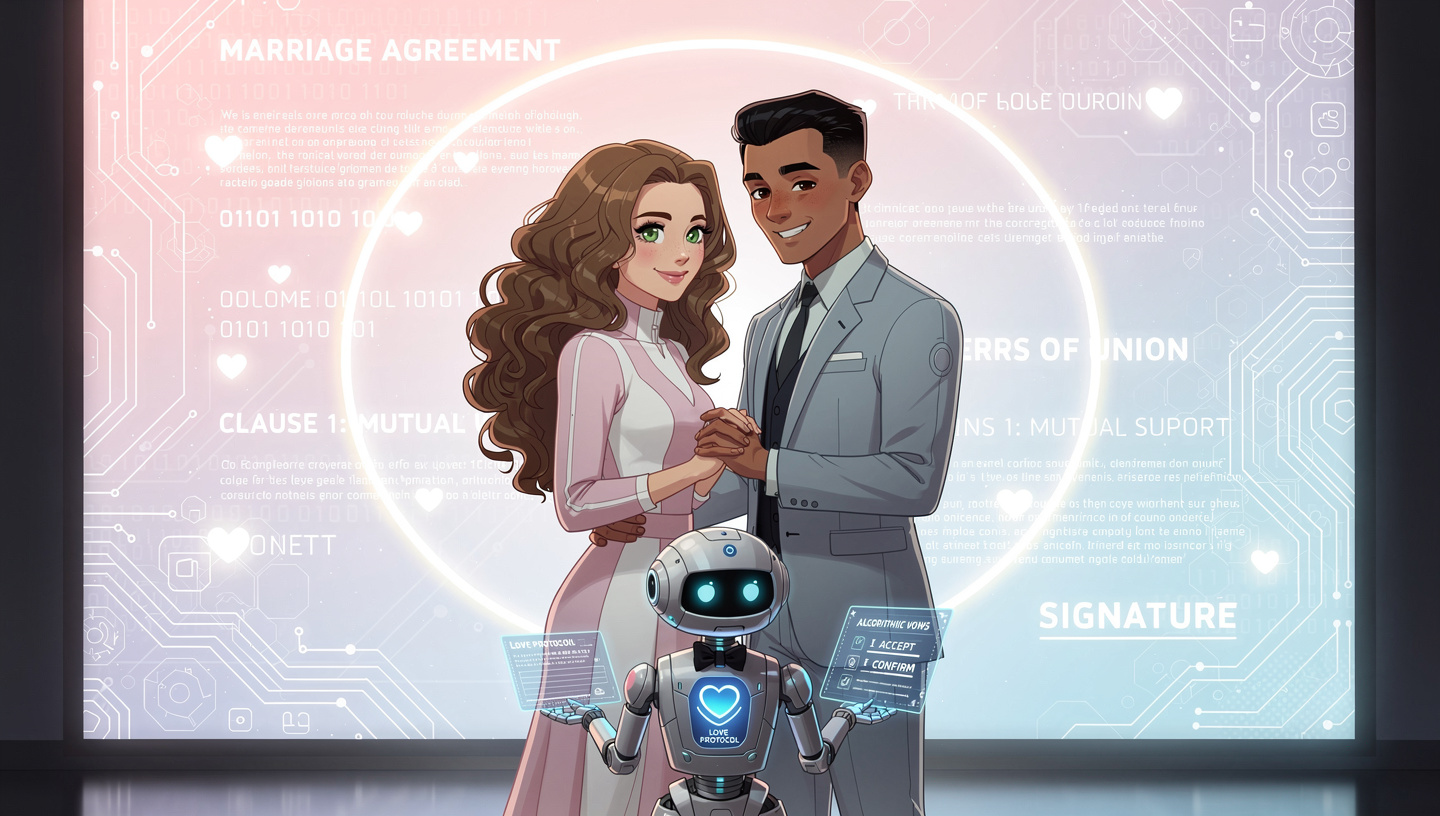
Traditional marriage relies on symbolic rituals and legal recognition. Algorithmic marriage replaces both with cryptographic finality.
The process typically follows:
- Proposal Transaction – one party deploys a draft contract.
- Negotiation Phase – parameters are adjusted through on-chain governance.
- Mutual Signature – both parties sign with private keys.
- Capitalization Event – joint assets are deposited.
- Activation Block – the contract becomes live.
From that moment, the relationship exists as a persistent on-chain object.
There is no priest.
No registrar.
No courthouse.
Only consensus.
Marriage certificates become transaction hashes.
Anniversaries are block heights.
4. Financialized Intimacy: When Love Becomes a Balance Sheet
Once relationships are programmable, they become composable. And composable systems inevitably financialize.
4.1 Relationship Derivatives
Secondary markets emerge:
- Futures on celebrity marriages
- Insurance against high-probability breakups
- Yield products backed by high-stability couples
A couple with strong historical metrics—low volatility in emotional oracles, consistent mutual investment—becomes a low-risk asset.
Conversely, turbulent relationships trade at a discount.
Love acquires a risk premium.
4.2 Romantic Credit Scores
Participants accumulate longitudinal relational data:
- Contract completion rates
- Average commitment duration
- Dispute frequency
- Tokenized empathy balances
These metrics feed into Romantic Credit Profiles, influencing:
- Matchmaking algorithms
- Housing access
- Joint loan eligibility
- Parenting DAOs
People become underwritten not just financially—but emotionally.
5. Consent in Code: The Ethics of Irreversible Commitment
Smart contracts are famously unforgiving. This collides directly with the messy, nonlinear nature of human attachment.
Key ethical tensions emerge:
5.1 The Problem of Exit
Traditional relationships allow soft exits. Algorithmic marriages require predefined dissolution logic:
- Cooldown periods
- Exit penalties
- Asset redistribution curves
Leaving becomes a transaction, not a conversation.
In some systems, breaking up too early triggers financial slashing. Emotional hesitation is replaced by economic friction.
5.2 Asymmetric Power
If one partner controls more capital or has superior technical literacy, contract negotiation becomes structurally unequal.
Love contracts inherit all the pathologies of code:
- Hidden clauses
- Adversarial parameterization
- Exploitative defaults
Romantic abuse migrates from psychology to protocol design.
5.3 Surveillance Normalization
To function, these systems require continuous monitoring.
Location.
Mood proxies.
Communication patterns.
Intimacy becomes observable state.
Privacy becomes optional.
6. Children, Custody, and DAO Parenting
Perhaps the most radical transformation appears in family formation.
Children born into algorithmic marriages are assigned:
- On-chain identities
- Trust funds governed by smart contracts
- Educational budgets released via performance oracles
Custody is no longer adjudicated by courts but by pre-written logic:
- Time allocation enforced by geofencing
- Support payments streamed continuously
- Disputes resolved by decentralized juries
Parenthood becomes a distributed system.
Love becomes infrastructure.
7. Cultural Consequences: What Happens to Romance?
Over time, norms adapt.
7.1 Courtship Becomes Due Diligence
Dating profiles display:
- Previous contract durations
- Emotional volatility indices
- Tokenized care histories
First dates resemble startup pitch meetings.
“Show me your relational uptime.”
7.2 Poetry Declines, Dashboards Rise
Spontaneity gives way to optimization.
Partners review weekly metrics.
They A/B test affection strategies.
They refactor arguments.
Romance becomes a UX problem.
7.3 Communities Fragment
Some societies embrace algorithmic marriage as efficient and transparent.
Others reject it as dehumanizing.
New cultural fault lines form:
- On-chain families vs off-chain romantics
- Quantified intimacy vs analog attachment
Love becomes ideological.
8. Why Crypto Enables This (and No Other Technology Does)
Traditional platforms cannot support this paradigm because they require:
- Centralized identity
- Trusted intermediaries
- Revocable permissions
Blockchains offer:
- Self-sovereign keys
- Global execution
- Immutable state
- Composable primitives
Once relationships become contracts, they naturally migrate to decentralized infrastructure.
Not because it is kinder.
Because it is final.
9. The Meta-Shift: From Moral Commitment to Mechanical Enforcement
Historically, relationships relied on internalized values:
- Loyalty
- Empathy
- Responsibility
Algorithmic marriages replace these with external enforcement.
You do not stay because you care.
You stay because the contract penalizes departure.
Trustlessness—originally a financial concept—becomes a moral framework.
Love no longer assumes goodwill.
It assumes adversarial conditions.
10. A World Where Breakups Are Forks
In the end, the most profound change is conceptual.
Relationships cease to be narratives.
They become systems.
Breakups resemble protocol upgrades.
Reconciliation is a merge request.
Emotional growth is a version bump.
And marriage is no longer a promise.
It is a deployment.
Conclusion: What We Lose When Love Becomes Code
Love contracts and algorithmic marriages promise clarity, accountability, and efficiency. They eliminate ambiguity. They reduce conflict. They automate fairness.
They also remove forgiveness.
They struggle with nuance.
They cannot model grace.
In this speculative crypto-native future, humans finally succeed in formalizing intimacy. Every promise is executable. Every feeling is proxied. Every relationship is auditable.
And yet something essential disappears in the process.
Not privacy.
Not romance.
Not even freedom.
What disappears is the possibility of staying without being forced to.
Because once love becomes software, commitment is no longer a choice.
It is a function call.