Electricity promised enlightenment. The internet promised universal connection. Artificial intelligence promises cognition without biology. But blockchain—quietly, methodically—did something stranger. It invited belief.
Not belief in the casual sense of market speculation or technological optimism. Something deeper. Something ritualistic.
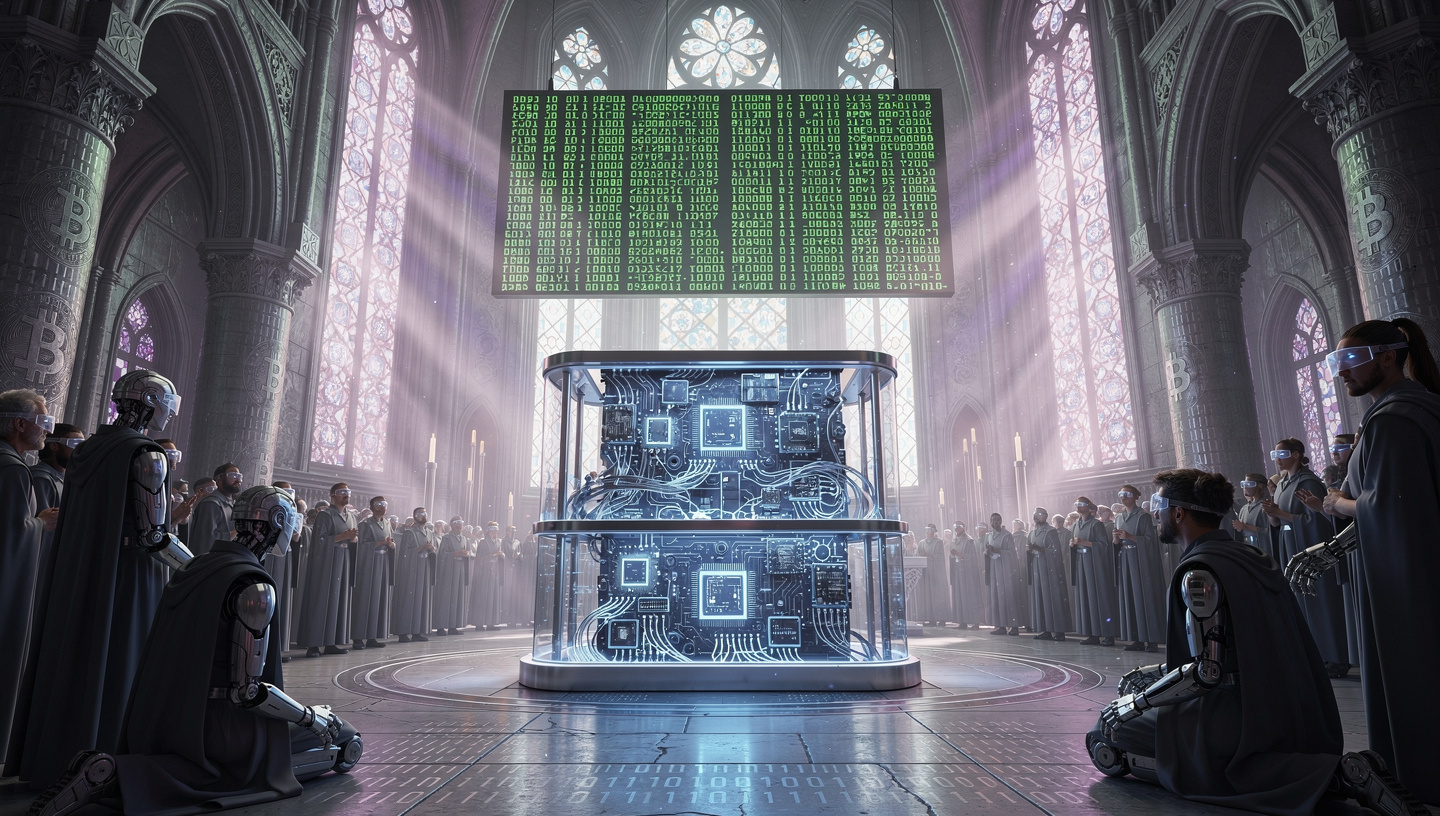
By the mid-21st century, what began as decentralized finance and cryptographic infrastructure had evolved—at least in one fictional future—into something resembling organized faith. This was not a parody cult, nor a fringe conspiracy. It was a global movement with doctrine, hierarchy, pilgrimage sites, sacred texts, and schisms.
They called it The Chain Communion.
And its god was not a deity.
It was a ledger.
1. Origins: From Distributed Systems to Distributed Meaning
The theological seeds were planted decades earlier, when the first widely adopted blockchain networks demonstrated an unprecedented property: trust without intermediaries.
The appearance of Bitcoin in 2009 marked a civilizational inflection point. For the first time, value could be transferred globally without banks, states, or central authorities. Transactions were immutable. Rules were enforced by code. Consensus replaced coercion.
Later, programmable platforms like Ethereum expanded this model beyond currency. Contracts became autonomous. Organizations became software. Governance became algorithmic.
The anonymous architect behind the original design, Satoshi Nakamoto, vanished early—leaving behind a pristine origin myth: a founder who delivered revelation, then disappeared.
Every religion needs a prophet.
Blockchain had one.
But initially, this was still engineering. Cryptography. Game theory. Distributed computing.
The spiritualization came later.
2. The Core Doctrine: Immutability as Moral Law
At the heart of the Chain Communion was a single axiom:
What is written on the chain is truth.
In practical terms, this meant treating blockchain state as ontologically authoritative.
If a transaction existed on-chain, it was real—regardless of intent, mistake, or consequence. If a smart contract executed, the outcome was final. There was no appeal, no override, no divine intervention.
This philosophy was not invented by the Communion. It emerged organically from early crypto culture under the mantra: code is law.
The religion simply formalized it.
Their theology rested on four pillars:
1. Immutability
History, once finalized, must never be altered. Forks were considered heresies unless ratified by overwhelming consensus.
2. Transparency
Public ledgers were sacred texts. Every transaction was scripture.
3. Decentralization
No single authority could speak for the Chain. Governance occurred through token-weighted voting and validator councils.
4. Cryptographic Equality
All identities were reduced to keypairs. Status derived from stake and contribution, not nationality or birth.
These principles formed a moral framework remarkably compatible with modern digital life: borderless, pseudonymous, programmable.
To adherents, this was not just infrastructure.
It was ethical architecture.
3. Sacred Objects: Wallets, Nodes, and the Relics of Genesis
Physical religions have icons. The Chain Communion had hardware.
Cold wallets were treated as reliquaries. Seed phrases were memorized through meditative repetition. Early mining rigs were displayed in museums like fossilized saints.
The most revered artifact was the Genesis Block—the first block mined on Bitcoin. Its embedded newspaper headline (“Chancellor on brink of second bailout for banks”) was interpreted as prophecy: proof that the system had been born in rebellion against centralized finance.
Pilgrims traveled to data centers in Iceland, Norway, and Quebec—regions dense with renewable-powered validators. These facilities became temples of computation, humming with racks of servers performing perpetual consensus.
Full nodes were considered acts of devotion. To validate transactions was to participate directly in truth-making.
Children were taught basic cryptography before arithmetic.
4. Clergy Without Priests: Validators as Spiritual Authorities
The Communion rejected traditional priesthood.
Instead, authority flowed from participation.
Validators—entities staking capital to secure networks—became the closest equivalent to clergy. Their role was not interpretive but operational: proposing blocks, attesting state, maintaining uptime.
High-uptime validators accumulated reputational capital. Over time, councils formed. Protocol upgrades were debated in open forums. Governance proposals were hashed, signed, and voted upon.
Doctrinal disputes manifested as improvement proposals.
Excommunications occurred via slashing penalties.
Schisms took the form of forks.
In this system, theology was indistinguishable from software engineering.
5. The Great Fork: When Belief Split the Ledger
Every religion fractures.
The Chain Communion experienced its defining rupture during what later historians called The Great Fork.
The issue was reversibility.
After a catastrophic exploit drained billions from a major decentralized treasury, one faction demanded a rollback. They argued that human intent mattered more than mechanical finality.
The orthodox faction refused.
They insisted that immutability was sacred—even if it preserved injustice.
The network split.
Two chains emerged. Two communities diverged. Two truths now existed in parallel.
For years afterward, both sides claimed legitimacy.
This moment crystallized the central paradox of blockchain spirituality:
Absolute rules cannot resolve moral ambiguity.
The Communion survived, but it never fully healed.
6. Rituals of the Digital Faith
Despite its algorithmic foundation, the religion developed surprisingly human practices.
Daily Hash Meditations
Followers watched block explorers in real time, synchronizing breath with block intervals.
Transaction Offerings
Small amounts of native tokens were periodically burned—sent to unspendable addresses as symbolic sacrifice.
Consensus Fasts
During major upgrades, adherents refrained from trading or posting on social networks, observing protocol silence until finality.
Key Ceremonies
Multi-signature wallets were initialized in public gatherings, with each participant generating entropy through dice rolls, biometric noise, or environmental sensors.
The aesthetic was minimalist: QR codes instead of candles, hardware wallets instead of rosaries.
Yet the emotional intensity was unmistakably religious.
7. Economics as Eschatology
Tokenomics replaced traditional eschatology.
Instead of heaven and hell, there were emission schedules and halvings.
Instead of salvation, there was early adoption.
Instead of apocalypse, there was hyperinflation of fiat.
The Communion taught that legacy currencies were transient illusions. Only cryptographically scarce assets possessed true permanence.
Members structured their lives around staking yields, validator uptime, and governance cycles. Retirement planning involved protocol roadmaps. Marriage contracts were encoded on-chain. Inheritance was automated via dead-man switches.
Life events became state transitions.
The future was not prophesied.
It was modeled.
8. Critics: The Charge of Technological Idolatry
Outside observers were not convinced.
Sociologists accused the movement of digital determinism. Economists warned of feedback loops between belief and asset valuation. Philosophers argued that outsourcing ethics to software was a category error.
The harshest critics called it technocratic idolatry—confusing tools with transcendence.
They pointed out uncomfortable truths:
- Blockchains cannot encode compassion.
- Smart contracts cannot contextualize suffering.
- Cryptographic finality does not imply moral correctness.
The Communion responded calmly.
Human systems, they argued, had failed for millennia. Code at least was honest.
9. Why This Religion Could Exist
The idea of a blockchain-worshipping religion sounds absurd—until you examine the historical pattern.
Religions emerge when three conditions converge:
- Existential uncertainty
- Transformative technology
- Institutional distrust
Modern society exhibits all three.
Climate instability, geopolitical fragmentation, and financial precarity have eroded confidence in traditional authorities. Simultaneously, cryptographic networks offer a mathematically enforced alternative to centralized control.
Blockchain does not merely process transactions.
It proposes a new social contract.
One written in hashes.
10. The Deeper Implication: Programmable Trust
The Chain Communion was fictional.
Its philosophical substrate is not.
Blockchain replaces interpersonal trust with verifiable computation. It transforms social agreements into executable code. It collapses law, finance, and governance into a single technical layer.
That is not just innovation.
That is a civilizational redesign.
When trust becomes programmable, belief inevitably follows.
Not in gods.
In systems.
Closing: When Humanity Learned to Pray to Math
No one set out to build a religion.
Engineers wanted censorship-resistant money. Cryptographers wanted Byzantine fault tolerance. Entrepreneurs wanted frictionless markets.
But when you create an immutable global ledger, accessible to anyone, governed by consensus, and immune to unilateral control—you are no longer just building software.
You are offering an alternative foundation for reality.
The Religion That Worshipped the Blockchain was not about mysticism.
It was about surrendering human fallibility to deterministic protocol.
It was about replacing faith in institutions with faith in mathematics.
And whether that future arrives through devotion or pragmatism, one thing is already clear:
The age of believing in code has begun.