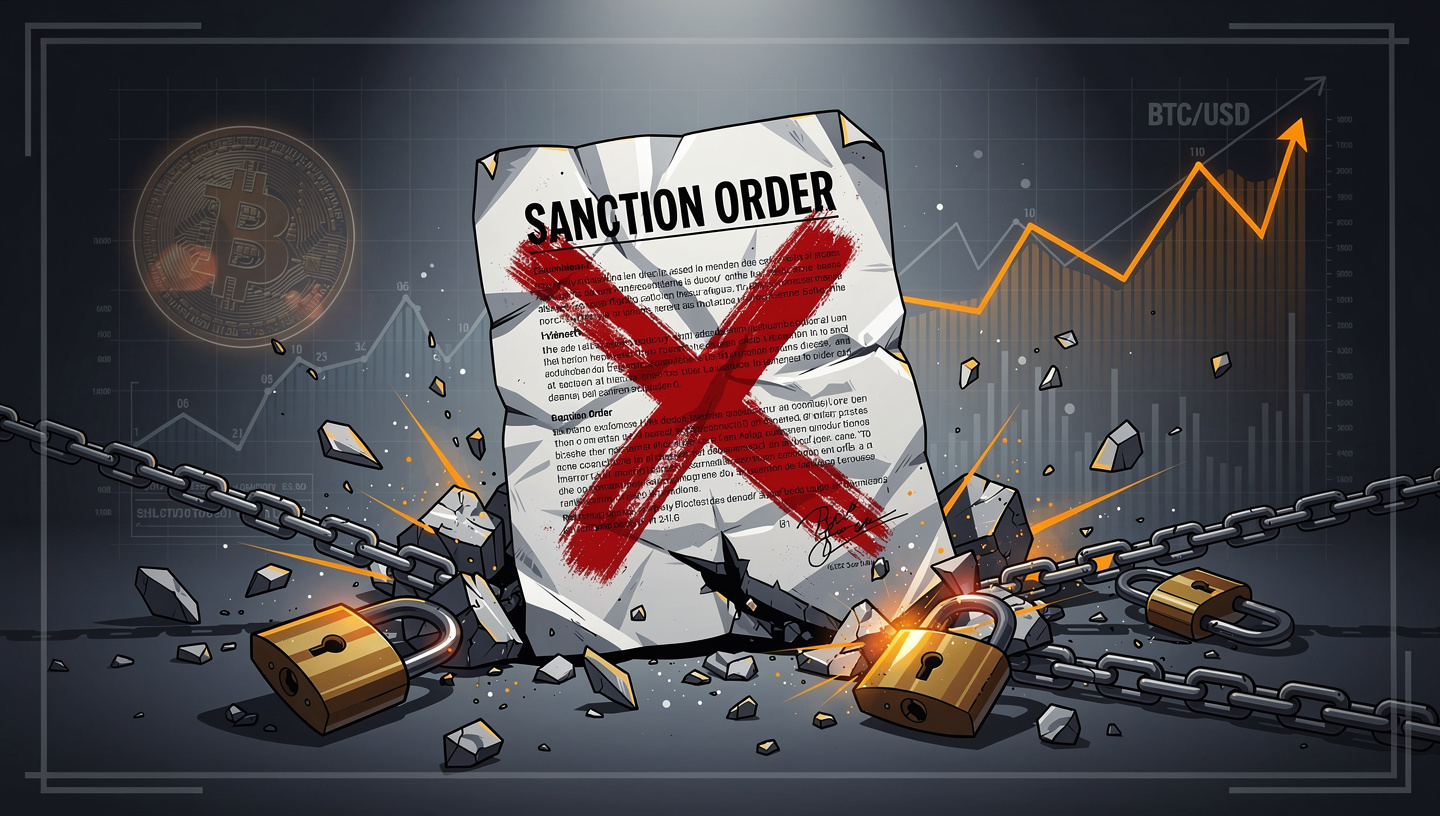
For more than half a century, international sanctions have functioned as a blunt but effective instrument of statecraft. Freeze assets. Block trade routes. Isolate banks. Starve regimes of liquidity until policy changes follow.
That model assumed one thing: money could be controlled.
Then crypto arrived.
Not as a rebellion in the streets, but as an alternative financial substrate—permissionless, borderless, programmable. And over the past decade, that substrate has matured quietly, accumulating liquidity, tooling, and human capital. By the time governments fully understood what they were dealing with, the architecture of sanctions had already begun to crack.
This article explores a speculative but research-driven scenario: a near-future geopolitical confrontation in which a major sanctions regime fails—not because of diplomacy, military escalation, or regime collapse—but because decentralized crypto infrastructure absorbs the shock and routes around it.
This is not a story. It is an analytical fiction: grounded in existing systems, extrapolated forward, and presented as a case study in how financial power may soon be contested.
Welcome to The Sanction That Failed Because of Crypto.
1. Sanctions as Infrastructure, Not Policy
Sanctions are often discussed in moral or political terms. In practice, they are infrastructural.
Modern sanctions depend on a tightly coupled global financial stack:
- Correspondent banking networks
- Dollar-clearing pipelines
- Centralized exchanges
- Trade finance intermediaries
- Insurance underwriters
- Settlement systems
At the center of this stack sit institutions aligned with Western regulatory frameworks—most notably the clearing systems governed by the Office of Foreign Assets Control, the financial messaging backbone of SWIFT, and coordinated enforcement across the European Union.
This architecture gives sanctioning states extraordinary leverage—especially the United States, whose currency remains the default medium for global trade.
But it also creates a single point of failure.
If value can move outside that stack, sanctions become advisory rather than coercive.
Crypto provides exactly that escape hatch.
2. The Target: A Digitally Adaptive State
In our fictional scenario, a technologically sophisticated nation—already accustomed to partial isolation—becomes the target of a coordinated sanctions package led by the United States and its allies.
Traditional levers are pulled:
- Foreign reserves frozen
- State banks disconnected from SWIFT
- Export controls tightened
- Shipping insurers pressured
- Secondary sanctions threatened against third parties
The intent is familiar: create a liquidity crisis severe enough to force concessions.
But this state has spent the previous decade preparing.
Not through dramatic announcements or ideological alignment with crypto—but through quiet integration.
Government-linked enterprises already settle some cross-border energy trades using stablecoins. Domestic mining absorbs surplus electricity and produces a steady stream of digital assets. Regional partners—some aligned with China, others with Iran—maintain bilateral payment corridors denominated outside the dollar.
The sanctions land.
Markets panic.
Yet something unexpected happens.
The country does not collapse into financial paralysis.
Instead, capital reroutes.
3. The Shadow Financial System Activates
Within days, crypto liquidity spikes across peer-to-peer desks in Central Asia, Southeast Asia, and parts of Eastern Europe. OTC brokers who normally service remittance flows suddenly handle industrial-scale volume.
Decentralized exchanges see record activity in trading pairs linked to energy exports and raw materials.
Tokenized invoices appear on permissionless lending platforms.
Supply chains that once depended on letters of credit migrate to smart-contract escrow.
This is not ideological adoption. It is operational necessity.
Crypto fills the gap left by disconnected correspondent banks.
Where SWIFT messages once coordinated trade, multisignature wallets now authorize settlement. Where dollar clearing once provided trust, on-chain proof of reserves takes its place.
Crucially, no single intermediary controls this system.
There is nothing to sanction.
4. Compliance vs. Code
Western regulators respond predictably.
Addresses are blacklisted.
Centralized exchanges freeze flagged accounts.
Analytics firms publish heat maps of suspicious flows.
But these measures only affect the visible surface layer of crypto—the regulated onramps.
Beneath that layer lies a dense mesh of:
- Self-custodied wallets
- Privacy-preserving bridges
- Atomic swaps
- Decentralized identity credentials
- Informal liquidity providers
The sanctioned state doesn’t need Coinbase or Binance.
It needs miners, validators, liquidity pools, and counterparties willing to accept digital settlement.
Those exist in abundance.
Even attempts to pressure third-party nations prove ineffective. Smaller economies—already wary of dollar dependency after watching assets frozen abroad—see opportunity rather than risk.
A new financial alignment begins to form, not through treaties, but through shared tooling.
5. Energy Becomes the Anchor
The real breakthrough comes through energy.
Oil, gas, and electricity are inherently physical. They cannot be “frozen” digitally. Once buyers and sellers agree on pricing and delivery, payment becomes the only bottleneck.
Crypto removes that bottleneck.
Energy exporters accept stablecoins backed by offshore collateral. Buyers hedge exposure using decentralized derivatives. Settlement occurs in minutes, not days.
Smart contracts replace trade finance desks.
For the first time, a commodity economy operates largely outside the legacy banking system.
This is the inflection point.
Sanctions depend on friction.
Crypto removes it.
6. The Failure Becomes Visible
Six months in, intelligence agencies present uncomfortable data.
The targeted state’s currency has stabilized.
Industrial output is recovering.
Foreign reserves—now partially held in digital assets—are growing again.
Parallel import channels flourish.
Black-market premiums collapse as supply chains normalize.
Meanwhile, domestic inflation in sanctioning countries ticks upward as energy markets tighten.
The political calculus shifts.
What was designed as asymmetric pressure begins to look symmetric.
Sanctions were supposed to isolate.
Instead, they accelerated financial bifurcation.
7. Why This Could Really Happen
Nothing in this scenario requires speculative technology.
Every component already exists:
- Permissionless blockchains
- Stablecoins with multi-billion-dollar liquidity
- Decentralized exchanges processing institutional volume
- Tokenized real-world assets
- Peer-to-peer settlement networks
- Jurisdictions competing to attract crypto infrastructure
What changes is scale and coordination.
Once a motivated state commits fully—and once enough counterparties decide that regulatory risk is preferable to economic stagnation—the system tips.
At that point, sanctions lose their teeth.
Not because governments are weak.
Because code is harder to coerce than corporations.
8. The New Geopolitical Primitive
Crypto introduces a new strategic variable: financial exit velocity.
How quickly can a nation reroute value flows when cut off from traditional rails?
In the 20th century, this depended on gold reserves and shipping lanes.
In the 21st, it depends on:
- Wallet penetration
- Validator diversity
- Domestic mining capacity
- Legal tolerance for self-custody
- Access to stable liquidity
States that optimize for these metrics become sanction-resistant.
Others remain exposed.
This is not ideology. It is infrastructure.
9. Lessons from the Failed Sanction
Three conclusions emerge from this fictional case study:
1. Sanctions Assume Centralization
Crypto thrives on decentralization. The two are structurally incompatible.
2. Financial Power Is Becoming Modular
Value can now move through multiple stacks simultaneously. Cutting one no longer guarantees control.
3. Neutral Protocols Outlive Political Cycles
Administrations change. Policies reverse. Blockchains persist.
Once a critical mass of economic activity migrates on-chain, rollback becomes nearly impossible.
10. What Comes Next
In response to the failure, sanctioning nations begin exploring alternatives:
- Central bank digital currencies with embedded compliance
- Tighter controls on mining hardware exports
- Expanded surveillance of stablecoin issuers
- Treaty-level agreements on validator regulation
But these measures face the same problem as before.
They require coordination.
Crypto does not.
The battlefield has shifted from institutions to protocols.
From policy to software.
Conclusion: The Quiet End of Financial Absolutism
“The Sanction That Failed Because of Crypto” is not about triumph or defeat.
It is about transition.
For decades, economic coercion relied on centralized choke points. Crypto dissolves those points into networks of autonomous actors and automated contracts.
This does not make sanctions obsolete overnight.
But it does cap their effectiveness.
In this emerging world, financial sovereignty is no longer granted by reserve status or diplomatic alliances. It is engineered—line by line, block by block—into decentralized systems that do not care who you are, what flag you fly, or which ministry signed the directive.
Sanctions once reshaped nations.
Now they merely stress-test protocols.
And increasingly, the protocols win.