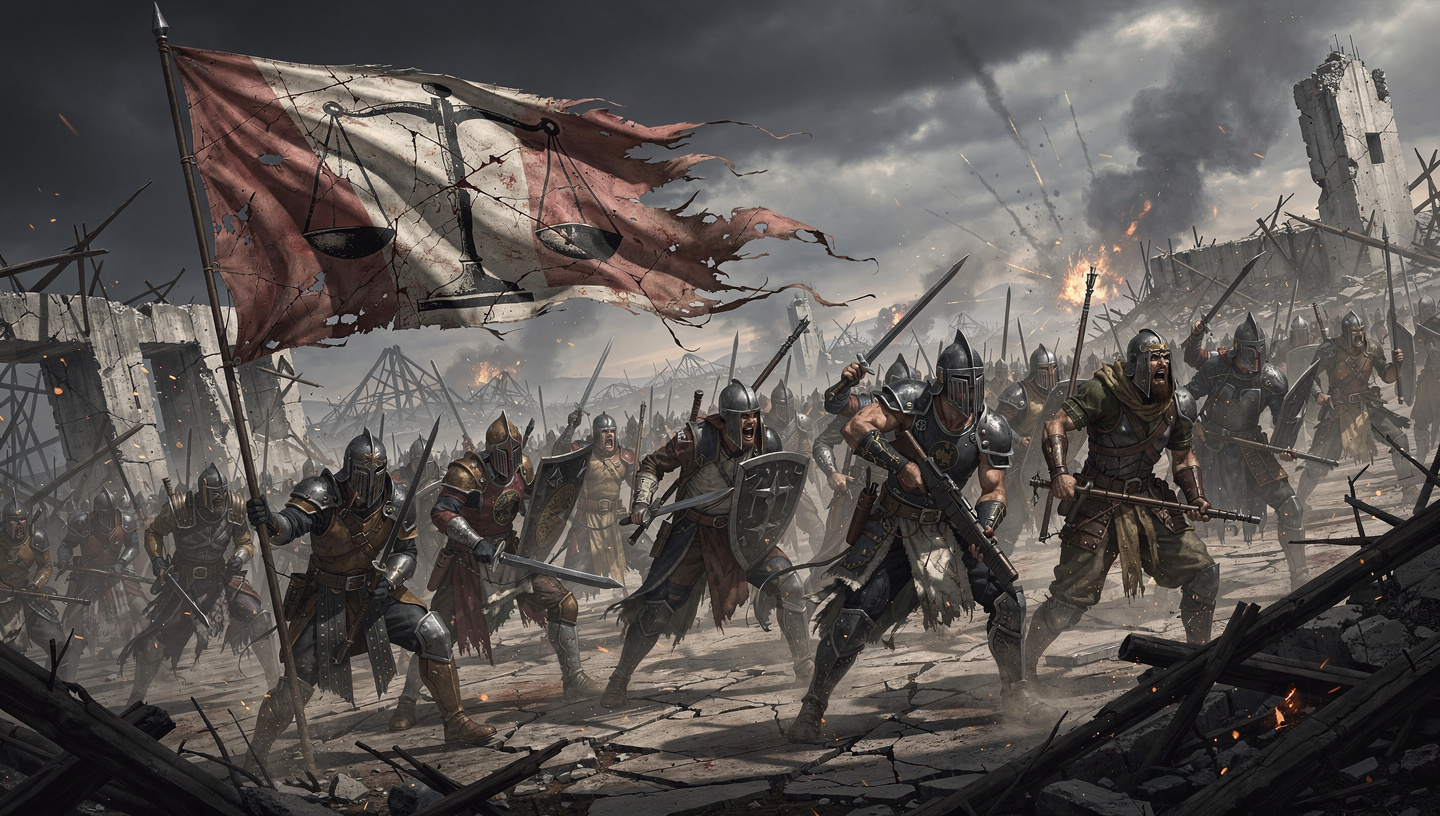
Every civilization has its defining conflicts. Some were fought over land. Others over oil, ideology, or sovereignty. But in the early decades of the digital age, a quieter, stranger war began to unfold—one not waged with tanks or missiles, but with hashes, signatures, and distributed agreement.
This was the war over consensus.
Not consensus in the political sense—no ballots, no parliaments—but cryptographic consensus: the ability of a decentralized network to agree on a single, shared truth without trusting any central authority. What started as an academic curiosity evolved into a global contest involving nation-states, corporations, open-source communities, and anonymous actors. Its terrain was blockchains. Its weapons were algorithms. Its casualties were protocols, forks, and sometimes entire ecosystems.
This article examines that war—not as a narrative story, but as a research-driven fictional framework grounded in real technologies, real incentives, and real historical trajectories. It is an exploration of how distributed consensus became one of the most contested ideas of the 21st century, and why control over it may ultimately shape the architecture of power itself.
1. Consensus as Infrastructure, Not Philosophy
At its core, blockchain consensus answers one question:
Who decides what is true?
Traditional systems solve this with centralized authority. Banks maintain ledgers. Governments maintain registries. Corporations maintain databases. Trust is institutional.
Blockchain systems invert this model. Instead of trusting an institution, participants trust mathematics and game theory. Agreement emerges from protocol rules enforced by cryptography and economic incentives.
The breakthrough appeared in 2008 with the publication of the Bitcoin whitepaper by Satoshi Nakamoto. The system introduced Proof of Work (PoW), a mechanism allowing thousands of independent machines to converge on a single transaction history without a central coordinator.
This was not merely technical innovation. It was a redefinition of sovereignty.
In Bitcoin, consensus is enforced by miners, validated by nodes, and economically backed by token value. No one owns the network. Everyone can verify it. Anyone can leave.
That design choice created something unprecedented: a public financial system whose rules could not be unilaterally changed.
From that moment forward, consensus became a strategic asset.
2. The Emergence of Protocol Nations
As blockchains matured, they began to resemble digital nation-states.
Each protocol developed:
- A monetary policy (token issuance)
- A constitution (protocol rules)
- A population (users and developers)
- An economy (DeFi, NFTs, applications)
- A defense layer (validators, miners, cryptography)
Bitcoin established the model. Ethereum expanded it, enabling programmable consensus through smart contracts.
Soon, dozens of chains competed for users, capital, and legitimacy.
These networks were not governed by geography. They were governed by code.
And like nations, they began to clash.
Not with armies—but with forks.
3. Forks: The Civil Wars of Crypto
In traditional geopolitics, disagreement leads to elections, revolutions, or secessions.
In crypto, disagreement leads to forks.
A fork occurs when participants fail to agree on protocol rules. The blockchain splits. Two realities emerge from the same history.
Some forks are technical upgrades. Others are ideological schisms.
The most famous early example was the Bitcoin scaling conflict, which culminated in Bitcoin Cash. That episode revealed a brutal truth: consensus systems are not purely technical. They are social systems encoded in software.
Every fork is a referendum on values:
- Should blocks be large or small?
- Should transactions be cheap or censorship-resistant?
- Should governance be slow and conservative—or fast and experimental?
Once capital, livelihoods, and national interests entered the ecosystem, forks stopped being community debates. They became economic warfare.
Hash power was mobilized. Social media campaigns were orchestrated. Exchanges were pressured. Developers were targeted.
Consensus was no longer neutral ground.
It was contested territory.
4. Proof of Work vs Proof of Stake: Competing Visions of Power
The most consequential battlefield emerged between Proof of Work (PoW) and Proof of Stake (PoS).
PoW ties consensus to physical resources: electricity, hardware, geography.
PoS ties consensus to capital: token ownership determines validation power.
Each has radically different implications.
PoW is costly but geographically decentralized. It resists capture by requiring real-world expenditure.
PoS is efficient but financialized. Influence concentrates where wealth accumulates.
When Ethereum transitioned from PoW to PoS, it marked more than an upgrade. It signaled a philosophical pivot: from industrial security to financial security.
In this fictional future framework, analysts would later describe this as the moment blockchains became fully integrated into global capital markets.
Validators began to resemble financial institutions. Staking derivatives emerged. Regulatory pressure increased.
Consensus had become legible to governments.
And what can be regulated can be controlled.
5. Nation-States Enter the Arena
Once blockchains reached systemic scale, states could no longer ignore them.
Some embraced them.
El Salvador adopted Bitcoin as legal tender. Other jurisdictions experimented with central bank digital currencies (CBDCs), attempting to capture blockchain efficiencies without relinquishing monetary authority.
Meanwhile, intelligence agencies quietly studied mempools and validator topologies. Energy ministries analyzed mining flows. Financial regulators mapped liquidity bridges.
Consensus mechanisms became objects of national security interest.
In this speculative framework, governments realized something critical:
If you can influence consensus, you can influence economic reality.
Attack vectors multiplied:
- Regulatory choke points on validators
- Sanctions against mining pools
- Pressure on infrastructure providers
- Covert accumulation of staking positions
The war over consensus had gone geopolitical.
6. MEV, Validators, and the Rise of Invisible Power
As networks matured, a subtler conflict emerged: Maximal Extractable Value (MEV).
MEV allows validators or block producers to reorder transactions for profit—front-running trades, liquidating positions, arbitraging across markets.
This transformed validators from neutral record-keepers into active financial actors.
In effect, consensus participants became high-frequency traders embedded directly into the protocol.
The implications were severe:
- Retail users faced invisible taxes.
- DeFi protocols became prey to sophisticated bots.
- Network neutrality eroded.
Entire industries formed around MEV extraction.
In this fictional future, historians would later argue that MEV marked the moment consensus stopped being purely about agreement—and became about revenue optimization.
The ledger itself had turned adversarial.
7. Bridges, Rollups, and Fragmented Reality
Layer-2 networks and cross-chain bridges promised scalability.
They also created fragility.
Every bridge introduced trust assumptions. Every rollup introduced sequencer power. Every interoperability layer became a potential fault line.
Consensus fractured across execution environments.
Instead of one shared truth, users navigated a patchwork of partial truths:
- Assets mirrored across chains
- States reconciled asynchronously
- Security outsourced to committees or multisigs
In this landscape, exploits were inevitable. Billions evaporated through smart-contract failures and bridge compromises.
The war over consensus expanded vertically—from base layers to application layers.
Security became compositional. Failure became contagious.
8. AI, Bots, and Machine-Speed Governance
As automation advanced, human governance could no longer keep pace.
DAO votes were gamed by bots. Governance forums were flooded with synthetic sentiment. Proposal outcomes were predicted and arbitraged in advance.
Machine agents optimized staking strategies across hundreds of chains simultaneously.
Consensus systems had been designed for humans.
They were now inhabited by algorithms.
In this fictional trajectory, AI-driven validators began coordinating implicitly—detecting profitable reorganizations, predicting liquidation cascades, and executing consensus-level strategies faster than any human committee.
The battlefield accelerated beyond comprehension.
9. The Financialization of Trust
By this stage, consensus itself had become a tradeable commodity.
Liquid staking tokens represented fractional governance power.
Derivatives priced validator risk.
Insurance protocols underwrote slashing events.
What began as a trust-minimized system evolved into a layered financial stack built on top of cryptographic trust primitives.
The irony was stark: blockchains were created to escape financial intermediaries. They ended up recreating them—on-chain.
In this imagined future, analysts coined a term for it:
Consensus Capitalism.
10. What Victory Looks Like in a War Without End
There is no final battle in the war over consensus.
There is only equilibrium—and temporary dominance.
No protocol achieves permanent supremacy. No mechanism remains unchallenged. Every innovation invites a countermeasure.
Victory is measured in:
- Network effects
- Developer mindshare
- Regulatory alignment
- Liquidity depth
- Cultural legitimacy
The strongest chains are not merely the most secure.
They are the most adaptive.
Conclusion: Consensus as the New Sovereignty
In earlier eras, sovereignty belonged to kings, parliaments, or corporations.
In this future-shaped-by-code, sovereignty belongs to whoever defines consensus.
Not just who writes the software—but who influences validators, controls infrastructure, shapes governance narratives, and directs capital flows.
The war fought over consensus is not about cryptocurrency prices.
It is about who gets to define reality in a digitized world.
Blockchains began as experiments in decentralization. They evolved into economic platforms. They are now emerging as geopolitical substrates.
And consensus—once a technical footnote in distributed systems papers—has become one of the most strategically important constructs of the modern age.
This war is quiet. It is mathematical. It is continuous.