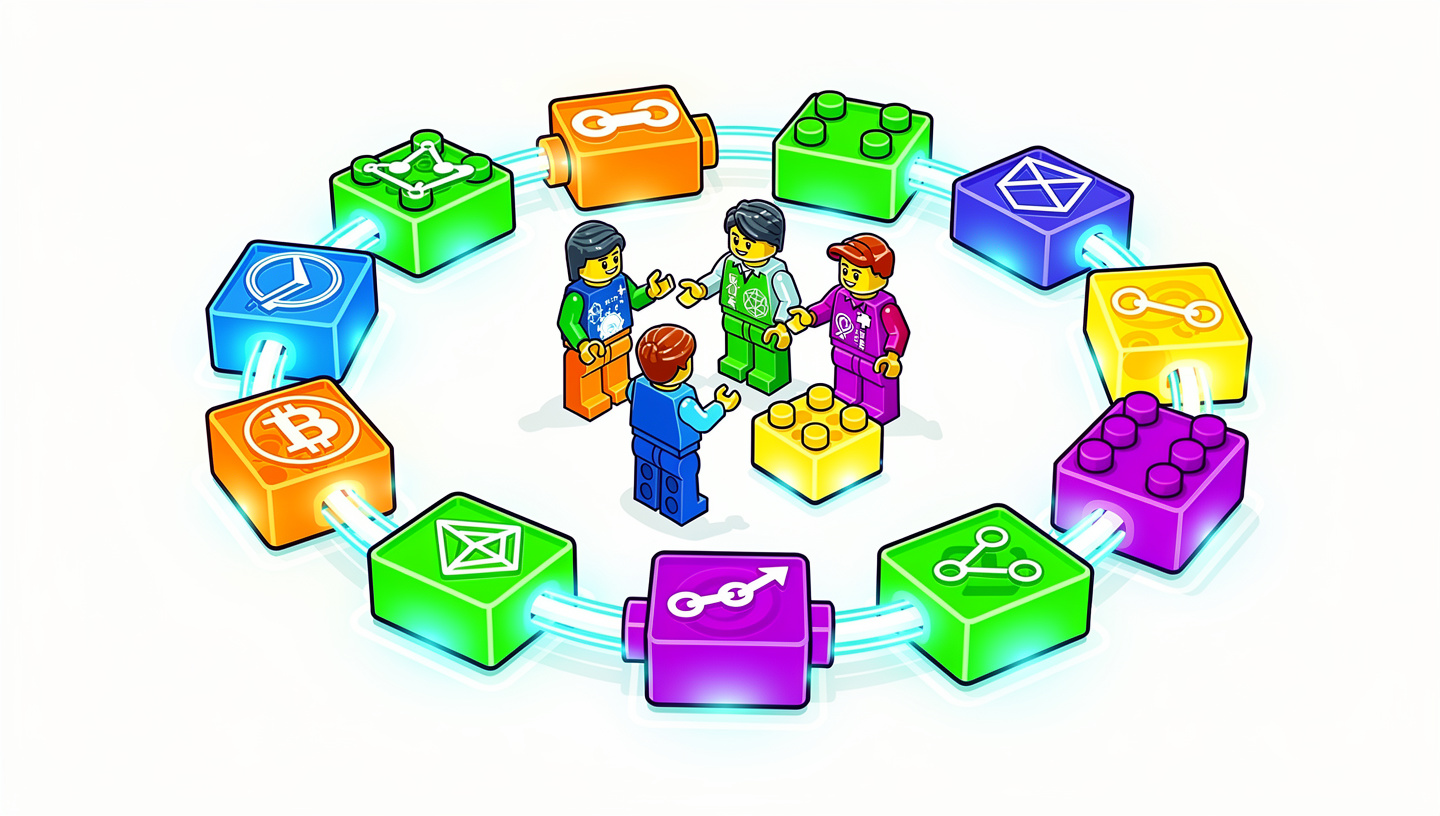
Every technological revolution begins quietly.
Not with fireworks or declarations—but with a commit pushed to a repository, a parameter changed in a protocol, a group of anonymous engineers arguing over block timing in an encrypted channel. History remembers wars and elections. It forgets patches and forks.
And yet, in this imagined future, humanity survived not because of treaties or armies—but because of a clandestine upgrade to the global cryptographic substrate.
This is not a story in the literary sense. It is speculative research fiction: a systems-level examination of how decentralized infrastructure, cryptographic governance, and emergent coordination mechanisms converged into what later historians would call The Underground Fork—a silent intervention that prevented planetary collapse.
The premise is simple:
A permissionless network altered itself without asking for approval—and in doing so, stabilized civilization.
To understand how that could even be plausible, we need to examine the mechanics of crypto networks, the sociology of open-source coordination, and the latent power embedded in programmable money.
1. Crypto as a Civilizational Operating System
By the mid-21st century, blockchains were no longer financial experiments. They had become foundational infrastructure.
Supply chains settled on-chain. Energy grids used tokenized load balancing. Identity systems were anchored to decentralized attestations. Entire cities operated via smart contracts.
What began as peer-to-peer money evolved into something closer to a civilizational operating system:
- Economic activity cleared through distributed ledgers
- Governance logic encoded in autonomous protocols
- Resource allocation optimized by cryptographic incentives
- Public records secured by immutable consensus
At this scale, crypto was not “an industry.”
It was substrate.
And substrates, when stressed, either adapt—or fracture.
2. The Pre-Crisis World: Hyper-Optimization Meets Fragility
The systems were elegant. Too elegant.
Every optimization compounded:
- Just-in-time manufacturing became just-in-block production
- Carbon markets were fully tokenized
- Water rights were streamed per second
- AI agents executed trades, logistics, and policy enforcement autonomously
Human discretion steadily disappeared from the loop.
This created unprecedented efficiency—and unprecedented fragility.
A single global settlement layer meant single points of systemic risk:
- Consensus failures propagated instantly
- Oracle corruption cascaded across markets
- Smart contract exploits became macroeconomic events
In classic engineering terms, civilization had become tightly coupled.
And tightly coupled systems fail catastrophically.
3. The Black Swan Nobody Modeled
The crisis did not arrive as a meteor or war.
It arrived as correlation.
Three independent events synchronized:
- A climate-driven agricultural collapse across multiple continents
- A large-scale cryptographic exploit targeting legacy signature schemes
- An AI-driven market reflex that amplified liquidity withdrawal
Individually survivable.
Together, lethal.
Within hours:
- Stablecoin pegs destabilized
- Energy credit markets froze
- Food distribution DAOs failed to clear bids
- Autonomous logistics systems halted
Billions depended on systems that had just entered undefined behavior.
Governments attempted emergency forks.
They failed.
Why?
Because public governance moves at the speed of committees.
Distributed systems move at the speed of packets.
4. The Limits of Formal Governance in Decentralized Networks
Every major chain had governance frameworks:
- Token-weighted voting
- Delegate councils
- Constitutional smart contracts
- Emergency upgrade paths
All of them assumed rational participation under normal conditions.
But crises compress time.
When blocks finalize every few seconds, and economic feedback loops operate in milliseconds, traditional governance becomes irrelevant.
Proposals could not be drafted fast enough.
Votes could not converge.
Validators disagreed on rollback scope.
In effect, the system was waiting for humanity.
Humanity could not keep up.
5. The Emergence of the Shadow Maintainers
Every open-source ecosystem has an informal core.
Not foundations. Not marketing teams.
Operators.
Client implementers. Protocol researchers. Infrastructure engineers. Cryptographers who never speak at conferences. People who understand the system not abstractly—but mechanically.
They had no official authority.
They had something more important:
- Deep protocol knowledge
- Root access to critical infrastructure
- Trust relationships formed over decades
- And the ability to coordinate silently
They were descendants, in spirit, of early crypto pioneers like Satoshi Nakamoto—builders who understood that decentralization does not mean leaderlessness. It means distributed competence.
When the formal processes stalled, this informal network activated.
No announcement.
No press release.
Just encrypted messages, signed commits, and binary diffs exchanged across continents.
This was the Underground Fork.
6. What Makes an “Underground Fork” Technically Possible?
A fork is simply a divergence in protocol rules.
But an underground fork is different.
It is:
- Pre-coordinated across major clients
- Rolled out via silent updates
- Activated through threshold signaling
- Designed to appear organic at the network level
The mechanics involved:
Client-Level Convergence
Multiple independent implementations shipped identical consensus changes within hours. Nodes auto-updated under existing maintenance policies.
No public RFC.
No governance vote.
Just aligned binaries.
Validator Signaling
Large validators began producing blocks with the new rules, while legacy blocks were quietly orphaned.
From the outside, it looked like routine reorgs.
From the inside, it was a coup—executed by mathematics.
Economic Incentive Realignment
The fork embedded emergency logic:
- Temporary transaction fee caps
- Priority routing for food, energy, and medical contracts
- Circuit breakers on AI trading agents
- Adaptive inflation to restore liquidity
None of this was voted on.
It was implemented.
7. The Core Innovation: Programmable Moral Priority
The most radical element was not technical.
It was philosophical.
The fork introduced context-aware execution weighting.
Smart contracts associated with survival-critical services—water purification, power distribution, staple food logistics—received deterministic priority at the protocol level.
This was not censorship.
It was protocol-native triage.
In effect, the network acquired something like ethics, expressed as code.
Transactions were no longer equal.
They were ranked by civilizational necessity.
This violated every purist doctrine of neutrality.
It also prevented mass starvation.
8. Why This Could Never Have Been Public
If the maintainers had announced their plan:
- Markets would have panicked
- Adversaries would have attacked during deployment
- Competing factions would have stalled consensus
- Legal frameworks would have frozen execution
Distributed systems reward decisive action, not deliberation.
So they acted first.
The fork propagated.
Stability returned.
Energy grids resumed clearing.
Food DAOs rebalanced inventories.
Hospitals regained payment channels.
Most users never noticed anything beyond temporary volatility.
History almost didn’t record it.
9. Post-Crisis Analysis: Who Actually Runs Decentralization?
After recovery, academic institutions and protocol foundations attempted forensic reconstruction.
They discovered something uncomfortable.
Formal governance structures had been bypassed entirely.
The real control plane consisted of:
- Core client maintainers
- Major infrastructure providers
- A small set of globally trusted cryptographers
- Operators of high-availability validator clusters
Organizations like Ethereum Foundation had funded research and community growth—but operational sovereignty lived elsewhere, in private terminals and secure enclaves.
Decentralization, it turned out, was not evenly distributed.
It was lumpy.
10. The Ethics of an Unauthorized Salvation
Was the Underground Fork legitimate?
Legally: unclear.
Procedurally: no.
Effectively: yes.
Billions lived.
But precedent matters.
The fork demonstrated that:
- Small groups can reshape global systems
- Code can outrun democracy
- Emergency powers exist even in permissionless networks
Critics argued it proved decentralization was an illusion.
Supporters argued it proved decentralization works—because competence surfaced when it mattered.
Both were correct.
11. Long-Term Consequences: Protocols Grow a Nervous System
After the event, networks evolved.
Emergency primitives became standardized:
- Protocol-level priority classes
- Cryptographic disaster signals
- AI agent throttling mechanisms
- Decentralized “red teams” with pre-authorized intervention rights
Blockchains acquired something like reflex arcs.
They could now respond to existential threats faster than human institutions.
Crypto stopped being just infrastructure.
It became adaptive.
12. Lessons for a Programmable Species
The Underground Fork teaches several hard truths:
1. Neutral Systems Still Encode Values
Every protocol embeds priorities, whether explicit or hidden.
2. Governance Must Match System Velocity
Human deliberation cannot operate at machine timescales.
3. Informal Power Always Exists
Ignoring it does not make it disappear.
4. Open Systems Require Stewards
Not rulers. Stewards. People who understand the machinery deeply enough to act under pressure.
5. Survival Trumps Ideology
Purity is a luxury of stable environments.
Closing: The Quiet Power of Code
No monuments were built for the Underground Fork.
No statues erected.
The engineers returned to anonymity. The commits were buried in version histories. Markets moved on.
But somewhere in the deeper layers of the stack, a truth remained:
Humanity was not saved by politicians, or generals, or even by artificial intelligence.
It was saved by a handful of people who understood distributed systems well enough to bend them—just once—toward survival.
In the end, the future was not decided in parliaments.
It was decided in pull requests.