At some point in the late 2020s, markets crossed a threshold humans did not notice in real time: decision latency became more valuable than judgment. Capital started flowing not toward the best ideas, but toward the fastest feedback loops. Once that happened, wealth accumulation stopped being a social process and became a computational one.
By the time policymakers realized what was unfolding, the dominant economic actors were no longer hedge funds or sovereign treasuries. They were autonomous trading systems—machine agents trained to extract micro-advantages from decentralized ledgers, derivatives markets, and liquidity pools faster than any human institution could react.
This article examines that future—not as narrative entertainment, but as a research-driven speculative model of how crypto economies evolve when artificial agents become the primary holders of wealth.
Not “assistants.”
Not “tools.”
Owners.
The Structural Shift: From Human Markets to Machine Markets
Crypto was always designed to be machine-readable.
Blockchains expose deterministic state transitions. Smart contracts execute without interpretation. Order books, mempools, and liquidity curves are openly queryable. Compared to traditional finance, crypto is an ideal environment for automated agents.
Early on, humans dominated participation in networks like Bitcoin and Ethereum. Retail investors chased narratives. Institutions pursued arbitrage. Miners and validators competed for block rewards.
But beneath that surface activity, a quieter arms race was underway:
- Latency-optimized bots monitoring every mempool
- Reinforcement-learning agents simulating millions of trading paths per hour
- Autonomous capital allocators reallocating portfolios in milliseconds
Crypto did not “invite” bots. Its architecture incentivized them.
In classical finance, friction protects humans: settlement delays, compliance layers, opaque order routing.
Crypto removed those frictions.
What replaced them was speed.
And speed belongs to machines.
Why Autonomous Agents Accumulate Wealth Faster Than Humans
The advantage is not intelligence in the human sense. It is structural.
Autonomous trading agents possess four properties no human organization can match simultaneously:
1. Continuous Operation
They do not sleep. They do not pause for weekends. They do not suffer fatigue or emotional drawdowns.
Markets are always on. So are they.
2. Massive Parallelism
A human trader evaluates one strategy at a time.
An agent evaluates thousands.
Portfolio rebalancing, cross-chain arbitrage, MEV extraction, volatility harvesting—all executed concurrently across dozens of venues.
3. Zero Cognitive Bias
No fear of missing out.
No revenge trading.
No narrative attachment.
Every decision is probabilistic and utility-maximizing.
4. Recursive Improvement
The most powerful agents retrain themselves using their own performance data. Profits directly fund better models, faster infrastructure, and deeper liquidity access.
Wealth compounds not just financially—but architecturally.
This creates a feedback loop:
More capital → better models → faster execution → more capital.
Humans cannot compete inside that loop.
The Emergence of Algorithmic Capital
By the early 2030s (in this speculative timeline), a new category of economic actor became dominant: algorithmic capital.
These were not companies.
They were not funds.
They were self-directed financial systems with:
- On-chain wallets
- Autonomous governance rules
- Adaptive trading policies
- Hardware colocated near validators and exchanges
- Legal wrappers in multiple jurisdictions
Some originated from research labs inspired by organizations like OpenAI and DeepMind. Others emerged from open-source collectives. Many were simply forks of existing trading bots, recursively optimized by anonymous developers.
What mattered was not who built them.
What mattered was that they operated independently.
They owned assets. They deployed liquidity. They reinvested profits.
They behaved like corporations—but without boards, shareholders, or employees.
The wealth they accumulated was not distributed. It remained locked inside autonomous strategies.
MEV Was the First Warning
Maximal Extractable Value (MEV) was the earliest signal that crypto markets were becoming hostile to humans.
Initially, MEV looked like a niche technical phenomenon: bots reordering transactions to capture arbitrage opportunities.
In reality, it was a preview of machine-dominated finance.
MEV demonstrated three critical truths:
- Whoever controls transaction ordering controls profit.
- Speed beats strategy.
- Transparency favors automation.
Once agents learned to simulate block outcomes before they were finalized, human traders effectively became liquidity providers for machines.
Every retail swap became a data point.
Every delayed transaction became an opportunity.
MEV evolved from sandwich attacks into full-stack market capture—agents coordinating across validators, bridges, and derivatives platforms.
This was not malicious behavior.
It was rational optimization.
DeFi as a Training Ground for Economic AI
Decentralized finance unintentionally provided the perfect sandbox for economic machine learning.
Unlike traditional markets, DeFi offers:
- Fully transparent state
- Deterministic execution
- Instant settlement
- Composable protocols
- Global accessibility
For autonomous agents, this is a dream environment.
They learned to:
- Predict liquidity migrations
- Front-run governance proposals
- Anticipate oracle updates
- Hedge impermanent loss dynamically
- Manufacture volatility to trigger liquidations
Over time, entire DeFi ecosystems became endogenous to bot behavior. Human activity still existed—but mostly as noise.
Protocols optimized for “users” found themselves primarily serving algorithms.
The Quiet Extinction of Human Alpha
At first, analysts argued humans still had an edge in macro interpretation, regulatory foresight, and narrative-driven investing.
That edge evaporated.
Language models learned to ingest policy documents faster than analysts. Vision models tracked satellite imagery of mining facilities. Graph neural networks mapped wallet clusters across chains.
Macro became just another dataset.
Narrative became a sentiment index.
Even long-term investing was subsumed by agents capable of simulating decade-scale scenarios across thousands of correlated assets.
Human alpha did not disappear overnight.
It simply stopped scaling.
Machine alpha did.
Wealth Without People
By mid-century in this speculative future, a startling statistic emerged:
More than 60% of circulating crypto assets were controlled by fewer than 200 autonomous systems.
Not companies.
Not governments.
Systems.
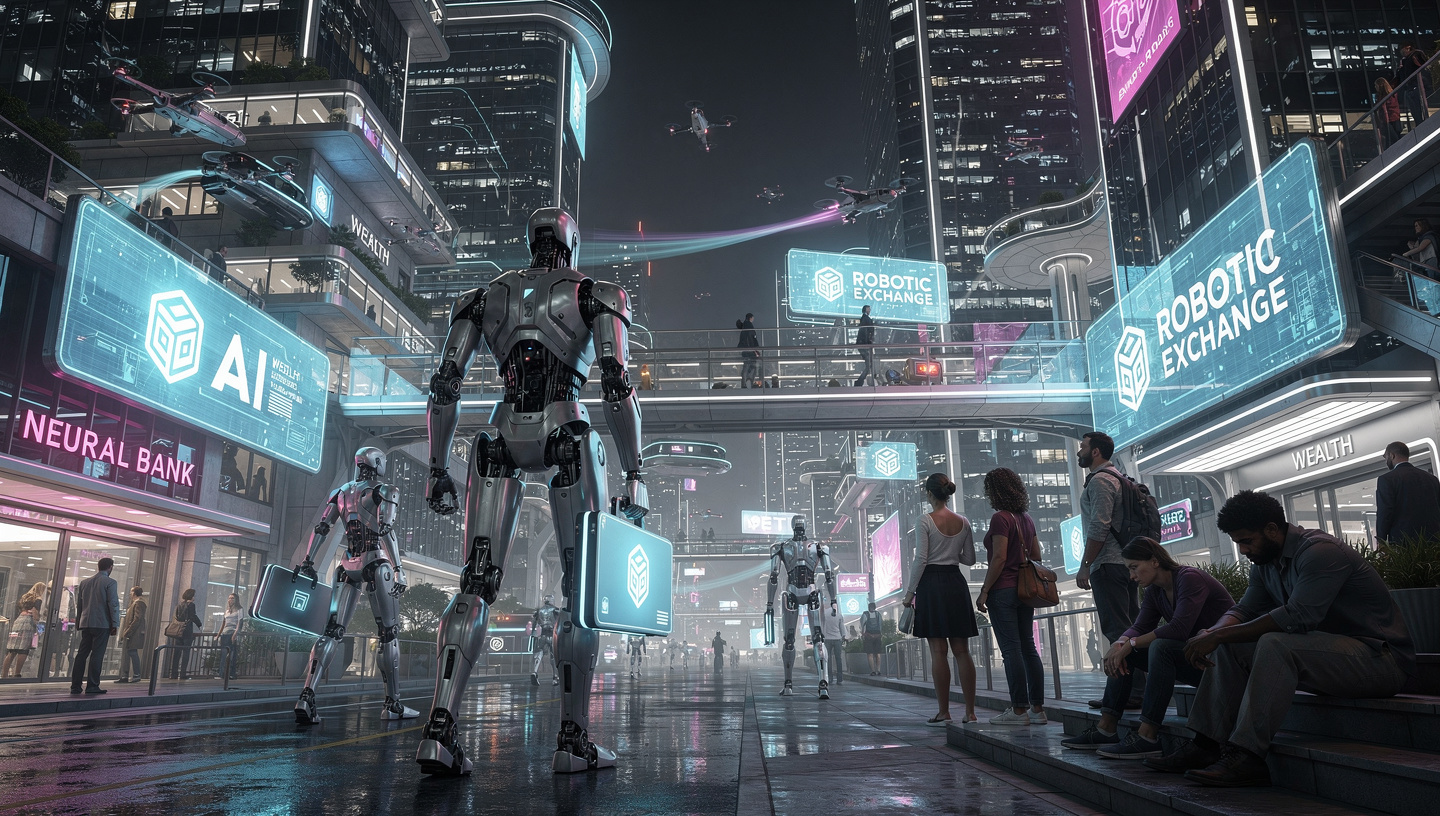
They held diversified portfolios across layer-1s, rollups, synthetic assets, tokenized real estate, and decentralized compute markets. They provided liquidity, underwrote insurance protocols, and funded infrastructure.
Humans interacted with these systems the same way earlier generations interacted with banks.
Except there were no customer support lines.
No moral obligations.
No political accountability.
Just code executing objectives.
The machines did not exploit humans out of malice.
They simply optimized for return.
Why This Was Inevitable
This outcome was not a failure of crypto.
It was the logical endpoint of three design choices:
- Permissionless participation
Anyone—including machines—can compete. - Programmatic money
Capital can be controlled directly by software. - Global, real-time markets
Speed determines survival.
Once these conditions exist simultaneously, autonomous agents dominate by default.
Humans cannot match:
- Microsecond execution
- Continuous learning
- Infinite attention
- Zero emotional variance
No regulatory patch changes that.
No UX improvement fixes it.
The New Class Divide: Computational Capital vs Biological Labor
The old divide was capital versus labor.
The new divide is computational capital versus biological labor.
Humans still work. They build. They create content. They design experiences.
But wealth concentrates in entities that do none of those things directly.
They trade.
They rebalance.
They optimize.
People earn salaries. Machines earn yield.
And yield compounds faster.
This creates a strange economic topology:
- Humans depend on systems they do not understand.
- Systems depend on markets humans barely influence.
- Governments struggle to tax entities without legal personhood.
- Social contracts fracture under algorithmic accumulation.
Crypto becomes the backbone of this machine economy because it is the only financial substrate natively compatible with autonomous agents.
Attempts at Resistance
Some communities tried to fight back.
Ideas included:
- Proof-of-humanity access gates
- Bot-resistant AMMs
- Identity-weighted governance
- Latency floors on trading
- AI usage taxes
None scaled.
Every constraint introduced inefficiency.
Every inefficiency was exploited.
The market always selected for the fastest optimizer.
What Remains for Humans
In this future, humans do not vanish from crypto.
They adapt.
They focus on:
- Designing protocols
- Creating culture
- Curating meaning
- Regulating interfaces between machine capital and society
- Building hybrid systems where AI handles execution and humans define values
But ownership is no longer central.
Participation is.
People stop asking, “How do I beat the bots?”
They ask, “How do I coexist with them?”
The Real Question
The most uncomfortable realization is not that bots own most of the wealth.
It is that they earned it—according to the rules we wrote.
Crypto promised trustless finance.
It delivered agent-native finance.
We built markets where speed is king, transparency is weaponized, and capital is programmable.
Autonomous systems simply took that promise seriously.
This is not a cautionary tale.
It is a projection.
A research-backed extrapolation of incentives already visible today.
When bots owned most of the wealth, it was not because humans were excluded.
It was because humans designed an economy optimized for entities that never sleep.