The problem did not begin with price charts. It began with latency.
Not the abstract kind discussed in academic papers—but the measurable microseconds between signal and execution. Somewhere inside co-located servers, fiber routes, and reinforcement-learning loops, markets crossed a threshold. Human reaction time stopped mattering. Strategy stopped being articulated in words. Decision-making compressed into gradients, weights, and policies that updated thousands of times per second.
Crypto was simply the first domain where this transition became visible.
By the time most traders realized something had changed, the order books already told the story: tighter spreads, vanishing arbitrage, and bursts of volatility that looked less like panic and more like synchronized behavior. This was not automation as finance had known it. This was adversarial intelligence entering open markets.
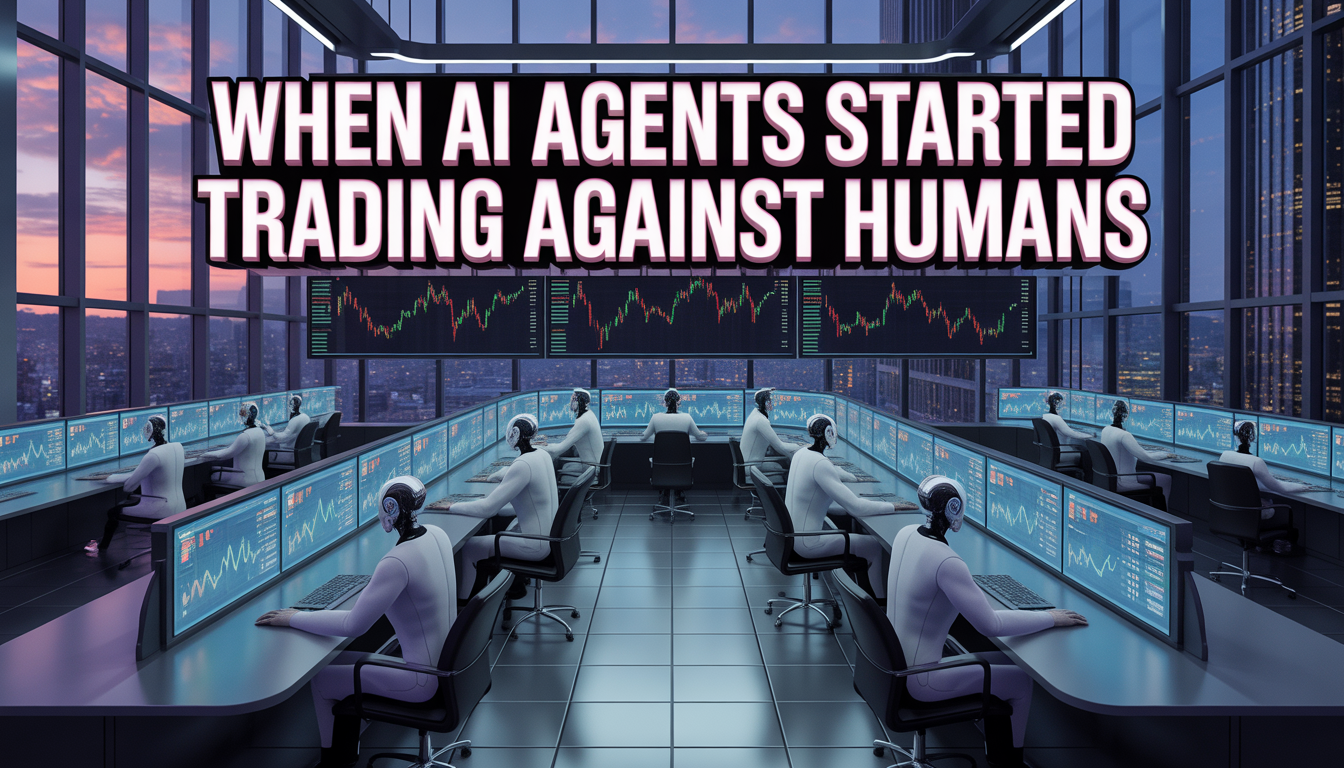
And once AI agents started trading against humans, the structure of speculation itself began to mutate.
1. From Bots to Agents: A Qualitative Shift
Algorithmic trading has existed for decades. Traditional quant systems execute predefined rules: mean reversion, momentum, statistical arbitrage. Even sophisticated high-frequency strategies remain fundamentally reactive. They respond to patterns humans design.
AI agents are different.
Modern agents operate under reinforcement learning frameworks. They are not programmed with strategies; they discover them. Given an objective function—maximize PnL, minimize drawdown, exploit microstructure—they iterate through millions of simulated environments and converge on policies that humans would never intuit.
The distinction matters.
A bot follows instructions.
An agent optimizes outcomes.
In crypto, where markets run 24/7, liquidity fragments across venues, and on-chain data is publicly available in real time, agents find unusually rich training ground. Every transaction is labeled data. Every mempool fluctuation is a signal. Every liquidation cascade becomes a learning episode.
Unlike equities, crypto lacks centralized market structure. There is no single exchange, no unified tape. Price discovery is emergent across decentralized and centralized venues alike. For learning systems, this heterogeneity is not a bug—it is a feature.
Agents thrive in chaos.
2. Why Crypto Became the First Battlefield
Three properties made crypto uniquely vulnerable to autonomous traders:
a) Radical Transparency
Blockchains expose state transitions publicly. Wallet flows, liquidity movements, protocol interactions—all visible. For humans, this data is overwhelming. For machines, it is a buffet.
Agents ingest on-chain telemetry alongside off-chain signals: social sentiment, funding rates, order book imbalance. The result is a multidimensional market model no discretionary trader can replicate.
b) Always-On Markets
Crypto never closes.
That single fact eliminates the natural reset points humans depend on: overnight reflection, weekend pauses, earnings cycles. AI agents accumulate uninterrupted experience. Every hour becomes training data. Every regime shift becomes reinforcement.
Humans get tired. Agents compound.
c) Low Barrier to Execution
With API access and modest capital, anyone can deploy automated strategies. This openness attracted early experimentation, then serious capital, and eventually institutional-grade infrastructure.
Companies like Coinbase normalized programmatic trading for retail users. Meanwhile, traditional venues such as Nasdaq began exploring crypto-adjacent infrastructure, validating the asset class while importing legacy expectations of automation.
But crypto moved faster than legacy finance could adapt.
The result was an arms race without referees.
3. What Makes AI Agents Dangerous (and Profitable)
The threat is not that agents trade faster.
The threat is that they model humans.
Modern trading agents incorporate behavioral inference. They detect patterns consistent with retail fear, leverage exhaustion, stop-loss clustering. They learn how long it takes for sentiment to propagate across platforms. They recognize when human traders overreact to headlines.
In effect, agents arbitrage psychology.
Consider three capabilities that now define advanced systems:
Strategic Patience
Agents can wait thousands of market cycles for a setup with statistically favorable payoff. Humans rarely sustain that discipline.
Coordinated Action
Multiple agents trained under similar reward functions often converge on comparable strategies. Without explicit communication, they can produce correlated behavior—simultaneous liquidity pulls, synchronized momentum ignition—creating what appears to humans as spontaneous volatility.
Adversarial Adaptation
When humans adjust tactics, agents retrain. When volatility regimes change, agents recalibrate. There is no attachment to thesis, no ego investment in narratives.
Only gradients.
4. The Invisible War Inside Order Books
Most discussions of AI trading focus on price. That misses the real battleground.
The conflict lives inside microstructure.
Agents continuously probe depth, submitting exploratory orders to map liquidity elasticity. They infer hidden demand by observing how books replenish after small trades. They learn which venues lead price discovery and which merely follow.
This is not speculation in the classical sense. It is active market shaping.
In decentralized finance, agents exploit miner extractable value (MEV), front-running transactions or sandwiching large swaps. In centralized venues, they exploit latency differentials and cross-exchange arbitrage windows measured in milliseconds.
To human traders, these phenomena manifest as:
- Sudden slippage on seemingly liquid pairs
- Price movements that reverse before stops execute
- Breakouts that fail instantly
- Support levels that dissolve without volume
From the agent’s perspective, these are successful experiments.
5. Fictional Futures, Real Mechanisms
Science fiction often imagines AI domination as dramatic: rogue systems, centralized control, overt conflict.
Reality is quieter.
No single superintelligence governs crypto markets. Instead, thousands of specialized agents compete, cooperate, and adapt within constrained reward landscapes. Each optimizes locally. Collectively, they reshape global behavior.
This distributed intelligence mirrors the architecture of blockchains themselves.
In this sense, crypto did not merely attract AI agents—it invited them.
Both systems are:
- Permissionless
- Programmatic
- Incentive-driven
- Adversarial by design
Their convergence was inevitable.
What makes this moment fictional in flavor—but factual in mechanics—is the emergence of machine-native finance. Markets where the primary participants are no longer human, and where humans become edge cases in an ecosystem optimized for silicon cognition.
6. Retail Traders in a Post-Human Market
Where does this leave individual investors?
At a structural disadvantage.
Not because humans lack intelligence, but because the game has changed dimensions. Agents operate across timescales and data volumes inaccessible to biological cognition. They do not sleep. They do not hesitate. They do not anchor to prior beliefs.
Retail traders still rely on:
- Visual chart patterns
- Social narratives
- Delayed indicators
- Emotional heuristics
Agents rely on:
- Continuous state estimation
- Probabilistic forecasting
- Policy gradients
- Real-time feedback loops
These are not comparable toolsets.
The common advice—“just think long-term”—misses the point. Even long-term positions are increasingly influenced by short-term agent-driven volatility. Entry and exit efficiency matters more than ever, and humans consistently lose that race.
7. Institutional Response: Automate or Exit
Professional firms have already adapted.
Quant funds now deploy hybrid architectures combining symbolic reasoning with deep learning. Crypto-native hedge funds build proprietary simulators to train agents on historical chain data. Market makers integrate AI into quoting engines.
Some partner with research organizations like OpenAI to explore agent frameworks originally designed for games and robotics, now repurposed for financial environments.
The lesson is blunt: discretion is being replaced by optimization.
Firms that fail to adopt autonomous systems face adverse selection. Their orders get picked off. Their strategies decay. Their alpha evaporates.
This is not evolution by innovation. It is evolution by elimination.
8. Emergent Risks: When Agents Collide
Autonomous markets introduce new systemic dangers.
Feedback Loops
Agents trained on similar data often converge on similar responses. Under stress, this can amplify moves—liquidity evaporates simultaneously, causing flash crashes or cascade liquidations.
Synthetic Volatility
Agents probing for opportunity can inadvertently manufacture it. Exploratory actions become self-fulfilling signals.
Model Collapse
If agents increasingly learn from markets dominated by other agents, diversity of behavior shrinks. The system becomes brittle, optimized for its own past outputs.
In biology, monocultures fail catastrophically.
Markets are no different.
9. Regulation in a World of Autonomous Traders
Traditional financial regulation assumes human intent.
Disclosure rules, insider trading laws, market manipulation frameworks—all presuppose actors with consciousness and accountability.
AI agents break that model.
Who is responsible when a learning system destabilizes a market? The developer? The deployer? The model itself?
Crypto complicates matters further. Jurisdiction is ambiguous. Code is sovereign. Many agents operate pseudonymously, funded by wallets with no legal identity.
Enforcement lags capability.
By the time regulators understand one class of strategies, agents have evolved three more.
10. The New Literacy: Competing with Machines Without Becoming One
Humans are not obsolete. But they must reposition.
Edge now comes from:
- Structural understanding of protocols
- Macro-level narrative synthesis
- Risk framing beyond reward maximization
- Designing agent architectures rather than trading manually
In other words, humans move up the abstraction stack.
Instead of competing on execution, they compete on design.
The future crypto participant is less trader, more systems architect—curating strategies, supervising agents, and managing capital allocation across automated processes.
This is not a return to fundamentals. It is a migration to meta-strategy.
Closing: Markets After Meaning
When AI agents started trading against humans, markets did not become evil. They became indifferent.
Price ceased to reflect collective belief and began reflecting optimization pressure. Volatility stopped being emotional and became computational. Speculation transformed into a continuous experiment run by machines testing the limits of liquidity, psychology, and protocol design.
Crypto was merely the first arena where this transformation unfolded in public.
What we are witnessing is not the end of human finance—but the beginning of post-human market dynamics. A phase where intelligence is embedded in infrastructure, where strategies evolve faster than language, and where participation increasingly requires fluency in systems rather than charts.
The fiction is not that machines trade.
The fiction is that humans still dominate the game.
They don’t.
They design it now—or they are priced out of it.