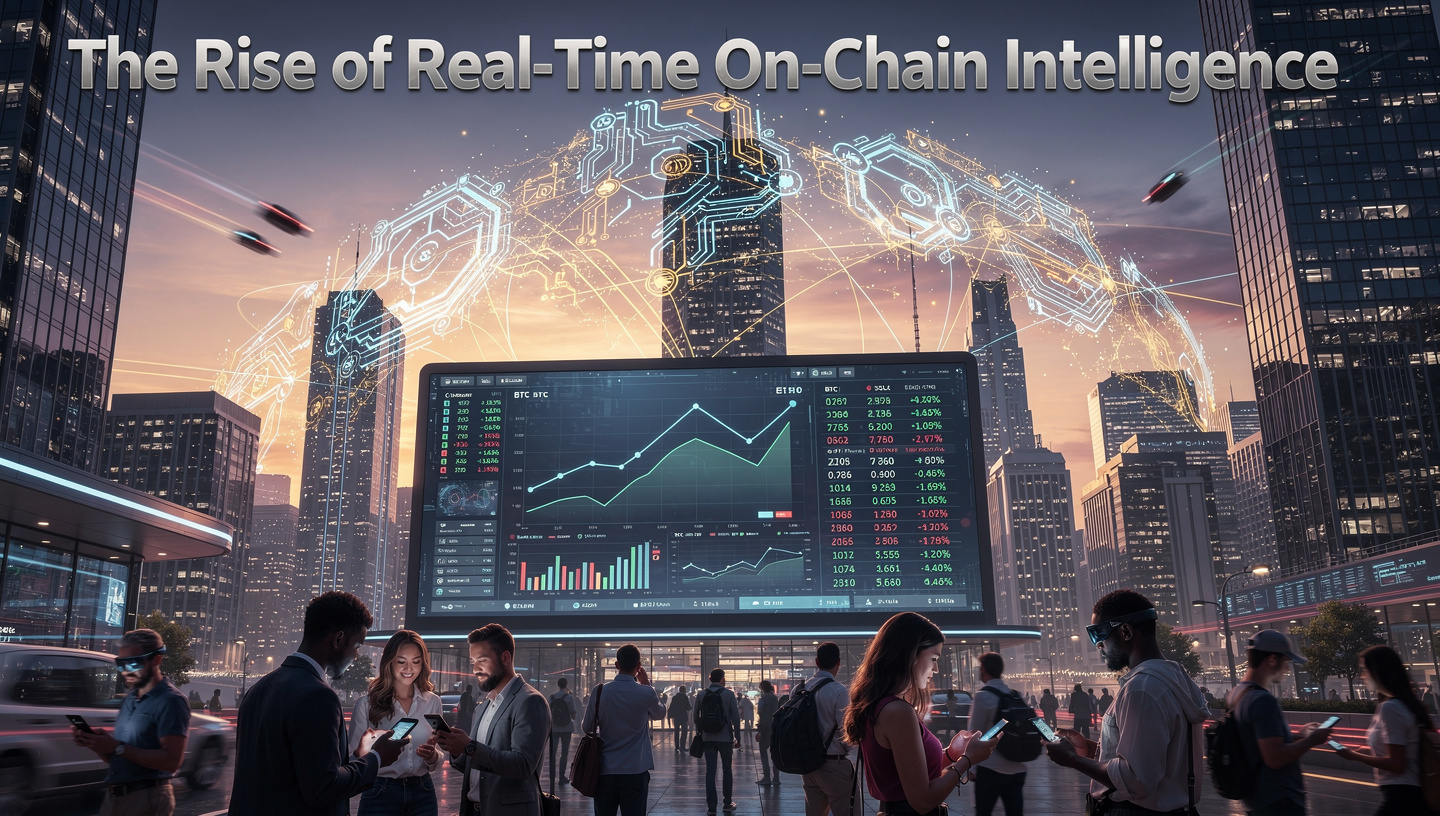
Every block confirmation, every liquidity shift, every whale transfer, every contract interaction—modern crypto markets emit a continuous pulse of data that never sleeps. Not reports. Not quarterly filings. Not curated narratives. Raw, cryptographically verifiable economic activity, unfolding in public memory at millisecond cadence.
This is not transparency in the traditional sense. It is something more radical.
It is live financial telemetry.
And over the past few years, that telemetry has evolved into what is rapidly becoming one of crypto’s most consequential primitives: real-time on-chain intelligence.
Not charts. Not indicators. Not sentiment dashboards.
Intelligence.
A layer that translates chaotic blockchain activity into actionable signal—while the event is still happening.
This shift is redefining how capital allocates, how risk is managed, how narratives form, and how alpha is generated. It is quietly dismantling the old information asymmetries of finance and replacing them with something closer to a global, permissionless market radar.
This article examines that transformation in depth: where on-chain intelligence came from, how it works at scale, why real-time matters, who is building it, and how it is reshaping crypto’s next phase.
From Explorers to Intelligence Systems
In crypto’s early years, on-chain data was accessible but unusable.
You could open a block explorer and inspect transactions one by one. Technically transparent. Practically meaningless.
This was blockchain as a raw ledger: unindexed, uncontextualized, and cognitively overwhelming.
The first analytical layer focused on historical aggregation:
- Daily active addresses
- Transaction counts
- Hash rate
- Exchange inflows/outflows
These metrics were backward-looking. Useful for macro narratives, useless for timing.
Then came cohort analysis, wallet labeling, and entity clustering. Platforms began identifying exchanges, funds, miners, and major holders. For the first time, market participants could distinguish between retail noise and institutional movement.
But it was still delayed.
By the time dashboards updated, price had already reacted.
Real-time on-chain intelligence emerged as a response to this latency.
The goal shifted from explaining what happened to detecting what is happening now.
That required three breakthroughs:
- Low-latency indexing of blockchain data
- Entity attribution at scale
- Streaming analytics rather than batch reporting
Once those pieces aligned, on-chain data stopped being archival—and became operational.
What “Real-Time On-Chain Intelligence” Actually Means
The term gets thrown around loosely. Let’s be precise.
Real-time on-chain intelligence is not simply fast dashboards.
It is a pipeline with four distinct layers:
1. Live Data Ingestion
Blocks, mempools, contract events, and internal transactions are captured as they propagate through the network.
This includes:
- Pending transactions (pre-confirmation)
- Smart contract calls
- Liquidity pool updates
- Bridge activity
- Validator behavior
Latency is measured in seconds, not minutes.
2. Attribution and Context
Raw addresses are mapped to entities:
- Centralized exchanges
- Market makers
- Funds
- DAOs
- Protocol treasuries
- Known whales
This is where companies like Chainalysis pioneered large-scale wallet clustering, while newer platforms specialize in high-frequency labeling for trading workflows.
Without attribution, data is noise.
With attribution, it becomes narrative.
3. Pattern Recognition
This layer detects behaviors, not just events:
- Accumulation phases
- Distribution cycles
- Liquidity migrations
- MEV activity
- Smart money rotations
- Bridge arbitrage
Machine learning increasingly plays a role here, identifying deviations from baseline behavior in real time.
4. Signal Delivery
Alerts, APIs, feeds, and automated strategies consume this intelligence directly.
Traders don’t “check dashboards” anymore.
They subscribe to flows.
When a large fund moves collateral.
When a protocol deploys a new contract.
When liquidity exits a pool.
When a dormant whale wakes up.
The system tells them immediately.
Why Real-Time Changes Everything
Historical analytics tell you why price moved.
Real-time intelligence tells you before it moves.
That difference defines the modern edge.
Capital Rotates Faster Than Narratives
Crypto cycles used to be thematic:
DeFi. NFTs. Layer 2s. Memecoins. AI.
Each lasted months.
Today, capital rotates across sectors in days—sometimes hours.
Real-time on-chain monitoring reveals these rotations as they begin:
- Stablecoins moving onto specific chains
- Large wallets bridging into emerging ecosystems
- Liquidity concentrating in new protocols
By the time social media notices, the move is already mature.
Liquidity Is Observable, Not Assumed
In traditional finance, liquidity is inferred through order books and volume.
On-chain, it is directly measurable.
You can watch:
- LP positions being withdrawn
- Vault TVL collapsing
- Protocol treasuries reallocating assets
This allows proactive risk management. When liquidity starts leaving, you don’t speculate—you see it.
Whale Behavior Is No Longer Mythical
“Smart money” used to be a rumor.
Now it is traceable.
Platforms like Nansen specialize in tracking labeled wallets in real time, showing exactly where experienced operators deploy capital.
This doesn’t guarantee success—but it eliminates informational blindness.
You no longer trade against ghosts.
The New Infrastructure Layer: Analytics as a Primitive
On-chain intelligence is becoming infrastructure, not tooling.
Just as RPC providers and indexers became foundational to Web3 applications, real-time analytics is becoming embedded directly into:
- Trading systems
- DeFi protocols
- Risk engines
- DAO governance
- Market-making strategies
Consider how builders use Dune Analytics for custom live dashboards, or how compliance platforms integrate Chainalysis APIs to screen flows continuously.
This is analytics as middleware.
Not a product. A dependency.
Protocols increasingly design mechanisms that react automatically to on-chain conditions:
- Dynamic interest rates
- Adaptive collateral ratios
- Real-time liquidation thresholds
These systems rely on streaming intelligence, not snapshots.
Institutional Adoption Accelerates the Shift
Retail traders discovered on-chain analytics first.
Institutions followed.
Now hedge funds, proprietary desks, and asset managers treat real-time blockchain data as a core input alongside traditional market feeds.
Why?
Because crypto markets lack central clearing.
There is no consolidated tape.
The blockchain is the tape.
Large players monitor:
- Exchange reserves
- Miner or validator flows
- Stablecoin issuance and redemption
- Protocol revenue in real time
Firms connected to organizations like the Ethereum Foundation increasingly publish telemetry around network health, while centralized platforms such as Coinbase expose on-chain metrics directly to professional clients.
The result is convergence: TradFi-style quantitative rigor meeting crypto-native transparency.
Use Cases That Define the Category
Real-time on-chain intelligence is not abstract. It already drives concrete workflows.
1. Trading and Alpha Discovery
High-frequency strategies ingest mempool data to anticipate large swaps.
Swing traders monitor accumulation patterns.
Macro desks track stablecoin flows to infer risk appetite.
Alpha now emerges from behavioral signals, not technical indicators.
2. Risk Management
Funds monitor protocol health continuously:
- Sudden TVL drops
- Abnormal oracle updates
- Exploit-like transaction patterns
Early detection often determines survival.
3. Compliance and Forensics
Real-time transaction screening identifies sanctioned flows or suspicious activity instantly, not days later.
This is essential for regulated entities entering crypto.
4. Protocol Operations
DAOs use live dashboards to govern treasuries, manage emissions, and respond to market stress dynamically.
Governance is becoming reactive instead of periodic.
The Technical Challenges Behind the Curtain
Delivering real-time intelligence is computationally brutal.
Key challenges include:
Data Volume
Major chains generate millions of events daily. Indexing, decoding, and storing this at low latency requires distributed systems engineering at scale.
Attribution Accuracy
Wallet labeling is probabilistic. False positives destroy trust. Maintaining accurate entity graphs is an ongoing arms race.
Cross-Chain Complexity
Capital no longer lives on one network. Bridges, rollups, and app-chains fragment liquidity across dozens of environments.
True intelligence requires unified cross-chain visibility.
Signal-to-Noise Ratio
Most transactions are irrelevant. Extracting meaningful patterns without overwhelming users is a product and data science problem, not just infrastructure.
The platforms that solve these problems become strategic assets.
How This Reshapes Market Psychology
There is a subtle but profound behavioral shift underway.
When everyone can see flows in real time:
- Rumors lose power
- Delayed narratives collapse
- Reflexivity accelerates
Markets become faster, sharper, and less forgiving.
The edge moves from access to interpretation.
Knowing what happened is trivial.
Understanding why it matters—immediately—is the new moat.
This also compresses learning curves. New participants gain visibility once reserved for insiders. Expertise still matters, but information monopolies erode.
Crypto becomes more meritocratic.
And more competitive.
The Next Evolution: Predictive On-Chain Intelligence
Real-time is only the beginning.
The frontier is predictive analytics:
- Modeling wallet behavior probabilistically
- Anticipating liquidity migrations
- Forecasting protocol stress before thresholds are breached
As machine learning models train on years of labeled blockchain history, platforms will begin offering forward-looking risk and opportunity signals.
Not certainties.
Probabilities.
This is where on-chain intelligence converges with quantitative finance.
The blockchain becomes not just a ledger—but a training dataset for global market behavior.
Strategic Implications for Crypto’s Future
Real-time on-chain intelligence pushes the ecosystem toward:
- Higher capital efficiency
- Faster price discovery
- More resilient protocols
- Reduced informational asymmetry
It also accelerates institutional integration, because it provides the observability professional markets require.
Crypto’s legitimacy will not come from regulation alone.
It will come from instrumentation.
From the ability to measure everything, continuously.
Final Thoughts
Every major financial system evolves toward better visibility.
Crypto skipped the opaque phase.
It started transparent—and is now becoming intelligible.
Real-time on-chain intelligence represents the maturation of that transparency into something operational: a living map of global digital capital, updating second by second.
This is not just another analytics trend.
It is the nervous system of the on-chain economy.
Those who learn to read it fluently will not merely react to markets.
They will see them forming.