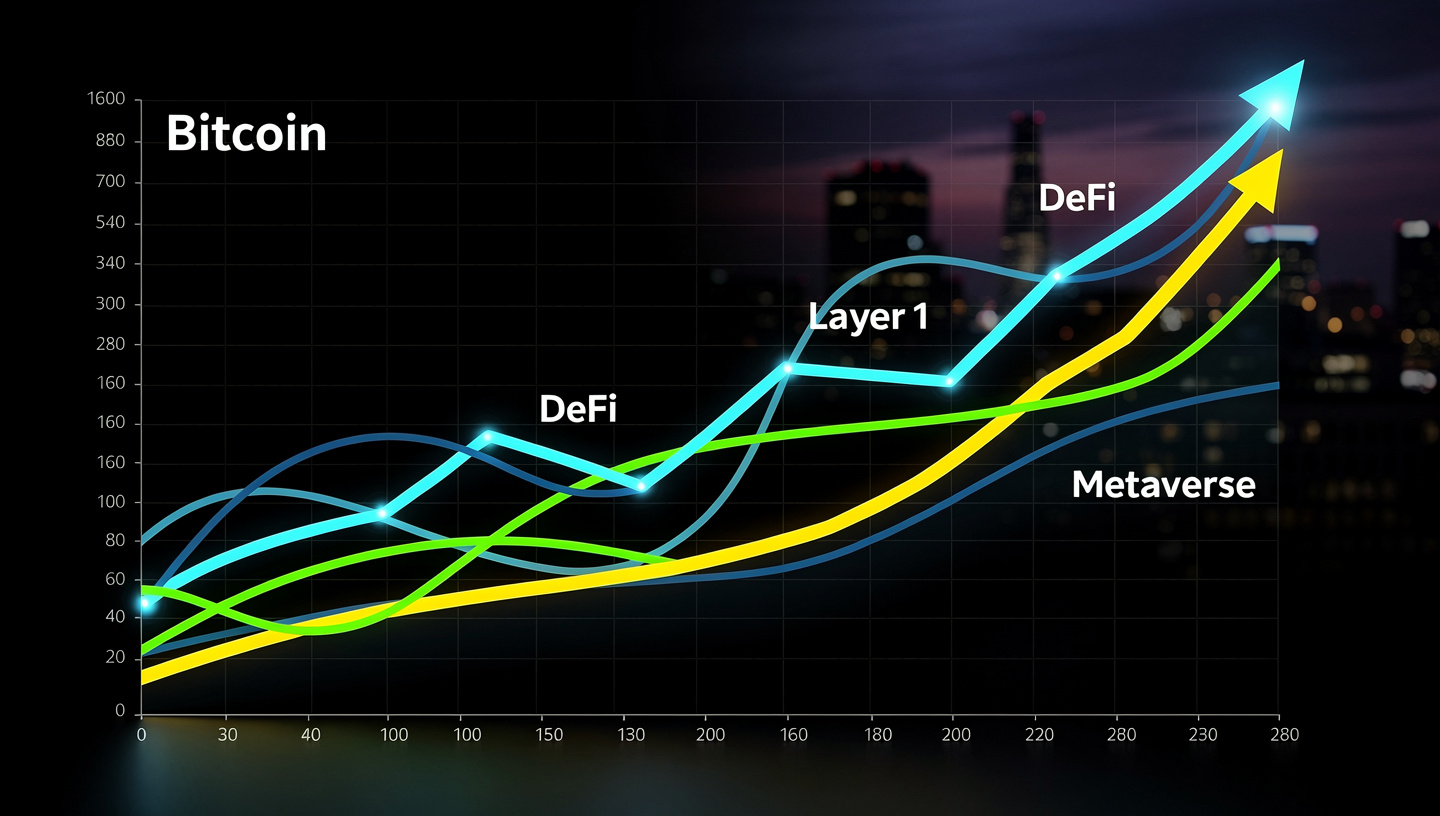
Before the headline asset reacts, before price charts light up with parabolic candles, something subtler happens beneath the surface. Liquidity shifts quietly. On-chain activity spikes in isolated pockets. Developers accelerate commits. Certain tokens start outperforming their peers—not loudly, not dramatically, but persistently. By the time most observers notice the broader move, the groundwork has already been laid.
Crypto is no exception to this pattern. In fact, it amplifies it.
Contrary to popular belief, market cycles in digital assets do not begin with Bitcoin. They resolve with Bitcoin. The ignition typically happens elsewhere—inside niche sectors, infrastructure layers, or speculative frontiers that absorb risk first. Understanding why this happens is one of the most underappreciated edges in crypto investing.
This article dissects that phenomenon in depth: the mechanics, the historical precedents, the sectoral leadership patterns, and the structural reasons certain crypto verticals consistently move before the benchmark asset.
Bitcoin Is the Thermometer, Not the Spark
Bitcoin is treated as crypto’s macro proxy. Institutions track it. Media reports on it. Retail measures portfolios against it. But Bitcoin behaves more like a thermometer than a matchstick.
It reflects market temperature—it rarely sets it.
Bitcoin’s role in the ecosystem has evolved into that of digital reserve asset: highly liquid, globally recognized, and increasingly financialized through ETFs, futures, and custody infrastructure. That makes it reactive to capital flows rather than predictive of them.
When risk appetite rises, capital rarely enters through Bitcoin first. It enters where upside is asymmetric.
And that is almost always somewhere else.
Capital Always Probes the Frontier
Markets search for inefficiencies. In crypto, those inefficiencies tend to exist at the edges:
- New narratives
- Emerging protocols
- Experimental primitives
- Underdeveloped liquidity pools
Early capital does not chase safety. It chases optionality.
This is why the first signs of a new cycle usually appear in:
- Layer-2 networks
- DeFi governance tokens
- NFT infrastructure
- AI-integrated blockchains
- Modular execution layers
- High-beta altcoins
These sectors offer leverage to future adoption. Bitcoin offers exposure to present legitimacy.
Different capital, different objectives.
The Risk Ladder: How Money Actually Enters Crypto
Crypto markets operate on a predictable capital progression:
- Speculative capital enters high-volatility sectors
- Early adopters rotate profits into mid-cap protocols
- Larger players allocate to major Layer-1s
- Only then does Bitcoin absorb significant inflows
- Finally, stablecoins and fiat ramps expand
This sequence has repeated across multiple cycles.
Why?
Because early participants are willing to absorb volatility in exchange for outsized returns. Bitcoin, with its trillion-dollar aspirations and mature liquidity, simply cannot provide the same convexity as emerging sectors.
By the time Bitcoin starts moving aggressively, most early movers are already rotating out.
Historical Proof: Sector Leadership Across Cycles
Let’s examine past market expansions.
2017: ICO Infrastructure Before Bitcoin
The 2017 cycle didn’t start with Bitcoin. It started with Ethereum-based token launches.
Ethereum became the backbone of the ICO explosion months before Bitcoin hit its peak. Gas fees surged. Developer activity skyrocketed. ERC-20 tokens multiplied rapidly.
Bitcoin followed—not led.
2020–2021: DeFi and NFTs Front-Run the Bull Market
In mid-2020, DeFi protocols began outperforming everything else. Yield farming took off. Decentralized exchanges gained volume. Governance tokens appreciated dramatically.
Platforms like Uniswap captured massive liquidity well before Bitcoin made its historic climb toward $69,000.
Then came NFTs.
Marketplaces such as OpenSea experienced explosive growth months before mainstream media rediscovered crypto.
Again: sector first, Bitcoin later.
2023–2024: High-Throughput Chains and Infrastructure Tokens
More recently, high-performance Layer-1s and oracle networks began showing strength while Bitcoin remained range-bound.
Solana rebounded aggressively, driven by meme coins, DeFi activity, and retail speculation.
Meanwhile, infrastructure providers like Chainlink rallied on enterprise integrations and real-world asset narratives.
Bitcoin followed once confidence returned system-wide.
Why This Pattern Exists (Structural, Not Psychological)
This is not coincidence. It is structural.
1. Bitcoin Has the Highest Market Efficiency
Bitcoin trades on every major exchange, in every jurisdiction, with deep derivatives markets and institutional custody.
That efficiency compresses alpha.
Smaller sectors are inefficient by design. They lack analyst coverage, have fragmented liquidity, and are driven by rapidly evolving narratives. This creates opportunity.
Early capital always seeks inefficiency.
2. Alt Sectors Are Narrative-Driven
Bitcoin’s narrative is stable: digital gold, monetary hedge, store of value.
Emerging sectors reinvent themselves constantly:
- DeFi promises permissionless finance
- NFTs promise digital ownership
- Layer-2s promise scalability
- AI tokens promise autonomous systems
Narratives create momentum long before fundamentals mature.
Markets price stories before they price cash flows.
3. Builders Lead Before Investors
Developer activity precedes price action.
New SDKs, protocol upgrades, and tooling improvements tend to appear first in non-Bitcoin ecosystems. Bitcoin’s development cadence is intentionally conservative.
Innovation happens elsewhere.
Capital follows builders.
4. Retail Enters Through Novelty
Retail traders rarely begin with Bitcoin. They begin with whatever is trending on social media or exchanges.
Centralized platforms such as Coinbase consistently report higher retail engagement during altcoin rotations than during Bitcoin accumulation phases.
Retail behavior accelerates sectoral moves.
Sector Rotation: Crypto’s Hidden Market Engine
Crypto does not move as a single asset class. It rotates internally.
Typical progression:
- Infrastructure tokens rally
- DeFi follows
- NFTs and gaming spike
- Meme coins explode
- Profits rotate into Layer-1s
- Finally, Bitcoin absorbs the surplus
This rotation is continuous, not sequential. But leadership always emerges outside Bitcoin first.
Understanding rotation allows investors to anticipate macro shifts instead of reacting to them.
On-Chain Signals That Precede Bitcoin Moves
Advanced participants monitor indicators that rarely make headlines:
- Rising stablecoin inflows to decentralized exchanges
- Increased bridge volume between chains
- Spikes in new wallet creation on emerging networks
- Protocol TVL growth in niche verticals
- Developer commit velocity on GitHub
These metrics tend to inflect weeks before Bitcoin responds.
By the time Bitcoin candles appear, the underlying capital migration is already complete.
The Role of Derivatives and ETFs
Bitcoin’s financialization has changed its behavior.
Spot ETFs, perpetual futures, and options markets introduce hedging strategies that dampen volatility. Institutions increasingly express directional views through derivatives rather than spot buying.
This makes Bitcoin slower to reflect risk-on sentiment.
Alt sectors, with fewer hedging instruments, respond immediately.
Why This Matters for Investors
If you wait for Bitcoin to move before positioning, you are late.
Bitcoin confirms trends. It does not initiate them.
Serious crypto participants treat Bitcoin as validation, not as an entry signal.
They track:
- Sector relative strength
- Narrative velocity
- On-chain capital flow
- Developer ecosystem growth
- Liquidity migration
These are the leading indicators.
Bitcoin is the lagging one.
Common Misconceptions
“Altcoins just follow Bitcoin.”
False. Altcoins frequently lead Bitcoin during early cycle phases.
“Bitcoin dominance tells the whole story.”
Dominance metrics are backward-looking. Sector leadership is forward-looking.
“Retail drives everything.”
Retail amplifies trends. It does not originate them.
The Meta-Pattern: Crypto Evolves Through Its Edges
Every technological ecosystem evolves from its periphery inward.
The internet grew through forums and open-source communities before corporations adopted it.
Mobile computing advanced through apps before operating systems matured.
Crypto expands through experimental sectors before consolidating into Bitcoin.
This is not chaos. It is how innovation propagates.
Looking Forward: What to Watch Next
Future cycles will follow the same architecture:
- New primitives will emerge
- Early adopters will concentrate capital
- Niche sectors will outperform
- Bitcoin will eventually validate the move
The specific sectors will change. The pattern will not.
Whether it’s real-world asset tokenization, decentralized identity, AI coordination networks, or modular blockchains, leadership will originate away from Bitcoin.
Always.
Final Thoughts
Bitcoin is crypto’s anchor. It is not its engine.
The engine lives in the margins—where risk is tolerated, narratives are born, and infrastructure is still malleable.
Understanding why some crypto sectors move before Bitcoin is not about chasing hype. It is about recognizing how capital behaves in emerging systems.
Markets do not announce their intentions.
They whisper first.