Capital does not simply “enter crypto” or “exit crypto.” It circulates. It compresses. It diffuses. It migrates across narratives, architectures, and risk profiles with a logic that only becomes obvious in hindsight.
Every cycle leaves residue—on-chain data, liquidity scars, forgotten wallets, half-built protocols, and abandoned Discord servers. Capital remembers where it last found velocity. It remembers where it was trapped. And when conditions change, it doesn’t return randomly. It flows along paths carved by previous speculation.
Understanding crypto is not about predicting price.
It is about understanding rotation.
Rotation is the hidden engine of every bull market and every drawdown. It explains why layer-1s run after Bitcoin. Why DeFi wakes up after infrastructure pumps. Why NFTs explode when traders are bored. Why memecoins appear at the end of cycles like foam on a wave.
This article dissects that engine.
Not as folklore. Not as Twitter heuristics.
As a structured system.
1. What “Capital Rotation” Actually Means in Crypto
In traditional finance, sector rotation refers to institutional capital reallocating between industries—technology, energy, consumer goods—based on macroeconomic expectations.
Crypto rotation is similar in concept but radically different in mechanics.
There are no earnings reports. No balance sheets. No dividend yields.
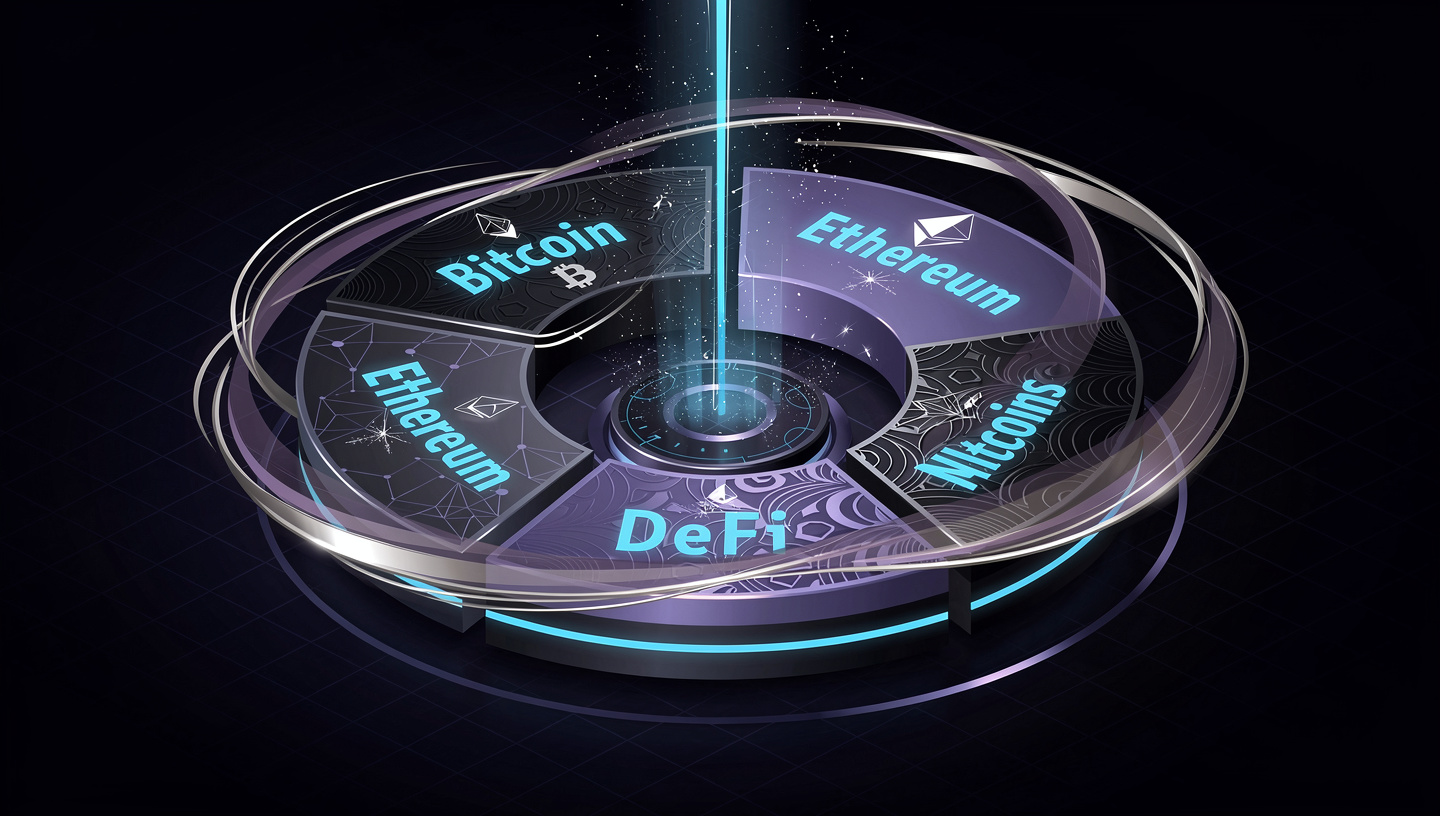
Instead, capital rotates across:
- Base assets (Bitcoin, Ethereum)
- Layer-1 blockchains
- Layer-2 scaling networks
- DeFi protocols
- NFT ecosystems
- Infrastructure tokens
- Narrative-driven verticals (AI, gaming, RWAs)
- High-volatility speculation (memecoins)
The drivers are not cash flow. They are:
- Liquidity depth
- Narrative momentum
- Developer activity
- On-chain velocity
- Retail attention
- Relative performance
Crypto capital behaves like reflexive liquidity. Price creates narrative. Narrative attracts liquidity. Liquidity amplifies price.
Rotation emerges from that feedback loop.
2. The Primary Liquidity Stack: Where Cycles Begin
Every crypto expansion starts with a narrow concentration of capital.
Historically, that entry point is Bitcoin.
Bitcoin functions as crypto’s monetary base. It absorbs the first wave of risk capital because:
- It has the deepest liquidity.
- It is easiest to custody.
- It is the most institutionally legible.
- It carries the strongest macro narrative.
When Bitcoin begins trending upward, it does not immediately distribute capital to the rest of the ecosystem. Instead, it absorbs liquidity first.
This phase is dominated by:
- Spot accumulation
- ETF inflows
- Long-term holder reactivation
- Derivatives positioning
Volatility remains compressed elsewhere.
Altcoins are ignored.
This is intentional.
Capital seeks safety before it seeks yield.
3. From Store of Value to Programmable Capital
Once Bitcoin establishes directional confidence, capital begins searching for beta.
That beta historically resides in Ethereum.
Ethereum is not just another asset. It is the settlement layer for most of crypto’s economic activity:
- DeFi
- NFTs
- Stablecoins
- Layer-2 networks
Rotation into Ethereum reflects a shift from passive exposure to productive capital.
This is where the cycle structurally changes.
Ethereum introduces:
- Smart contract composability
- Yield primitives
- Tokenized liquidity
At this stage, investors begin reallocating from Bitcoin into ETH to capture higher volatility and ecosystem leverage.
This is not retail behavior.
This is sophisticated capital front-running downstream narratives.
4. Layer-1 Expansion: The Infrastructure Trade
After Ethereum rallies, capital looks for asymmetric alternatives.
This is where layer-1 ecosystems enter the rotation.
Platforms like Solana attract capital for one primary reason: they offer cheaper optionality.
Layer-1 rotations follow a familiar logic:
- Ethereum becomes expensive.
- Users complain about fees.
- Developers migrate experiments.
- Liquidity follows activity.
- Narratives emerge (“faster,” “cheaper,” “more scalable”).
This phase is marked by:
- Explosive TVL growth
- New DEX launches
- Ecosystem grants
- Airdrop speculation
- Venture capital deployment
The market is no longer betting on crypto as an asset class.
It is betting on platform dominance.
5. DeFi: When Capital Learns to Work
Once infrastructure gains traction, capital seeks yield.
This is the DeFi rotation.
Protocols like Uniswap, Aave, and MakerDAO become focal points.
This phase introduces:
- Liquidity mining
- Leveraged yield strategies
- Recursive lending loops
- Governance token speculation
DeFi is where capital stops merely appreciating and starts compounding.
Rotation here is driven by:
- APY differentials
- Incentive programs
- Protocol revenue narratives
- On-chain analytics dashboards
It is also where systemic risk accumulates.
Leverage increases.
Correlation tightens.
Failures propagate faster.
DeFi is crypto’s financial nervous system—and its fragility amplifier.
6. NFTs and Cultural Liquidity
After yield saturation, capital gets bored.
That boredom expresses itself culturally.
NFT ecosystems emerge as speculative pressure valves. Marketplaces like OpenSea become liquidity hubs not because NFTs produce income—but because they create socialized speculation.
NFT rotations are driven by:
- Identity signaling
- Community narratives
- Artificial scarcity
- Influencer amplification
This is capital seeking meaning as much as return.
Historically, NFT booms coincide with late-stage optimism, when traders begin pricing culture instead of fundamentals.
7. Layer-2s and Scaling: Efficiency Trades
As Ethereum congestion returns, rotation shifts toward scaling solutions like Arbitrum and Optimism.
Layer-2 rotations are efficiency-driven.
They represent:
- Cheaper transactions
- Faster settlement
- Airdrop expectations
- Infrastructure maturity
Capital rotates here not for narrative hype—but for operational advantage.
These networks become liquidity routers for the next generation of applications.
8. Exchanges as Capital Distribution Engines
Centralized platforms like Binance and Coinbase act as macro-level capital valves.
They determine:
- Which assets gain retail access
- Where liquidity pools deepen
- Which narratives reach mass exposure
Listings are not cosmetic.
They are liquidity events.
Rotation accelerates once assets appear on high-volume venues, creating reflexive feedback loops between price and attention.
9. The Endgame: High Beta and Terminal Speculation
Every cycle ends the same way.
Capital migrates into:
- Low-liquidity tokens
- Narrative experiments
- Meme assets
- Microcaps with no product
This is not stupidity.
It is mathematical exhaustion.
When all rational opportunities are priced in, traders pursue convexity.
This terminal phase is characterized by:
- Vertical charts
- Rapid narrative turnover
- Extreme leverage
- Retail dominance
- Social media saturation
It feels euphoric.
It is structurally fragile.
This is where rotations stop being strategic and become emotional.
10. On-Chain Signals That Reveal Rotation in Real Time
Advanced participants track rotation through:
- Stablecoin inflows/outflows
- DEX volume migration
- Bridge activity between chains
- TVL distribution changes
- Perpetual funding rates
- Wallet cohort behavior
Rotation is visible on-chain long before it appears on price charts.
Capital always moves quietly first.
11. Why Most Investors Miss Rotation
Most participants focus on individual tokens.
Rotation operates at the sector level.
By the time retail discovers a narrative, capital has already begun exiting it.
This is why:
- People buy layer-1s after they peak.
- People discover DeFi after yields collapse.
- People enter NFTs at cultural saturation.
- People chase memecoins at distribution.
They see performance, not flow.
Rotation is invisible unless you zoom out.
12. Strategic Implications for Long-Term Participants
Understanding rotation changes behavior:
- You stop chasing green candles.
- You start watching liquidity shifts.
- You think in sectors, not assets.
- You anticipate narratives instead of reacting to them.
This does not guarantee profit.
It reduces structural blindness.
Crypto is not a collection of tokens.
It is a rotating liquidity machine.
Conclusion: Crypto Is a Circulatory System
Capital does not randomly wander through crypto.
It moves in sequences.
From safety to risk.
From infrastructure to applications.
From productivity to culture.
From logic to emotion.
Every cycle follows this architecture with minor variations.
Those who understand rotation operate upstream.
Everyone else trades the leftovers.
Crypto rewards awareness of flow more than conviction in any single asset.
If you want to understand where markets are going, stop asking which token will pump.
Start asking where capital is leaving—and where it is quietly arriving next.
That is where the real signal lives.