At some point, every technological system reaches a moment where raw ambition collides with physical limits.
Not in a dramatic crash. Not in a headline-grabbing failure. It happens quietly—through queues, delays, workarounds, and rising costs. Engineers call it congestion. Economists call it inefficiency. Users simply feel friction.
Crypto has arrived at that moment.
The original vision of blockchains promised open, permissionless global finance. What it delivered—brilliantly, but imperfectly—was a base layer that secured trillions in value while struggling to serve hundreds of millions of people. This tension between security and scale is not temporary. It is structural.
And that’s why Layer 2s are no longer an optimization.
They are becoming the operating system of the entire crypto economy.
The Scalability Wall Nobody Could Ignore
Public blockchains were never designed to be fast. They were designed to be trustworthy.
Take Ethereum. Every transaction is validated by thousands of nodes worldwide. That redundancy is what gives Ethereum its censorship resistance and security. It’s also what caps throughput and drives fees higher when demand spikes.
This is not a bug. It is the core tradeoff of decentralized systems.
You can visualize it as a triangle: security, decentralization, scalability. Improve one, and you usually sacrifice another.
For years, the industry tried to “solve” this at Layer 1. Bigger blocks. Faster consensus. New chains with different architectures. Some made progress. Many compromised decentralization. A few gained traction.
But a deeper realization emerged: base layers should remain conservative. They should be slow, expensive, and extremely hard to corrupt.
Scaling should happen elsewhere.
That “elsewhere” is Layer 2.
What a Layer 2 Actually Is (Without the Marketing)
Strip away the buzzwords and venture capital slides.
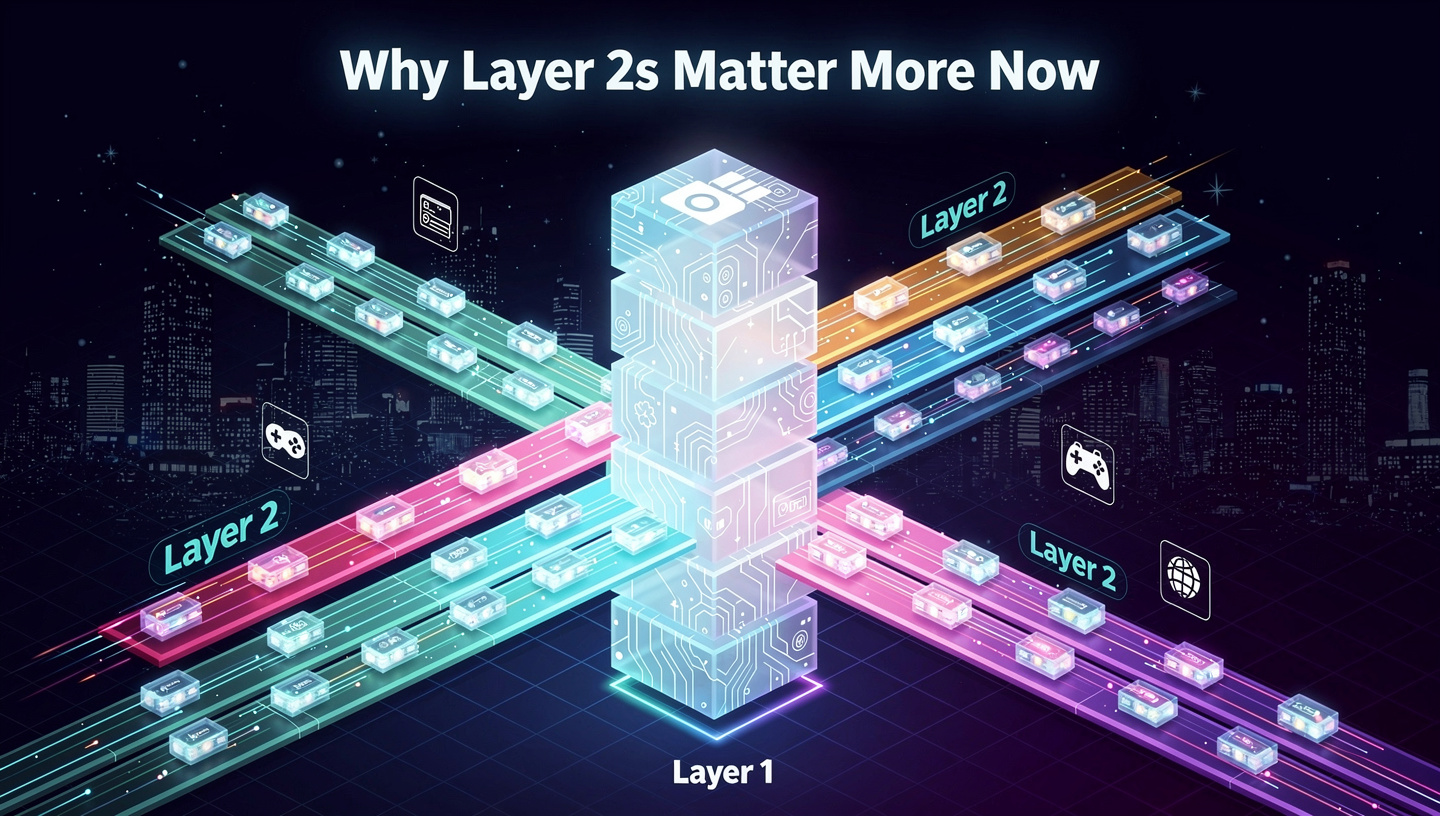
A Layer 2 is a system that processes transactions off the main blockchain, then periodically posts compressed proofs back to Layer 1 for final settlement.
In practical terms:
- Users transact on the Layer 2.
- Thousands of transactions are bundled together.
- A cryptographic summary is submitted to the base chain.
- Ethereum (or another Layer 1) acts as the ultimate judge.
The result is dramatic efficiency.
Instead of paying for every individual transaction on Ethereum, users share the cost of one aggregated proof. Fees drop by orders of magnitude. Throughput increases massively. Security is inherited from the base chain.
This is not sidechain scaling. This is cryptographic scaling.
Two major approaches dominate today:
Optimistic Rollups
These assume transactions are valid by default, allowing anyone to challenge fraud during a fixed window.
Examples include Arbitrum and Optimism.
Zero-Knowledge Rollups
These use mathematical proofs to verify correctness instantly, without requiring challenge periods.
Leading implementations include zkSync and StarkNet.
Different tradeoffs. Same destination.
A modular blockchain stack where Layer 1 secures value, and Layer 2 handles activity.
From Scaling Tool to Economic Substrate
Early Layer 2s were framed as cost reducers.
That framing is already obsolete.
Layer 2s are becoming sovereign execution environments—complete ecosystems with their own liquidity, applications, governance models, and developer communities.
Consider what’s happening:
- Entire DeFi stacks now live primarily on rollups.
- NFT marketplaces launch directly on Layer 2.
- Gaming studios build on Layer 2 by default.
- Consumer apps avoid Layer 1 entirely.
Even major companies are embracing this architecture. Coinbase launched Base as its own Layer 2 network, signaling that onboarding the next hundred million users will not happen on Ethereum mainnet.
It will happen on rollups.
This is a subtle shift with massive implications.
Layer 2s are no longer satellites orbiting Ethereum.
They are cities connected by a shared legal system.
The Rise of the Modular Blockchain Thesis
Crypto is quietly transitioning from monolithic chains to modular architectures.
Instead of one blockchain doing everything—execution, settlement, data availability, consensus—each layer specializes.
- Layer 1: settlement and security
- Layer 2: execution
- Specialized networks: data availability
- Bridges and messaging: interoperability
This mirrors how modern computing evolved. CPUs didn’t try to handle storage, networking, and graphics alone. They delegated.
Blockchains are doing the same.
Layer 2s sit at the center of this modular stack. They are where users interact. Where developers deploy. Where applications compete.
Ethereum becomes the global court system.
Layer 2s become the global economy.
Fees Are Only the Beginning
Lower transaction costs are the obvious benefit.
But the deeper impact lies elsewhere.
1. Programmable User Experiences
On Layer 1, every action is expensive. Wallet prompts feel heavy. Simple interactions cost real money.
Layer 2 changes that.
Developers can abstract gas. Batch transactions. Create Web2-like onboarding. Subsidize fees. Implement account abstraction.
This is how crypto finally becomes usable for normal people.
2. High-Frequency Onchain Activity
Markets that were impossible on Layer 1 suddenly become viable:
- Onchain order books
- Real-time games
- Micropayments
- Machine-to-machine transactions
These require sub-cent fees and instant confirmations.
Layer 2 provides both.
3. New Financial Primitives
When transactions are cheap and fast, entirely new behaviors emerge:
- Automated portfolio rebalancing
- Streaming payments
- Onchain subscriptions
- Per-second yield distribution
This is not incremental improvement. It’s a different design space.
The Liquidity Gravity Effect
Money flows to where activity lives.
As Layer 2 usage grows, liquidity follows. Stablecoins migrate. Bridges deepen. Market makers deploy capital. DAOs hold treasuries on rollups.
Once that flywheel starts, it compounds.
We’re already seeing this dynamic on networks like Polygon, where enterprise partnerships, gaming projects, and consumer apps coexist alongside DeFi infrastructure.
Liquidity concentration creates better markets. Better markets attract more builders. More builders attract more users.
Layer 2s are entering that phase now.
ZK Technology Changes Everything
Zero-knowledge proofs deserve special attention.
They don’t just scale blockchains. They redefine trust.
ZK systems allow one party to prove something is true without revealing how. Applied to rollups, this means transactions can be validated cryptographically, instantly, without waiting for fraud challenges.
But that’s only the surface.
ZK enables:
- Private transactions
- Verifiable offchain computation
- Identity systems without data exposure
- Compliance without surveillance
This is why ZK rollups are attracting intense research investment. They are not merely faster blockchains. They are cryptographic infrastructure for the internet.
The long-term convergence of privacy, scale, and composability will run through ZK.
Ethereum’s Founder Saw This Coming
Years before rollups gained mainstream attention, Vitalik Buterin argued that Ethereum should scale primarily through Layer 2.
His reasoning was simple:
Base layers must remain maximally decentralized.
Everything else can be optimized elsewhere.
That philosophy now guides Ethereum’s roadmap. Instead of increasing Layer 1 throughput aggressively, the network focuses on becoming the best settlement layer possible while empowering rollups to handle execution.
It’s a conservative approach.
It’s also why Ethereum continues to dominate developer mindshare.
Why This Matters for Investors
Layer 2s reshape the investment landscape.
Not in obvious ways like “buy token X.”
In structural ways.
Infrastructure Capture
Value increasingly accrues to networks that host activity, not just those that secure it.
Rollups with strong ecosystems can capture fees, MEV, governance influence, and developer loyalty.
Application Differentiation
Apps built on Layer 2 can outcompete Layer 1 counterparts on cost, speed, and UX. This creates asymmetric advantages.
New Risk Models
Security assumptions change. Bridge designs matter. Sequencer decentralization becomes critical.
Understanding Layer 2 architecture is now part of basic crypto due diligence.
Ignoring it is equivalent to ignoring cloud computing in 2010.
Interoperability Is the Next Battlefield
As Layer 2s multiply, fragmentation becomes a risk.
Users don’t want ten wallets and twenty bridges.
The industry is responding with:
- Shared liquidity layers
- Native cross-rollup messaging
- Unified standards for account abstraction
The goal is seamless movement across rollups, with Ethereum acting as the settlement anchor.
When that matures, the distinction between individual Layer 2s will blur. Users will simply “use crypto,” unaware of which rollup processes their transactions.
That abstraction layer is already under construction.
The Endgame: Invisible Infrastructure
The most important technologies eventually disappear from view.
TCP/IP. DNS. SSL.
Layer 2s are heading the same way.
Five years from now, most users will not know what a rollup is. They will just experience fast, cheap, global applications that happen to settle on Ethereum.
Developers will deploy where tooling is best.
Liquidity will concentrate where markets are deepest.
And Layer 1 will quietly do its job in the background: finality, security, neutrality.
Final Thoughts
Layer 2s are not a temporary scaling patch.
They are the architectural pivot that allows crypto to grow without sacrificing its core principles.
They transform blockchains from slow, expensive ledgers into programmable global infrastructure.
They enable applications that were previously impossible.
They redefine where value is created and captured.
Most importantly, they mark crypto’s transition from experimental technology to usable system.
The future won’t be built on Layer 1 alone.
It will be built on layers—stacked, modular, interoperable—and anchored by trust-minimized settlement.
Layer 2s sit at the center of that future.
And they are about to matter far more than most people realize.