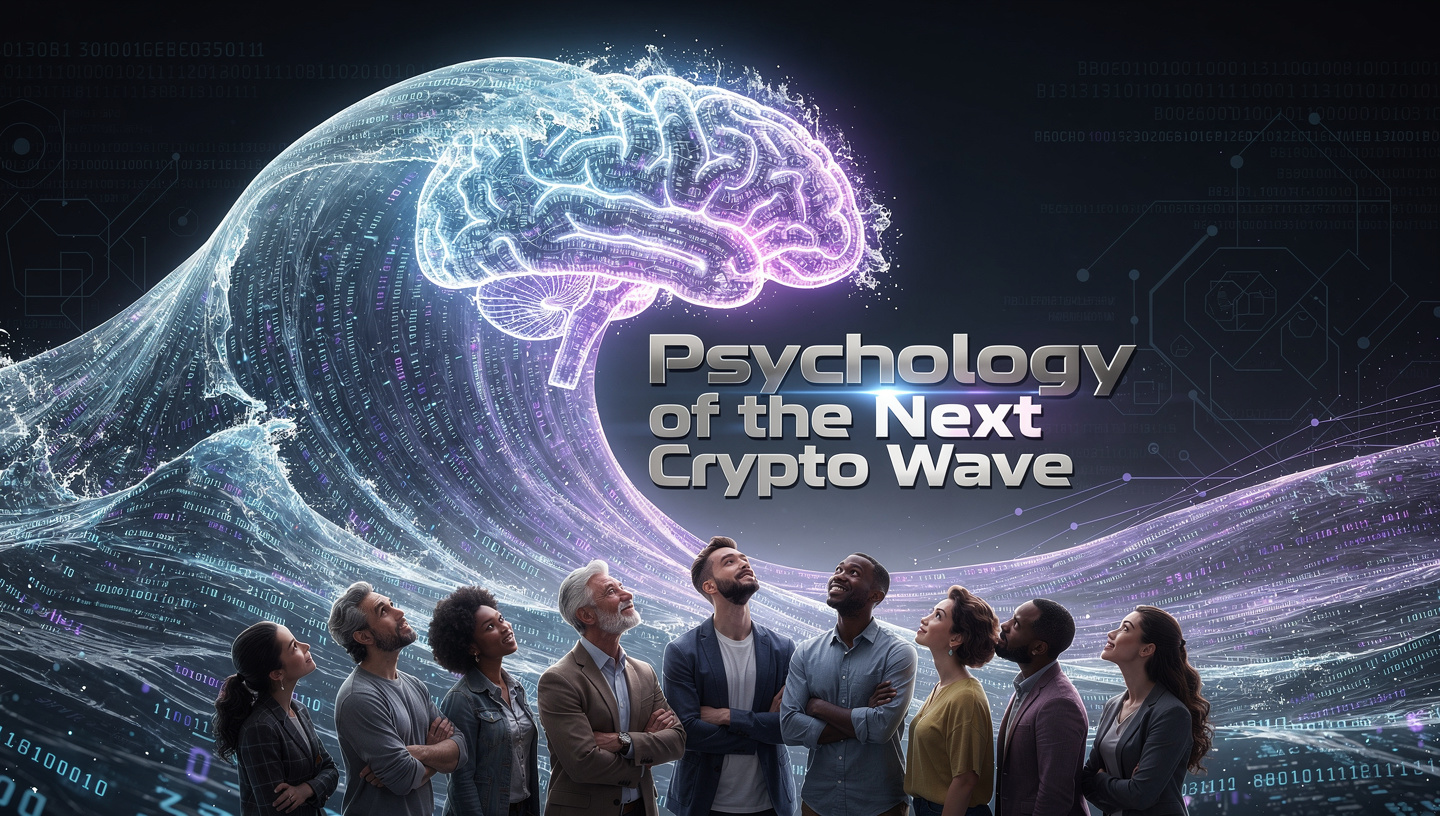
The next crypto wave will not begin with a chart breakout.
It will begin quietly—inside millions of individual minds.
Not in trading terminals or on-chain dashboards, but in the invisible space where expectation forms before action. In the pause between reading a headline and clicking “buy.” In the subtle shift from skepticism to curiosity. In the moment when disbelief gives way to narrative.
Markets don’t move first. People do.
Every major crypto cycle in history has followed the same hidden sequence: perception changes, attention migrates, conviction consolidates, and only then does capital flood in. Price is merely the exhaust.
What’s coming next will be no different.
But the psychology behind it is evolving.
This article dissects that evolution—how investor behavior is changing, how collective belief now forms in fragmented digital environments, why emotional cycles are compressing, and how the next wave will be driven less by technological novelty and more by psychological architecture.
This is not a price prediction.
It is a behavioral map.
Markets Are Made of Stories, Not Assets
Crypto is often framed as a technological revolution. Blockchain. Decentralization. Smart contracts.
Those matter—but they are not what move markets.
Markets move when stories gain emotional traction.
Consider Second Life. Technologically impressive. Culturally irrelevant to finance.
Now consider Axie Infinity. Far less sophisticated in raw engineering terms—yet it generated billions in volume because it carried a story: play-to-earn, economic mobility, digital ownership.
Crypto waves emerge when narratives align with latent psychological needs.
In early cycles, the dominant story was rebellion: financial sovereignty, censorship resistance, escape from banks. That story powered the rise of Bitcoin and was anchored by the mystique of Satoshi Nakamoto.
Later came utility narratives: smart contracts, decentralized finance, programmable money—embodied by Ethereum.
Then came speculation narratives: NFTs, metaverse land, meme coins.
Each wave rode a different emotional vector.
The next wave will be driven by something subtler.
Not rebellion.
Not novelty.
Not even yield.
It will be driven by identity.
From Financial Instrument to Psychological Extension
Crypto is transitioning from being perceived as an asset class to being experienced as a personal expression system.
This matters.
Traditional finance treats money as external. Crypto collapses that distance.
Wallets are personal. On-chain history is public. Communities are tribal. Tokens signal belonging. PFPs act as status markers. Governance votes feel participatory. Even losses are shared socially.
The market is no longer just a place to allocate capital.
It is a place to construct identity.
That shift changes everything.
In psychology, this is called self-concept integration: when an external object becomes part of how someone defines themselves. Once this happens, rational evaluation declines and emotional attachment increases.
This is why people defend their coins like sports teams.
Why criticism feels personal.
Why narratives override data.
The next crypto wave will exploit this dynamic far more intentionally.
Projects will not market features.
They will market who you become by holding them.
The Compression of Emotional Cycles
In traditional markets, sentiment cycles unfold slowly.
Crypto has compressed them to absurd speed.
Fear, greed, disbelief, euphoria—entire emotional arcs now occur in weeks instead of years. This is the result of three forces:
- Always-on social platforms
- Real-time price visibility
- Gamified trading interfaces
Apps like Binance and Coinbase didn’t just lower friction—they turned investing into a dopamine loop.
Push notifications replaced opening bells.
Leaderboards replaced fund statements.
Candlestick charts replaced patience.
The result is a generation of investors conditioned for rapid emotional turnover.
This creates a paradox:
- People feel more intensely
- But for shorter durations
Conviction windows are shrinking.
Future crypto waves will be sharper, faster, and more violent—not because fundamentals are weaker, but because attention spans are.
Narrative Liquidity Is the New Market Liquidity
In previous cycles, liquidity meant capital availability.
Today, narrative liquidity matters just as much.
Narrative liquidity is the ease with which an idea spreads.
A token with mediocre tech but high meme velocity can outperform a superior protocol simply because it travels faster through social networks.
This is why meme assets routinely outperform during speculative phases. They are emotionally efficient.
They require no explanation.
They compress complexity into symbols.
They spread horizontally across platforms like X, TikTok, and Discord in minutes.
The next wave will be defined by projects that understand narrative engineering:
- Simple metaphors
- Strong visual identity
- Clear villains and heroes
- Shareable belief systems
Whitepapers will matter less than memes.
Roadmaps less than vibes.
This is uncomfortable for analysts.
But psychologically inevitable.
Retail Is Not Dumb. Retail Is Emotional.
Institutional investors often dismiss retail behavior as irrational.
That is lazy analysis.
Retail investors operate under different constraints:
- Smaller capital
- Higher risk tolerance
- Stronger social influence
- Greater emotional exposure
They are not less intelligent.
They are more psychologically leveraged.
Retail doesn’t chase returns.
Retail chases meaning, momentum, and community.
When retail flows in, it is not because they discovered valuation models. It is because a narrative crossed a psychological threshold.
Understanding that threshold is key to anticipating the next wave.
That threshold is reached when three conditions converge:
- Accessibility – Entry feels easy
- Legitimacy – Participation feels socially acceptable
- Imagination – Upside feels personally transformative
When those align, capital follows automatically.
The Institutional Halo Effect
Institutions don’t drive crypto bull markets.
They legitimize them.
When firms like BlackRock or Fidelity make moves in crypto, they don’t create demand directly.
They reduce psychological resistance.
They tell cautious participants that it’s safe to pay attention.
This produces what behavioral economists call the halo effect: credibility transfers from institution to asset class.
Retail doesn’t follow institutions.
Retail follows the permission institutions provide.
The next wave will see this effect amplified as crypto becomes embedded in retirement platforms, payment rails, and mainstream fintech.
Not explosive adoption.
Quiet normalization.
Which is far more powerful.
Why the Next Wave Will Feel Different
Previous cycles were driven by discovery.
The next cycle will be driven by re-entry.
Millions of participants already experienced crypto once.
They lost money.
They learned lessons.
They developed scar tissue.
This changes market psychology dramatically.
First-time optimism will be replaced by cautious opportunism.
People will scale in slowly.
They will rotate faster.
They will take profits earlier.
This creates structurally different price action:
- Shorter parabolic moves
- Faster corrections
- More sector rotation
- Less blind holding
The myth of “diamond hands” is fading.
The psychology of capital preservation is replacing the psychology of maximal risk.
That doesn’t weaken the next wave.
It professionalizes it.
Attention Is the Scarce Asset
Crypto narratives used to compete with each other.
Now they compete with everything.
Streaming platforms. AI content. Short-form video. Gaming.
Investor attention is fragmented across dozens of stimuli.
This means future winners will not be the most innovative.
They will be the most mentally sticky.
Projects that understand:
- Cognitive load
- Visual priming
- Social proof loops
- Reward anticipation
The next generation of crypto products will look less like financial protocols and more like consumer apps.
They will optimize for habit formation.
That is where value will accrue.
The Rise of Psychological Alpha
Technical analysis provides signals.
On-chain data provides context.
But psychological alpha—the ability to read sentiment before it becomes visible—is emerging as the dominant edge.
This involves tracking:
- Language shifts on social platforms
- Meme velocity
- Search trends
- Community tone changes
- Influencer narrative pivots
Price reacts after psychology changes.
Always.
Those who understand this will front-run markets not with leverage, but with awareness.
Final Thoughts: The Market Inside the Market
The next crypto wave will not be announced.
There will be no clear starting gun.
It will begin when enough people quietly decide that crypto is worth thinking about again.
Not buying.
Thinking.
That moment—when attention returns—is the true genesis of every bull cycle.
Technology will matter. Regulation will matter. Macro conditions will matter.
But none of them move first.
Belief does.
And belief is psychological.
If you want to understand where crypto is going, stop staring at charts.
Start observing people.
That is where the next wave is already forming.