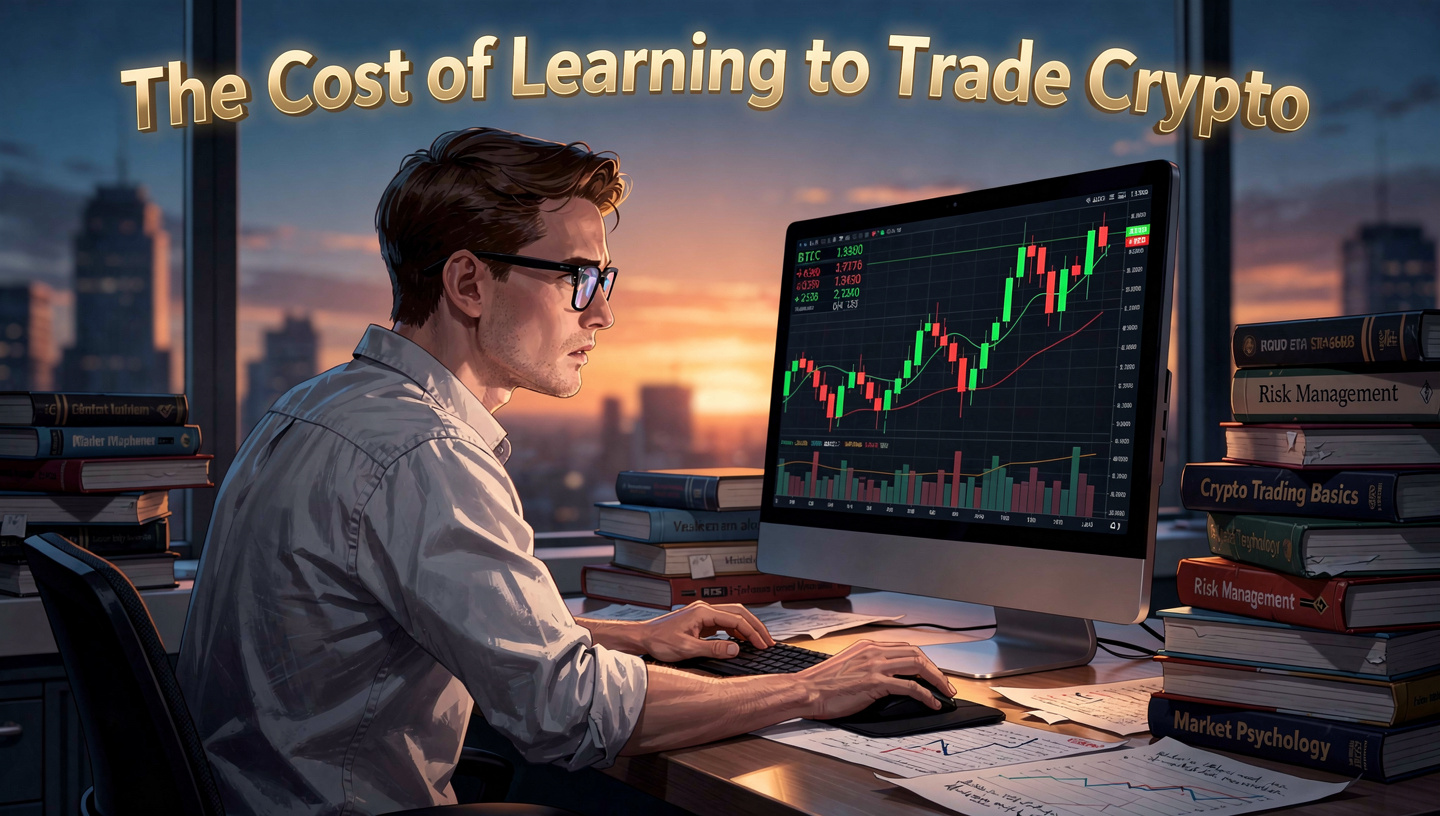
You don’t learn crypto trading the way you learn algebra.
There is no clean syllabus. No professor circles your mistakes in red. No exam tells you exactly where your logic broke.
Instead, the market invoices you directly.
Every hesitation has a price. Every impulsive click leaves a receipt. Every untested idea compounds interest in the form of drawdowns, stress, and opportunity cost. The tuition is paid in real time, with real capital, under real emotional pressure.
That is the defining feature of this industry: feedback is instant, brutal, and unforgiving.
People like Elon Musk are often cited in crypto conversations for their bold thinking and appetite for asymmetric bets. But what rarely gets discussed is the invisible infrastructure beneath success: years of iteration, failed experiments, and disciplined learning loops. Crypto trading is no different—except here, the mistakes are public on-chain, and the losses hit your wallet immediately.
This article is not motivational. It is technical, practical, and grounded in how traders actually evolve. If you want to understand what it truly costs to learn crypto trading—and how to pay that cost intelligently—read on.
1. The First Bill: Financial Losses (Your Real Tuition)
Every trader pays their initial tuition in losses.
It usually starts small:
- A poorly timed long.
- A breakout that immediately reverses.
- A “sure thing” that bleeds for days.
Then it escalates.
Most beginners underestimate volatility, overestimate their edge, and size positions emotionally. They encounter assets like Bitcoin and Ethereum thinking they behave like stocks.
They do not.
Crypto trades 24/7, has thinner liquidity in many pairs, and reacts violently to sentiment shifts. A 5–10% move is routine. A 20% candle is not unusual. Leverage amplifies everything.
Your early losses are not anomalies. They are the curriculum.
Typical financial mistakes during the learning phase:
- Trading without predefined risk.
- Averaging down on losers.
- Overleveraging because the margin allows it.
- Confusing random wins with skill.
- Holding losers “until it comes back.”
These errors cost money. But more importantly, they expose structural weaknesses in your process.
If you treat early losses as punishment, you quit.
If you treat them as data, you evolve.
Professional traders don’t eliminate losses. They minimize their informational cost.
2. The Hidden Expense: Time (The Asset You Can’t Replenish)
Money can be earned back.
Time cannot.
Most people dramatically underestimate how long it takes to become consistently profitable. They imagine months. In reality, for most serious traders, competence emerges over years.
Not because crypto is mystical—but because trading demands mastery of multiple disciplines simultaneously:
- Market structure
- Probability
- Risk management
- Behavioral psychology
- Statistical thinking
- Execution discipline
You must study charts. Review trades. Journal emotions. Backtest strategies. Forward-test in live conditions. Analyze drawdowns. Refine entries. Optimize exits.
This is thousands of hours of focused effort.
And unlike traditional careers, there is no salary while you learn.
You are paying with:
- Evenings
- Weekends
- Mental bandwidth
- Opportunity cost from other pursuits
Many traders fail not because they lack intelligence—but because they are unwilling to invest sustained time without immediate validation.
Crypto rewards persistence, not impatience.
3. Emotional Capital: The Psychological Toll
This is the cost nobody budgets for.
Trading exposes your cognitive biases with surgical precision.
You will meet yourself under pressure:
- Fear during drawdowns.
- Greed after wins.
- Revenge after losses.
- Paralysis during uncertainty.
Every unresolved psychological pattern gets amplified.
Common emotional expenses include:
- Sleep disruption from overnight positions.
- Anxiety from open risk.
- Overtrading after a loss.
- Euphoria after a lucky win.
- Self-doubt during stagnation periods.
Markets don’t care how you feel. But your decisions are deeply affected by how you feel.
This is why many technically capable traders fail. They cannot maintain behavioral consistency.
Professional trading is not about prediction. It is about emotional regulation in probabilistic environments.
Until you learn to execute your plan regardless of outcome, profitability remains unstable.
4. Education Isn’t Free (Even When Content Is)
You can find endless free material online.
Most of it is noise.
High-quality learning requires:
- Books on market psychology and probability
- Data subscriptions
- Charting platforms
- Backtesting software
- Communities or mentorship (if chosen carefully)
Then there’s platform infrastructure.
Whether you trade on Binance or Coinbase, you pay:
- Trading fees
- Funding rates
- Slippage
- Withdrawal costs
These are small individually, but significant over thousands of trades.
More importantly, poor tools distort your feedback loop. Bad data leads to bad conclusions.
Serious traders invest in serious infrastructure.
5. The Cost of Bad Frameworks
This is where most people derail.
They build their trading around:
- Indicators copied from YouTube
- Signals from Telegram
- Random entries based on headlines
- Strategies with no statistical validation
The result is predictable: inconsistent outcomes and emotional exhaustion.
A sustainable trading framework includes:
- Defined setups
- Quantified risk per trade
- Expected value calculations
- Maximum drawdown thresholds
- Performance metrics
- Review processes
Without structure, you are gambling with extra steps.
Bad frameworks don’t just lose money—they waste years.
6. Market Tuition Comes in Cycles
Crypto education accelerates during volatility.
Bull markets teach greed.
Bear markets teach humility.
Sideways markets teach patience.
Each regime exposes different weaknesses.
In strong uptrends, traders overestimate their skill.
In downtrends, they abandon systems.
In ranges, they overtrade.
You must learn to adapt your strategy to regime conditions—or step aside.
This is not optional.
Every profitable trader eventually internalizes one truth:
Capital preservation matters more than capital growth.
Survive long enough, and opportunity returns.
Blow up, and you start over.
7. The Compound Effect of Process
Once fundamentals are in place, progress accelerates.
You stop chasing entries.
You size positions rationally.
You accept losses without emotional spikes.
You evaluate performance over hundreds of trades, not single outcomes.
Your journal becomes more valuable than your indicators.
This is where learning costs shift from expensive to efficient.
Instead of paying with large drawdowns, you pay with:
- Minor opportunity losses
- Small controlled stops
- Occasional missed moves
This is the phase where consistency emerges.
Not perfection. Consistency.
8. What Successful Traders Actually Pay
Let’s summarize the real bill:
Financial
- Early losses
- Fees
- Slippage
- Small drawdowns during optimization
Temporal
- Years of study
- Daily review routines
- Market observation
Psychological
- Stress tolerance
- Emotional discipline
- Ego management
Intellectual
- Learning probability
- Understanding risk
- Building systems
- Evaluating data objectively
This is the price of admission.
There is no shortcut around it.
9. How to Reduce the Cost (Without Avoiding It)
You cannot eliminate learning costs—but you can optimize them.
Here is how professionals do it:
Trade Small While Learning
Protect capital. Your goal is skill acquisition, not income.
Journal Everything
Entries, exits, emotions, mistakes. Patterns emerge only when documented.
Backtest Before You Believe
If a strategy has no historical edge, it has no future edge.
Risk a Fixed Percentage
Never let one trade materially damage your account.
Separate Outcome from Process
Judge decisions, not results.
Specialize
One market. One timeframe. One setup. Depth beats breadth.
These practices compress your learning curve dramatically.
10. The Final Truth
Crypto trading does not reward enthusiasm.
It rewards competence.
It does not care about your goals, your timeline, or your motivation.
It responds only to execution quality over large sample sizes.
The cost of learning is unavoidable.
But there is a difference between paying intelligently and paying repeatedly for the same lesson.
Those who succeed treat every loss as information.
Those who fail treat every loss as injustice.
If you approach crypto with discipline, humility, and structured experimentation, the market becomes a teacher.
If you approach it with ego and urgency, it becomes a tax.
The choice is yours.