Every candle on a crypto chart is a footprint left behind by capital. Not sentiment. Not hope. Capital. Behind those footprints are two very different species of participants—retail traders and professionals—operating under radically different constraints, incentives, and mental models.
This divide is invisible to most newcomers. Both groups use the same exchanges. Both see the same charts. Both read the same headlines. Yet one group consistently extracts liquidity, while the other provides it.
Understanding this distinction is not academic. It determines whether you compound or churn.
This article dissects that divide with precision—structure, tools, psychology, execution, and edge—so you can see crypto markets as they actually function, not how social media portrays them.
Two Participants, Two Realities
Crypto markets appear democratic. Anyone can open an account on platforms like Binance or Coinbase, fund it, and trade the same assets as hedge funds.
But access does not equal parity.
Retail traders operate at the surface level of price. Professionals operate at the level of liquidity.
That difference alone explains most outcomes.
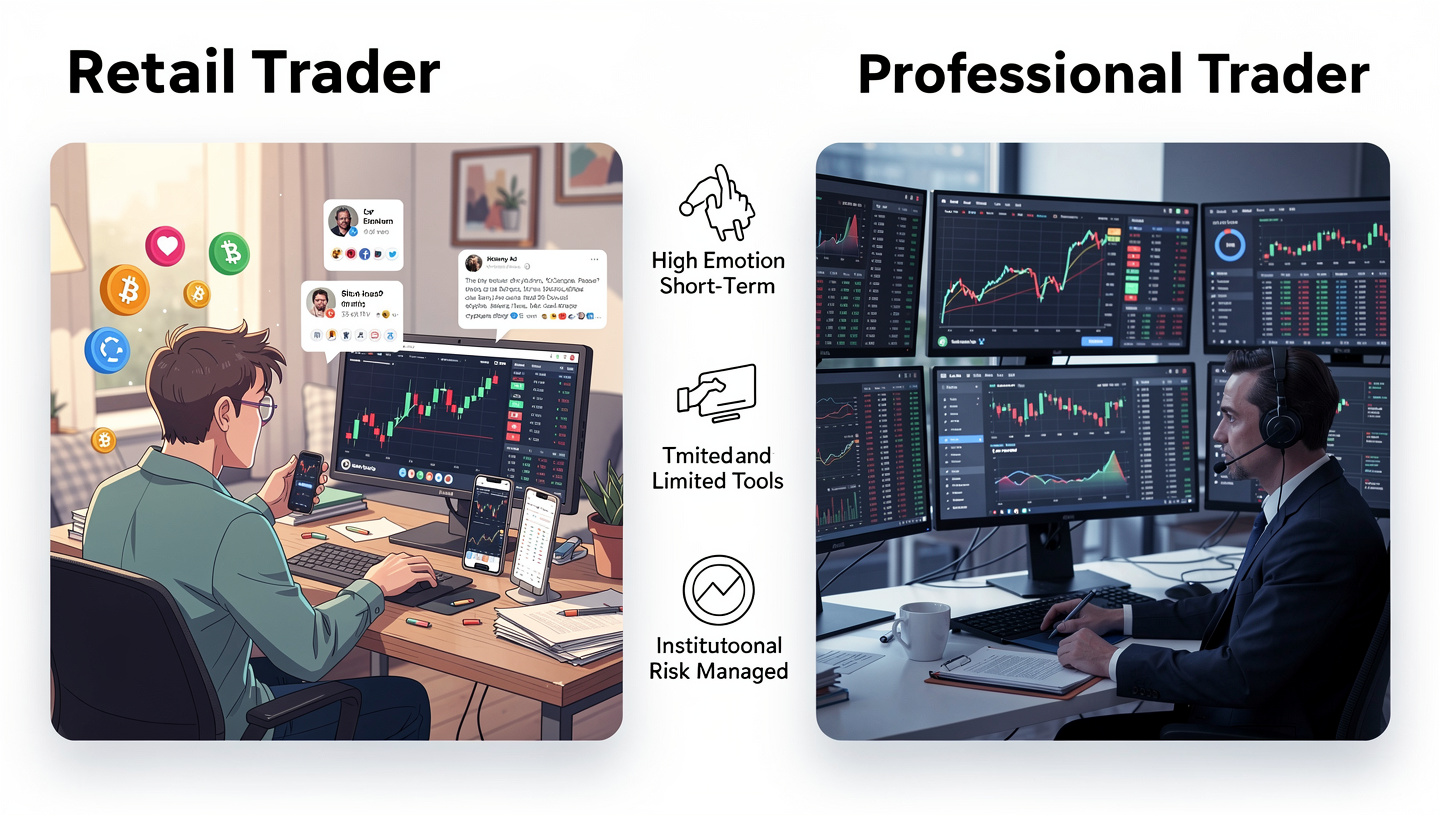
Retail Traders
Retail traders are individuals managing personal capital. They typically:
- Trade from home or mobile devices
- Use standard charting tools and indicators
- Rely on discretionary decision-making
- React to news and social narratives
- Focus on short-term price movement
- Size positions emotionally
- Learn primarily through trial and error
Their capital is small. Their feedback loop is fast. Their exposure to randomness is extreme.
They see markets through candles and indicators.
Professional Traders
Professional traders manage institutional or proprietary capital. They include:
- Quantitative funds
- Market makers
- High-frequency firms
- Crypto-native hedge funds
- Prop desks
They operate with:
- Dedicated infrastructure
- Co-located servers
- Custom execution algorithms
- Risk committees
- Structured mandates
- Portfolio-level optimization
Their objective is not prediction.
It is extraction.
They see markets through order flow, inventory, and statistical edges.
Capital Structure: Why Size Changes Everything
Retail traders think in terms of gains.
Professionals think in terms of capacity.
A retail trader can enter and exit positions instantly with minimal slippage. A professional moving eight figures cannot. Every large order deforms the market.
This forces professionals to:
- Accumulate positions slowly
- Use iceberg orders
- Split execution across venues
- Engineer liquidity events
- Trade around VWAP
Retail traders chase breakouts.
Professionals manufacture them.
The implication is uncomfortable but critical: many retail “setups” exist precisely because professional desks need counterparties.
Retail participation provides liquidity.
Professionals monetize it.
Information Asymmetry Isn’t What You Think
Retail traders often assume professionals have secret news.
They don’t.
Crypto is one of the most transparent markets in existence. On-chain data is public. Exchange flows are visible. Funding rates update in real time.
The edge comes from interpretation and reaction speed.
Professionals:
- Model derivatives positioning
- Track cross-venue spreads
- Monitor liquidation clusters
- Quantify funding imbalances
- Measure passive vs aggressive flow
Retail traders:
- Watch RSI
- Draw trendlines
- Read Twitter
Same data. Different lenses.
A professional desk doesn’t ask, “Will price go up?”
They ask:
- Where is leverage concentrated?
- Who is offsides?
- Where must stops exist?
- How much liquidity is available at each level?
Price is a consequence.
Liquidity is the cause.
Risk Management: The Core Separation
This is the single biggest differentiator.
Retail traders manage trades.
Professionals manage portfolios.
Retail logic:
“I risk 2% per trade.”
Professional logic:
“What is my exposure to correlated drawdowns across regimes?”
Professionals operate under:
- Value-at-Risk constraints
- Max drawdown limits
- Volatility targeting
- Correlation matrices
- Scenario stress testing
They predefine:
- Maximum daily loss
- Maximum weekly loss
- Kill-switch conditions
- Capital rotation rules
Retail traders often decide risk after entering.
Professionals decide risk before strategy design.
That ordering matters.
Execution: The Invisible Battlefield
Retail clicks market buy.
Professionals deploy execution strategies.
This includes:
- TWAP and VWAP algorithms
- Smart order routing
- Dark pool interaction
- Latency arbitrage
- Post-only rebate optimization
On regulated venues such as CME Group, institutional crypto flows are integrated with traditional derivatives infrastructure.
Retail never sees this layer.
Execution quality alone can determine profitability even when both parties have identical directional bias.
Retail pays spread.
Professionals earn it.
Strategy Design: Prediction vs Probability
Retail strategies are narrative-driven.
- “ETF approval is bullish.”
- “This altcoin has strong fundamentals.”
- “This pattern looks like a breakout.”
Professional strategies are distribution-driven.
They ask:
- What is the historical expectancy of this setup?
- How stable is that expectancy across regimes?
- What is the skew?
- What is the tail risk?
They run thousands of simulations.
Retail traders run intuition.
This difference compounds.
Psychological Architecture
Retail traders battle emotions.
Professionals design systems to remove them.
Retail struggles with:
- FOMO
- Revenge trading
- Overconfidence
- Loss aversion
Professionals structure environments:
- Trades are automated
- Risk is capped externally
- Decision trees are predefined
- Performance is reviewed statistically
Retail trades from emotion.
Professionals trade around it.
Even discretionary professionals operate inside rigid frameworks.
Freedom is constrained by process.
Time Horizon Mismatch
Retail traders obsess over entries.
Professionals obsess over distributions.
Retail thinks in minutes or days.
Professionals think in:
- Monthly Sharpe
- Quarterly drawdown
- Annual return on capital
This allows professionals to endure temporary adverse movement while retail is forced out by leverage or psychology.
Retail gets shaken.
Professionals absorb.
The Role of Leverage
Retail traders misuse leverage.
Professionals use it surgically.
Retail leverage is emotional—used to amplify conviction.
Professional leverage is mechanical—used to optimize capital efficiency.
Retail traders blow accounts.
Professionals rebalance exposure.
Same tool. Different outcomes.
Asset Selection: Why Retail Loves Alts
Retail gravitates toward volatile altcoins because:
- Small capital needs big percentage moves
- Social media promotes them
- They feel accessible
Professionals focus on deep liquidity instruments like Bitcoin and Ethereum because:
- They support size
- Derivatives markets are mature
- Hedging is efficient
Retail seeks excitement.
Professionals seek scalability.
Narrative Trading vs Flow Trading
Retail trades stories.
Professionals trade flows.
Retail enters because of news.
Professionals enter because funding flipped, basis widened, or liquidation density formed.
Retail sees headlines.
Professionals see imbalance.
This is why retail often buys tops and sells bottoms.
They respond to visible narratives.
Professionals respond to invisible mechanics.
Education Paths Are Not Equal
Retail learns from:
- YouTube
- Discord groups
- Twitter threads
- Paid courses
Professionals learn from:
- Quantitative research
- Market microstructure
- Years inside trading firms
- Direct exposure to flow
Retail education is descriptive.
Professional education is empirical.
One teaches what happened.
The other teaches why.
Performance Measurement
Retail tracks:
- Account balance
- Win rate
- Individual trade outcomes
Professionals track:
- Risk-adjusted return
- Drawdown duration
- Correlation-adjusted performance
- Capital efficiency
Retail celebrates winners.
Professionals optimize systems.
Why Most Retail Traders Lose
Not because they are unintelligent.
Because they operate in an environment designed for extraction.
They:
- Trade without structural edge
- Size positions emotionally
- Chase momentum late
- Ignore portfolio risk
- Learn slowly through loss
Professionals:
- Trade statistical advantage
- Control exposure
- Enter where retail exits
- Learn rapidly through data
The game is asymmetric by design.
Can Retail Think Like Professionals?
Yes—but not by copying indicators.
By adopting professional principles:
1. Stop Predicting. Start Measuring.
Track expectancy, not opinions.
2. Build Rule-Based Systems
Remove discretionary impulses.
3. Focus on Risk First
Define loss before entry.
4. Trade Liquid Markets
Avoid thin altcoins unless you accept casino dynamics.
5. Journal Everything
Data beats memory.
6. Think in Probabilities
Every trade is one sample in a long distribution.
The Hard Truth
Retail traders want certainty.
Professionals accept uncertainty and design around it.
Retail wants fast gains.
Professionals want stable compounding.
Retail looks for signals.
Professionals build frameworks.
Retail fights the market.
Professionals use it.
Final Perspective
Crypto markets are not chaotic.
They are structured arenas where capital flows from reactive participants to systematic ones.
Retail traders are not doomed—but they must abandon the fantasy of prediction and adopt the discipline of probability.
Professional traders are not smarter—they are engineered differently.
Once you see this, charts change meaning.
Losses become data.
And trading stops being a guessing game.
It becomes a process.
That shift—not any indicator—is the real edge.