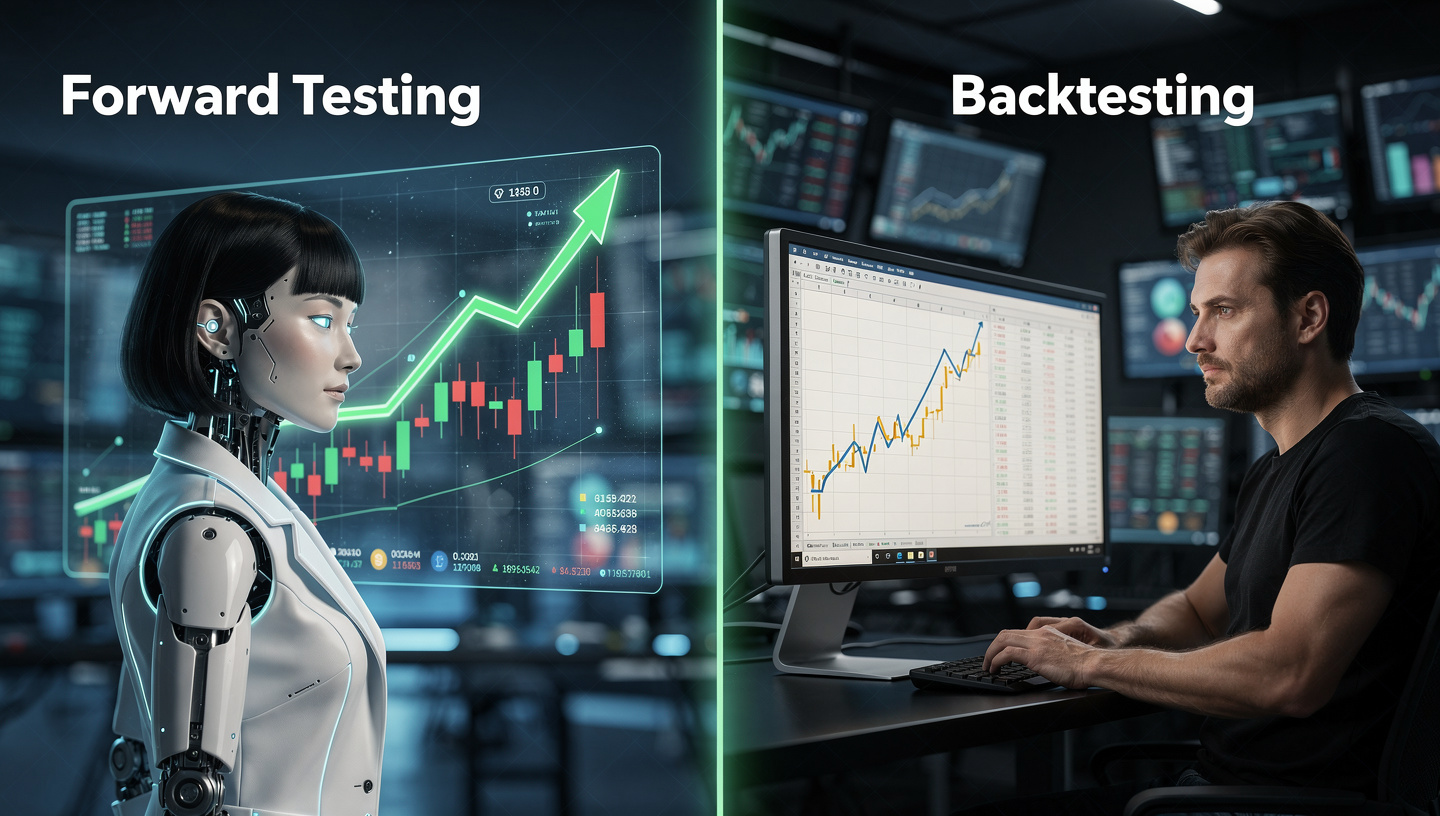
Markets don’t reward imagination. They reward evidence.
Every trader eventually learns this the hard way. You can have elegant theories, clever indicators, and a chart layout that looks like aerospace telemetry—but until your strategy survives contact with real price action, it’s just an idea. Crypto, with its 24/7 liquidity, regime shifts, and reflexive narratives, amplifies this truth.
Forward testing and backtesting exist for one reason: to turn intuition into data.
They are not interchangeable. They answer different questions. And confusing them is one of the fastest ways to build false confidence in a system that will later implode under live conditions.
This article dissects both methods in depth—mechanics, strengths, failure modes, and how serious traders combine them into a single research workflow.
No folklore. No motivational fluff. Just operational reality.
What Backtesting Actually Measures
Backtesting is the process of applying a trading strategy to historical market data to see how it would have performed.
At a surface level, it sounds simple:
- Define entry rules
- Define exit rules
- Run the logic over past candles
- Analyze results
In practice, it is a statistical minefield.
Backtesting answers one narrow question:
Did this logic produce favorable outcomes in the past, under these exact assumptions?
That’s it.
It does not tell you:
- Whether the strategy will work tomorrow
- Whether it survives regime changes
- Whether execution friction destroys the edge
- Whether you can psychologically trade it
Backtesting is retrospective pattern evaluation—not validation.
Why Backtesting Is Still Essential
Despite its limitations, backtesting is non-negotiable.
It provides:
- Baseline expectancy (win rate × payoff ratio)
- Drawdown characteristics
- Trade frequency estimates
- Initial parameter ranges
Without backtests, you’re operating blind.
They allow you to quickly eliminate structurally flawed ideas and narrow hundreds of hypotheses down to a handful worth deeper investigation.
Think of backtesting as your filtering stage.
Cheap, fast, and brutally efficient.
Common Backtesting Errors That Ruin Results
Most retail traders sabotage their own research without realizing it.
Here are the most destructive mistakes:
1. Lookahead Bias
Using future data—directly or indirectly—to make past decisions.
Examples:
- Indicators calculated with future candles
- Strategy logic that references closed bars incorrectly
This alone can turn a losing system into a phantom profit machine.
2. Survivorship Bias
Testing only assets that still exist or are currently liquid.
Dead coins don’t show up in datasets. Failed projects vanish. Your backtest universe becomes artificially optimistic.
3. Curve Fitting
Over-optimizing parameters until equity curves look perfect.
This is statistical overfitting: tailoring rules to noise instead of signal.
A system that requires precise values like RSI(17.3) and stop-loss at 2.17% is already broken.
4. Ignoring Slippage and Fees
Crypto execution isn’t frictionless.
Even on large venues like Binance or Coinbase, spreads widen during volatility spikes, funding rates fluctuate, and market orders move price.
Backtests that assume zero slippage produce fantasy statistics.
Forward Testing: Where Theory Meets Reality
Forward testing—also called paper trading or walk-forward testing—is the process of running your strategy in real time using live market data, without risking capital.
This is where most “profitable” backtests quietly die.
Forward testing answers a very different question:
Does this system function under live conditions, with real data flow and real execution constraints?
It exposes everything backtesting hides.
What Forward Testing Reveals
Forward testing surfaces:
- Latency effects
- Order fill inconsistencies
- Psychological friction
- Strategy degradation
- Regime sensitivity
It also forces you to deal with boredom, missed trades, and streaks of losses—things no spreadsheet prepares you for.
Backtests don’t make you wait three weeks for a setup. Forward testing does.
That matters.
Forward Testing Is Not Optional
If you skip forward testing and go straight from historical results to live capital, you are gambling.
Period.
Even institutional desks at quant firms and proprietary trading groups run extensive forward validation before deploying models.
Retail traders who ignore this step usually discover their edge evaporates the moment money is involved.
The Structural Differences (Not Just Methodological)
Backtesting and forward testing differ at a fundamental level:
Backtesting operates in a closed system.
- Fixed data
- Known outcomes
- Repeatable runs
You can iterate endlessly.
Forward testing operates in an open system.
- Uncertain future
- Adaptive participants
- Narrative-driven volatility
You only get one timeline.
This is why strategies often degrade after launch: markets respond to behavior.
Once an inefficiency becomes crowded, it disappears.
Crypto accelerates this process because information spreads instantly across social platforms and influencers—sometimes amplified by figures like Elon Musk, whose single posts have historically triggered liquidity cascades.
Why Crypto Makes Testing Harder Than Traditional Markets
Crypto markets differ structurally from equities and FX:
- No centralized exchange
- Fragmented liquidity
- Constant leverage availability
- Retail-dominant order flow
- Narrative-driven volatility cycles
There is no closing bell. No earnings calendar. No unified tape.
Price discovery happens simultaneously across dozens of venues.
This introduces additional variables:
Exchange Microstructure Risk
A strategy that works on one exchange may fail on another due to:
- Different fee tiers
- Funding rate mechanics
- Matching engine behavior
Your backtest might look spectacular on aggregate candles, but forward testing reveals the edge collapses once real fills are introduced.
Regime Instability
Crypto rotates violently between:
- Momentum expansions
- Range compression
- Panic liquidation phases
A system optimized during trending conditions often disintegrates in chop.
Backtests average these regimes together. Forward testing forces you to live through them.
Walk-Forward Analysis: Bridging the Gap
Serious traders don’t choose between backtesting and forward testing.
They sequence them.
The standard workflow looks like this:
- Backtest on historical data
- Optimize within broad parameter ranges
- Validate on out-of-sample periods
- Deploy to forward testing
- Measure live performance
- Refine or discard
This is known as walk-forward analysis.
It mimics how strategies age in real markets.
You develop on one window, test on another, then move forward.
If performance collapses outside the training set, the edge isn’t real.
Metrics That Actually Matter (Beyond Profit)
Most traders obsess over net profit.
Professionals look elsewhere.
Key metrics include:
- Maximum drawdown – survival matters more than returns
- Expectancy per trade – edge clarity
- Profit factor – efficiency
- Trade distribution – dependency on outliers
- Time in drawdown – psychological sustainability
Forward testing often reveals that a strategy with beautiful historical returns is emotionally untradeable due to prolonged flat periods or clustered losses.
That’s actionable information.
Psychological Drift: The Invisible Variable
No backtest accounts for you.
Forward testing does.
Live simulation exposes:
- Hesitation
- Overtrading
- Rule bending
- Revenge impulses
These human variables destroy more strategies than bad math ever will.
Forward testing is where discipline becomes measurable.
A Practical Framework for Crypto Traders
If your goal is consistency rather than entertainment, follow this structure:
Phase 1: Hypothesis Generation
- Market observation
- Structural patterns
- Behavioral inefficiencies
Phase 2: Backtesting
- Broad parameter ranges
- Conservative assumptions
- Multiple market regimes
Discard anything fragile.
Phase 3: Forward Testing
- Same rules, no tweaks
- Fixed position sizing
- Journal everything
Run for at least 50–100 trades.
Phase 4: Deployment
Only after forward results resemble backtest distributions do you introduce capital.
Even then, scale gradually.
The Core Truth
Backtesting tells you if a strategy could have worked.
Forward testing tells you if it actually functions.
Backtesting is hypothesis screening.
Forward testing is reality.
Crypto markets punish shortcuts. They expose statistical illusions. They amplify execution errors. They magnify emotional leaks.
Traders who survive long-term don’t rely on hope, intuition, or beautifully optimized equity curves.
They rely on process.
They test in the past, validate in the present, and risk capital only after evidence accumulates.
That is the entire game.
Everything else is noise.