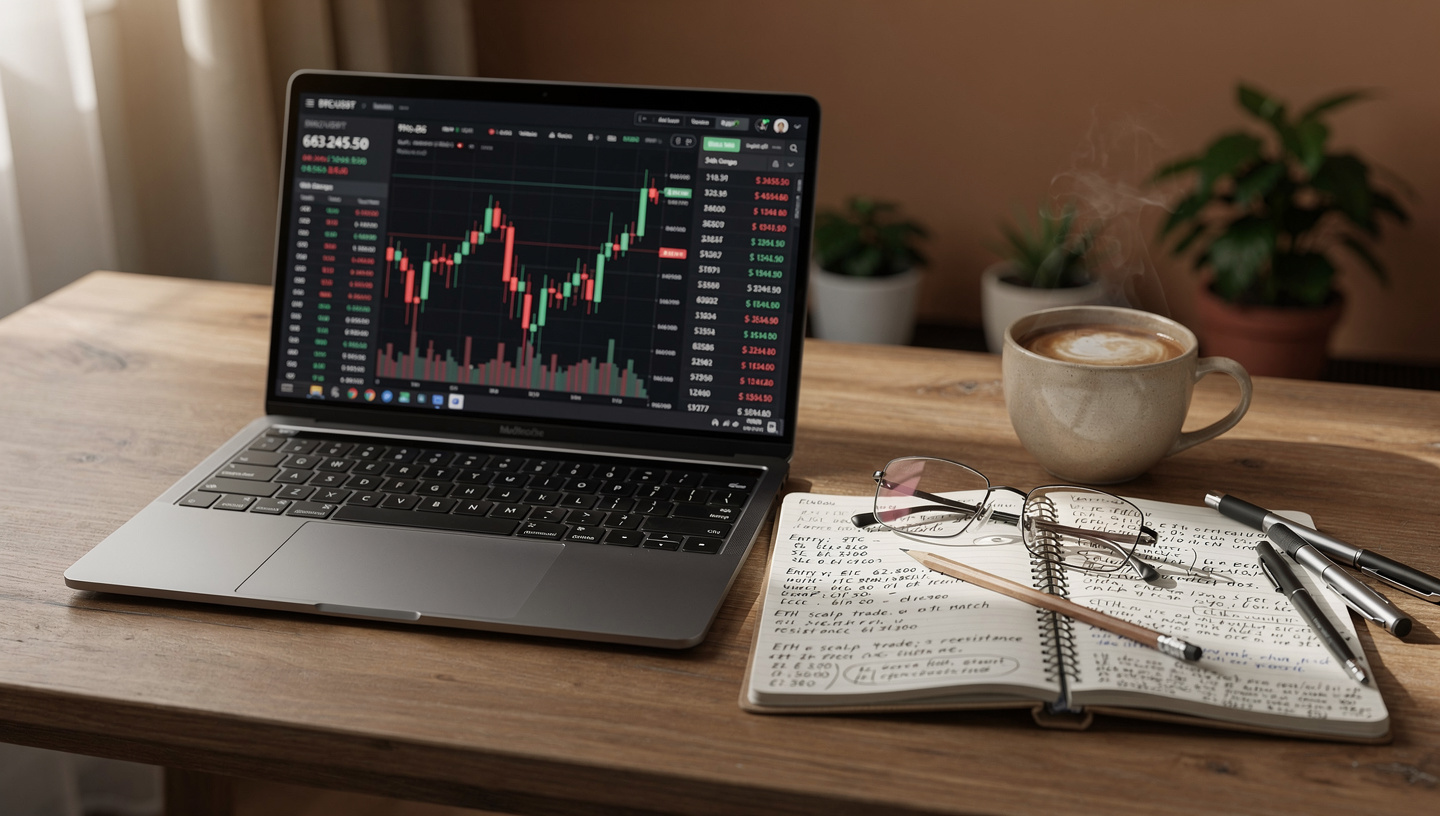
The modern crypto market moves at the speed of thought. A single tweet can erase weeks of gains. A funding-rate spike can flip sentiment in minutes. A thin order book can turn a routine breakout into a liquidation cascade. In this environment, most traders obsess over charts, indicators, and entry models—yet ignore the one tool that quietly compounds edge over time: a trading journal.
Not a casual notebook. Not a few screenshots. A systematic, analytical, brutally honest record of every decision you make.
The difference between traders who plateau and traders who scale is rarely intelligence or access to information. It’s feedback loops. Elite performers in every field build tight loops between action and reflection. This is the same discipline you see in founders like Elon Musk—relentless iteration driven by data, not emotion.
Crypto trading is no different.
A trading journal turns randomness into patterns, emotion into metrics, and experience into strategy. Without it, you are guessing. With it, you are engineering.
This article explains why.
The Invisible Tax Every Trader Pays (Without Realizing It)
Every trader pays three hidden taxes:
- Memory distortion
- Emotional rewriting of history
- Unmeasured mistakes
You remember your best trades vividly. You vaguely recall your worst. You rationalize losses as “bad luck” and wins as “skill.” This cognitive bias is universal.
A journal removes subjectivity.
It shows you:
- How often you break your rules
- Which setups actually make money
- What time of day you perform best
- Whether your “edge” exists outside of isolated wins
- How slippage and fees quietly eat your returns
Most traders never see this because they never collect the data.
They live inside narratives instead of numbers.
A Trading Journal Is Not Optional in a Probabilistic Market
Crypto is not deterministic. It is probabilistic.
No setup works every time. No indicator is predictive in isolation. Every strategy operates on distributions, not certainties.
Professional trading is therefore a statistical game:
- You test hypotheses
- You measure outcomes
- You adjust parameters
- You repeat
A journal is your experiment log.
Without it, you cannot:
- Calculate expectancy
- Track variance
- Identify regime shifts
- Validate improvements
You are trading blind.
What a Proper Crypto Trading Journal Actually Contains
Most beginners log only entries and exits. That’s inadequate.
A serious journal captures four layers:
1. Market Context
- Overall trend (BTC dominance, alt rotation, volatility regime)
- Funding rates
- Key liquidity zones
- News catalysts
This tells you why the trade existed.
2. Trade Structure
- Entry price
- Stop-loss
- Take-profit targets
- Position size
- Risk in R-multiples
This tells you how you executed.
3. Thesis
Write it in plain language:
- What is your setup?
- What invalidates it?
- What must happen for this trade to work?
If you cannot explain a trade simply, you don’t understand it.
4. Post-Trade Review
After closing:
- Did you follow your plan?
- Did you exit emotionally?
- Was the setup valid?
- What would you change?
This is where growth happens.
The Journal Is a Mirror You Cannot Lie To
Your journal exposes patterns that feel uncomfortable:
- You overtrade during low-volume sessions
- You increase size after wins
- You revenge trade after losses
- You exit winners early and hold losers too long
These behaviors are invisible without records.
Once documented, they become actionable.
This is how discipline is built—not through motivation, but through awareness.
Quantifying Your Edge: Expectancy and Distribution
Every strategy has an expectancy:
Expectancy = (Win Rate × Average Win) – (Loss Rate × Average Loss)
Your journal provides these numbers.
From here, you can answer real questions:
- Does this setup beat random chance?
- Is your risk/reward skewed correctly?
- Are losses clustered or evenly distributed?
- Do certain assets outperform others in your hands?
You stop thinking like a gambler and start thinking like a systems engineer.
Emotional Regulation Through Documentation
Crypto amplifies emotion:
- Parabolic pumps trigger FOMO
- Sharp dumps trigger panic
- Chop induces boredom trades
A journal introduces friction.
Before entering, you write.
After exiting, you review.
This slows impulsive behavior and replaces it with process.
Over time, you become less reactive—not because you’re calmer, but because your workflow demands accountability.
Why Most Traders Plateau at the Intermediate Level
There is a predictable ceiling many traders hit:
They learn technical analysis.
They understand risk management.
They become consistently “okay.”
Then they stall.
Why?
Because they stop measuring.
They assume improvement will come naturally with screen time.
It doesn’t.
Progress requires deliberate practice. A journal converts experience into structured feedback.
Without it, years can pass with no meaningful evolution.
Journaling Reveals Strategy–Personality Fit
Not every strategy fits every trader.
Some thrive on scalping. Others perform better on higher timeframes. Some handle leverage well. Others don’t.
Your journal shows:
- Which styles align with your temperament
- Where you make the fewest execution errors
- What holding periods suit you psychologically
This is crucial.
The “best” strategy is irrelevant if you cannot execute it consistently.
Practical Tools Traders Actually Use
You don’t need specialized software to start.
Many professionals log trades in:
- Spreadsheets via Microsoft Excel
- Cloud sheets via Google Sheets
- Chart annotations on TradingView
For execution data, most pull histories from exchanges like Binance or Coinbase.
The tool matters less than consistency.
A simple template beats an abandoned complex system.
The Weekly Review: Where Professionals Separate from Amateurs
Journaling without review is incomplete.
Once per week, analyze:
- Total R gained or lost
- Best and worst trades
- Rule violations
- Emotional decisions
- Market conditions
Then extract one improvement for the next week.
Just one.
This incremental approach compounds faster than massive overhauls.
Turning Your Journal Into a Trading Playbook
Over months, your journal becomes a database.
From it, you build a playbook:
- A-list setups
- Market conditions that favor them
- Position sizing rules
- Entry triggers
- Exit criteria
This is your personal trading manual—custom-built from real performance, not theory.
When markets turn chaotic, you don’t improvise.
You consult your playbook.
Journaling During Drawdowns
Drawdowns are inevitable.
What matters is response.
Your journal helps you distinguish between:
- Strategy failure
- Execution failure
- Market regime change
Each requires a different solution.
Without records, traders often do the wrong thing: they abandon working systems or double down on broken ones.
Journals Reduce Overtrading by Design
Writing forces selectivity.
If every trade must be documented, you naturally avoid low-quality setups. The friction improves trade quality.
This alone can dramatically increase profitability.
The Compound Effect of Small Process Improvements
A 2% improvement in:
- Entry timing
- Position sizing
- Emotional control
doesn’t sound impressive.
But applied consistently, it reshapes your equity curve.
Journals create these marginal gains.
Over hundreds of trades, they become massive.
Common Excuses—and Why They Fail
“I don’t have time.”
Then you don’t have time to lose money either.
“I already know my mistakes.”
If that were true, they wouldn’t repeat.
“It’s boring.”
So is risk management. Both are non-negotiable.
The Hard Truth
Indicators don’t make traders profitable.
Mindset alone doesn’t either.
Process does.
A trading journal is the backbone of that process.
It transforms chaos into structure, emotion into data, and repetition into mastery.
You can spend years chasing setups—or you can build a system that learns from every trade.
Only one approach scales.
Final Perspective
Crypto rewards adaptability. The market evolves. Strategies decay. Volatility regimes shift.
Your journal is what keeps you aligned with reality.
It doesn’t care about ego.
It doesn’t forget mistakes.
It doesn’t romanticize wins.
It tells the truth.
And in a market built on noise, truth is the rarest asset of all.
If you are serious about trading—not gambling, not hoping, not reacting—then journaling is not a productivity hack.
It is infrastructure.
Ignore it, and you stay average.
Commit to it, and you give yourself something most traders never develop:
a measurable, repeatable edge.