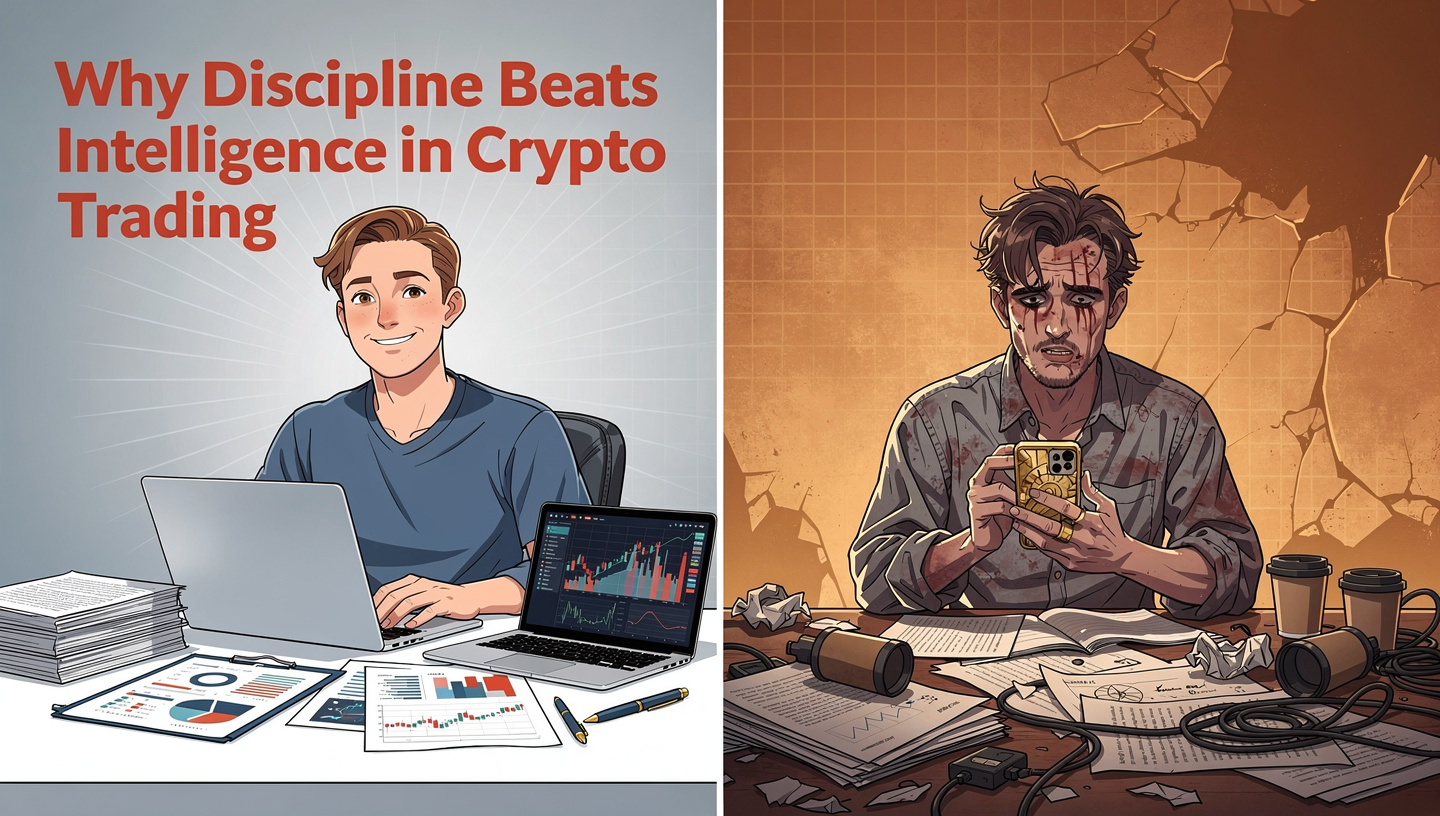
Every cycle, the same pattern repeats: highly intelligent people build complex models, debate macro narratives, and predict price paths with academic precision—then proceed to lose money. Meanwhile, quieter traders with average analytical ability but rigid execution frameworks compound steadily.
This is not accidental.
Markets don’t pay you for what you know. They pay you for what you do, repeatedly, under pressure.
Even icons of innovation like Elon Musk often emphasize execution over raw intellect. In crypto, that lesson is amplified. Intelligence gives you ideas. Discipline turns ideas into profits.
This article dissects why discipline consistently outperforms intelligence in crypto trading—and how you can engineer it into your own process.
Intelligence Builds Strategies. Discipline Monetizes Them.
Intelligence helps you:
- Understand blockchain mechanics
- Read whitepapers
- Interpret on-chain data
- Follow macro liquidity flows
- Design sophisticated trading systems
All of that matters.
But none of it generates returns unless paired with disciplined execution.
Crypto markets operate 24/7, move violently, and weaponize human psychology. Your IQ is irrelevant at 3:00 AM when a leveraged position is down 18% and Twitter is screaming “capitulation.”
At that moment, your outcome depends on whether you follow your rules.
Most don’t.
Highly intelligent traders are often worse here because they rationalize deviations:
- “This setup is different.”
- “My model says there’s asymmetric upside.”
- “I’ll just widen the stop.”
Discipline doesn’t negotiate.
It executes.
Crypto Is an Adversarial Environment
Traditional markets already punish emotional behavior. Crypto multiplies that effect.
Why?
- Extreme volatility – 10–30% moves are normal.
- Constant access – You can trade anytime, anywhere.
- Information overload – Social feeds, influencers, and breaking news never stop.
- Low friction leverage – One click can destroy months of work.
- Narrative-driven pumps – Prices move on memes as often as fundamentals.
This creates an environment where impulsive decisions feel justified.
Your brain is flooded with stimuli, urgency, and social reinforcement. Intelligence tries to interpret all of it in real time. Discipline filters it out.
The disciplined trader ignores noise and executes pre-defined actions.
The intelligent but undisciplined trader improvises.
Improvisation is expensive.
The Myth of the “Smart Trade”
One of crypto’s most persistent illusions is the idea of the brilliant trade—a perfectly timed entry on an obscure altcoin that produces a 20x return.
These trades exist. They also destroy more portfolios than they build.
Why?
Because traders start optimizing for cleverness instead of consistency.
They chase:
- Early entries
- Complex indicators
- Exotic strategies
- Insider-like information
They want to feel smart.
Professional traders want to feel boring.
They repeat the same setups thousands of times. They accept small losses without hesitation. They size positions mechanically. They log every trade.
Their edge is not insight. It is process integrity.
Discipline Is a System, Not a Personality Trait
People often think discipline is about willpower.
It isn’t.
Discipline is structural.
Serious traders externalize discipline into systems:
- Written trading plans
- Fixed risk per trade
- Hard stop-loss rules
- Position size formulas
- Checklists before execution
- Journals after execution
They do not rely on mood, motivation, or confidence.
They design environments where bad decisions are harder to make.
This is critical.
If your discipline depends on “being strong today,” you already lost.
Why Intelligent Traders Self-Sabotage
High intelligence introduces specific failure modes in crypto:
1. Overfitting
Smart traders build intricate models that perform beautifully in backtests and collapse in live markets.
They optimize for historical perfection instead of future robustness.
Discipline favors simple, repeatable frameworks.
2. Narrative Attachment
Intelligent people construct compelling macro stories. Then they emotionally attach to them.
When price invalidates the thesis, they defend it instead of exiting.
Discipline exits.
3. Complexity Addiction
Sophisticated minds gravitate toward sophisticated systems.
But complexity increases fragility.
Most profitable trading strategies can be summarized on one page.
4. Ego Preservation
Smart traders struggle to admit error quickly.
They widen stops. They average down. They “give the trade more room.”
Discipline cuts losses without debate.
Risk Management Is Where Discipline Shows Up
You can survive mediocre entries.
You cannot survive poor risk control.
Every professional operation—whether at a proprietary desk or a large exchange like Binance or Coinbase—prioritizes risk management over strategy.
Retail traders do the opposite.
They obsess over entries and ignore:
- Position sizing
- Maximum drawdown limits
- Correlated exposure
- Leverage stacking
Discipline enforces:
- Fixed percentage risk per trade
- Maximum daily loss
- Maximum concurrent positions
- Mandatory cooldown after losses
Intelligence might design the rules.
Discipline applies them when it hurts.
The Compounding Effect of Small, Boring Wins
Crypto culture celebrates moonshots.
Professionals celebrate survival.
Consistent 1–3% gains with controlled drawdowns beat sporadic 50% wins followed by catastrophic losses.
Why?
Because capital preservation allows compounding.
A trader who avoids large losses has something most participants don’t: time.
Time lets skill express itself.
Most traders eliminate themselves before that happens.
Emotional Regulation Outperforms Market Prediction
You do not need to predict markets perfectly.
You need to manage yourself imperfectly.
Key emotional traps in crypto:
- FOMO after breakouts
- Revenge trading after losses
- Overconfidence after wins
- Paralysis during volatility
- Despair during drawdowns
Intelligence analyzes these states.
Discipline neutralizes them through predefined behavior.
For example:
- After three losses: stop trading for the day.
- After a big win: reduce size.
- During high volatility: cut leverage.
These rules feel restrictive.
They are also why disciplined traders stay solvent.
Process Orientation vs Outcome Orientation
Undisciplined traders obsess over outcomes.
Did I win?
Did I lose?
Was this a good trade?
Disciplined traders obsess over process.
Did I follow my plan?
Did I size correctly?
Did I execute my edge?
Outcomes are noisy. Processes are controllable.
You cannot control price.
You can control execution.
This mindset shift alone separates amateurs from professionals.
The Professional Model: Think Like a Risk Manager
The fastest way to upgrade your trading is to stop thinking like a speculator and start thinking like a risk manager.
Risk managers ask:
- What is my maximum downside?
- How many correlated positions do I hold?
- What happens if liquidity vanishes?
- How exposed am I to regime change?
Speculators ask:
- How high can this go?
Discipline lives in the first set of questions.
Discipline Creates Psychological Asymmetry
Here is the quiet advantage disciplined traders possess:
They are emotionally neutral.
Losses do not destabilize them.
Wins do not inflate them.
This neutrality creates asymmetry.
While others spiral through fear and euphoria, disciplined traders execute mechanically.
Markets transfer capital from emotional participants to systematic ones.
This is not poetic. It is structural.
Building Discipline: Practical Framework
Discipline is built, not discovered.
A minimal professional framework looks like this:
1. One Strategy, One Market
Master a single setup on a single asset before expanding.
Complexity comes later.
2. Fixed Risk Model
Risk the same percentage per trade. No exceptions.
3. Hard Stops
Define invalidation before entry. Never move stops further away.
4. Trade Journal
Log entry, exit, rationale, emotions, and rule adherence.
Review weekly.
5. Loss Limits
Set daily and weekly drawdown caps.
Hit the limit. Stop trading.
6. Automation Where Possible
Use alerts, bracket orders, and predefined position sizes.
Reduce discretion.
This is unglamorous.
It works.
Intelligence Still Matters—Just Not How You Think
This is not an argument against intelligence.
Intelligence helps you:
- Learn faster
- Avoid obvious scams
- Understand market structure
- Adapt to new instruments
But intelligence must be subordinate to discipline.
Think of intelligence as your research department.
Discipline is your execution desk.
Execution pays the bills.
Final Perspective
Crypto does not reward cleverness. It rewards consistency.
The market does not care how sophisticated your thesis is or how elegant your chart work looks. It cares whether you manage risk, follow rules, and stay operational during adversity.
Most participants try to outthink the market.
Professionals outlast it.
If you take only one lesson from this:
Build discipline first. Let intelligence serve it.
That hierarchy determines whether you become another intelligent trader with a blown account—or one of the few who quietly compound while everyone else chases brilliance.