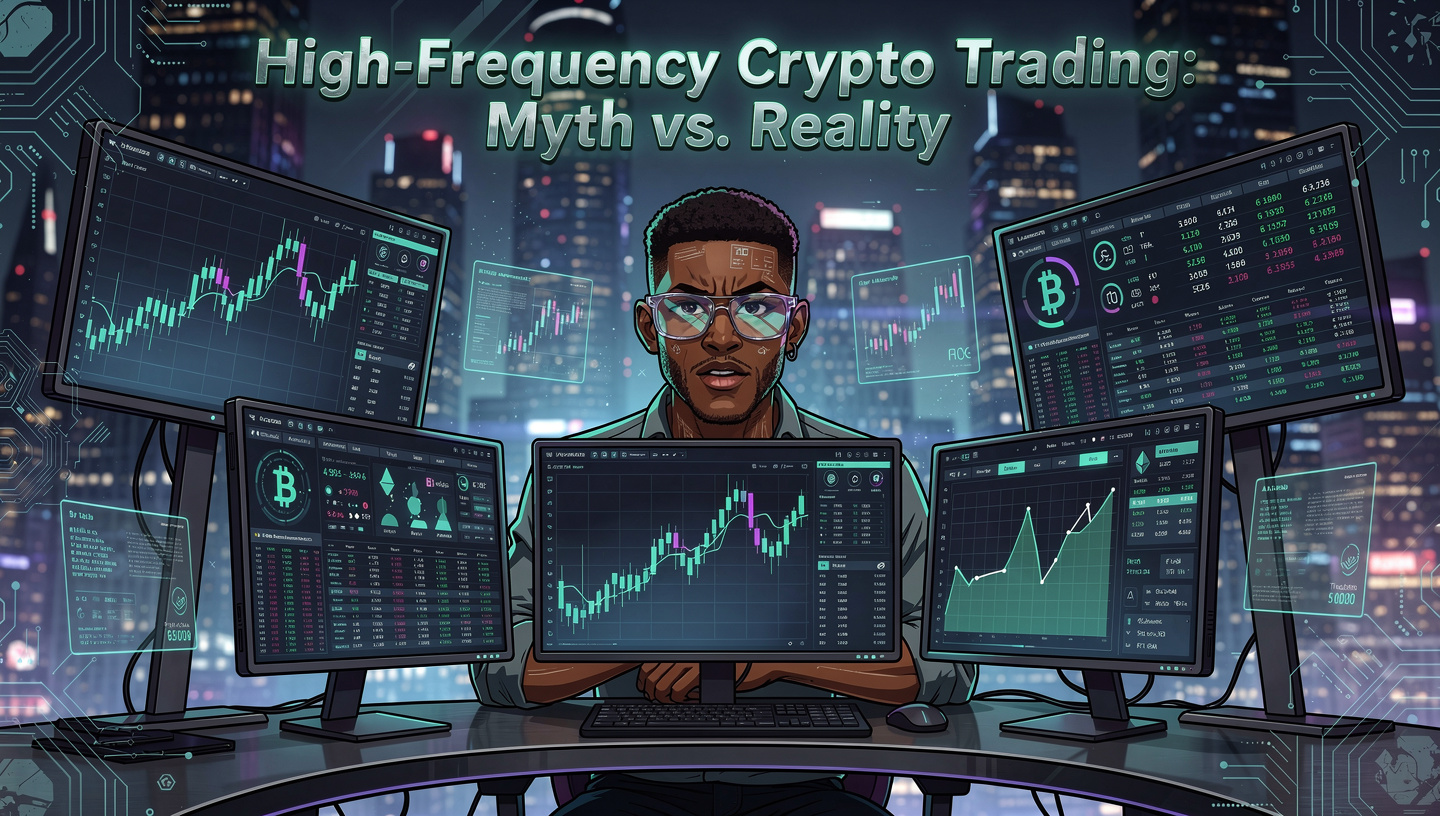
The first lie about high-frequency trading is that it looks fast.
Speed, in the public imagination, still has texture. You picture fingers hammering keyboards, charts flickering, caffeine-fueled nights, and some savant trader catching microscopic price moves by instinct. That image belongs to another era.
Real high-frequency crypto trading does not feel fast. It feels silent.
No drama. No charts. No decision-making in the human sense. Just servers co-located beside exchange engines, deterministic models firing orders in microseconds, and risk systems cancelling thousands of positions before a retail trader can blink.
This article dismantles the mythology surrounding high-frequency crypto trading (HFT). Not from hype. Not from marketing decks. From market structure, engineering reality, and economic incentives.
Let’s separate folklore from facts.
What High-Frequency Trading Actually Means in Crypto
High-frequency trading is not simply “trading a lot.” It is a specialized market-making and arbitrage discipline built around:
- Ultra-low latency infrastructure
- Automated order placement and cancellation
- Statistical micro-edge exploitation
- Extremely short holding periods (milliseconds to seconds)
- Massive message throughput
- Tight risk constraints
- Profit per trade measured in basis points—or less
Traditional finance developed HFT over decades. Crypto inherited it almost overnight.
The same core mechanics apply, but with different constraints:
- Fragmented exchanges
- Inconsistent APIs
- Frequent outages
- Extreme volatility
- Retail-heavy order flow
- Less mature surveillance
Crypto HFT is structurally closer to early-2000s equities than modern Wall Street.
Which makes it both lucrative—and chaotic.
The Infrastructure Reality Nobody Talks About
Retail traders obsess over indicators.
HFT firms obsess over nanoseconds.
Here’s what actually matters:
1. Physical Proximity
Professional HFT shops colocate servers inside exchange data centers or nearby facilities. Distance equals latency. Latency equals lost edge.
If your orders travel across continents, you are not competing.
2. Deterministic Execution
Algorithms are compiled for predictable timing. Garbage collection pauses, OS scheduling jitter, and packet buffering are enemies.
Many systems run stripped-down Linux kernels or custom networking stacks.
3. Market Data Engineering
HFT firms consume raw exchange feeds—not web sockets or REST APIs. They reconstruct order books locally, track queue positions, and model fill probabilities.
Retail platforms show snapshots.
Professionals build realities.
4. Cancellation Dominance
The majority of HFT messages are not trades. They are cancellations.
Liquidity is continuously probed, reshaped, withdrawn, and reinserted.
What looks like a stable order book is often an illusion lasting milliseconds.
The Core HFT Strategies in Crypto
Despite mystique, most crypto HFT falls into a few categories:
Market Making
Providing both bids and asks while managing inventory.
Profit comes from spread capture and exchange rebates—not directional bets.
Risk is controlled via delta hedging and position limits.
This is the backbone of crypto HFT.
Cross-Exchange Arbitrage
Buying on one venue and selling on another when prices diverge.
Latency is king.
By the time you see the discrepancy, it’s gone.
Statistical Arbitrage
Short-term mean reversion models exploiting microstructure noise.
These strategies live on second-to-minute horizons.
They decay quickly once discovered.
Liquidation Hunting
Monitoring leveraged positions and positioning ahead of forced liquidations on derivatives venues.
This is uniquely crypto.
The Firms Running the Game
The public associates crypto trading with influencers and hedge funds.
The actual volume is dominated by quantitative shops.
Names rarely advertised to retail:
- Jump Trading
- Citadel Securities
- Alameda Research
These organizations bring decades of experience from equities and futures into digital assets.
They don’t speculate on narratives.
They extract inefficiencies.
Even the collapse of Alameda—tied to Sam Bankman-Fried—did not remove HFT from crypto. It merely reshuffled market share.
Capital moves faster than reputation.
Myth #1: HFT Traders Predict Market Direction
They don’t.
Directional conviction is poison to HFT systems.
High-frequency models focus on:
- Order flow imbalance
- Short-term volatility expansion
- Queue position optimization
- Adverse selection avoidance
They are agnostic to macro.
They don’t care about halving cycles.
They don’t debate narratives around Elon Musk.
Their holding periods are too short for opinions.
Myth #2: You Can Compete with Bots Using Better Indicators
You cannot.
Not because you lack intelligence—but because the playing field is asymmetric.
Retail traders operate at:
- 50–300ms latency
- Aggregated price feeds
- Simplified order books
- Manual execution
HFT systems operate at:
- Sub-millisecond reaction times
- Raw packet data
- Predictive fill modeling
- Continuous automated execution
This is not a strategy gap.
It is a physics gap.
Myth #3: HFT Drains Liquidity from the Market
This one is nuanced.
HFT both provides and removes liquidity.
During normal conditions, market makers tighten spreads and increase depth.
During stress, they pull orders instantly.
Liquidity is conditional.
Crypto learned this brutally during flash crashes and exchange outages.
The order book looks thick—until it vanishes.
Exchanges Are Not Neutral Venues
Every exchange designs incentives.
Fee tiers. Maker rebates. Matching engine behavior.
These mechanics shape HFT profitability.
Major venues like Binance and Coinbase compete aggressively for professional flow.
They offer:
- Co-location services
- VIP latency routes
- Custom APIs
- Fee discounts
Retail traders see interfaces.
HFT firms see protocol specifications.
Why Crypto Is Especially Attractive to HFT
Crypto offers something traditional markets no longer do:
Structural inefficiency.
Reasons:
- Fragmented liquidity
- Immature surveillance
- Retail-dominated order flow
- High volatility
- Frequent exchange outages
- Constant new listings
Every one of these creates micro-edges.
This is why assets like Bitcoin and Ethereum trade across dozens of venues with persistent basis spreads.
It’s also why faster chains such as Solana attract latency-sensitive strategies.
Chaos is opportunity.
The Economics: Tiny Margins, Massive Scale
HFT profits per trade are microscopic.
Often less than 0.01%.
The edge comes from:
- Millions of trades
- Near-zero holding risk
- Extremely high turnover
Capital efficiency matters more than accuracy.
Winning 51% of trades is enough—if you trade fast enough.
Why Retail “HFT Bots” Are Mostly Fiction
You’ve seen them marketed:
“AI scalper.”
“High-frequency crypto bot.”
“Institutional strategy for $99.”
These products are not HFT.
They are automated retail strategies.
Real HFT requires:
- Co-located servers
- Direct market access
- Proprietary data feeds
- Custom networking stacks
- Dedicated risk infrastructure
Anything running on cloud VPS with public APIs is several orders of magnitude too slow.
The term “HFT bot” in retail contexts is marketing, not engineering.
The Psychological Trap for Retail Traders
The danger isn’t losing to HFT.
You already do.
The danger is trying to imitate it.
Retail traders attempt:
- Over-scalping
- Excessive automation
- Hyper-short timeframes
- Random micro-entries
This usually ends in:
- Overtrading
- Fee bleed
- Slippage death
- Emotional burnout
Professional HFT is built on capital scale and infrastructure.
Retail edge comes from patience, structure, and timeframe selection.
Different games.
Where Individual Traders Can Compete
Not in milliseconds.
In hours, days, and weeks.
Retail advantages:
- Flexible positioning
- Narrative awareness
- Asymmetric bets
- Illiquid market access
- Longer holding horizons
HFT cannot ride multi-week trends.
They flatten constantly.
You don’t have to.
Regulatory Blind Spots
Crypto HFT operates in a gray zone.
Wash trading, spoofing, and self-matching are harder to detect across fragmented venues.
Surveillance is improving, but enforcement lags.
This is not conspiracy.
It is technological reality.
Traditional finance took decades to build market integrity systems.
Crypto is still early.
The Real Impact of HFT on Crypto Markets
High-frequency trading:
- Tightens spreads in calm periods
- Amplifies volatility during stress
- Accelerates price discovery
- Extracts retail inefficiencies
- Professionalizes liquidity
It does not control market direction.
It shapes microstructure.
Final Reality Check
High-frequency crypto trading is not glamorous.
It is not intuitive.
It is not accessible.
It is an engineering discipline masquerading as finance.
Retail traders are not failing because they lack speed.
They fail when they fight battles they cannot win.
HFT firms live in microseconds.
You live in human time.
That difference defines everything.
Understand the machinery. Respect the asymmetry. Trade where algorithms cannot breathe.
That is the real edge.