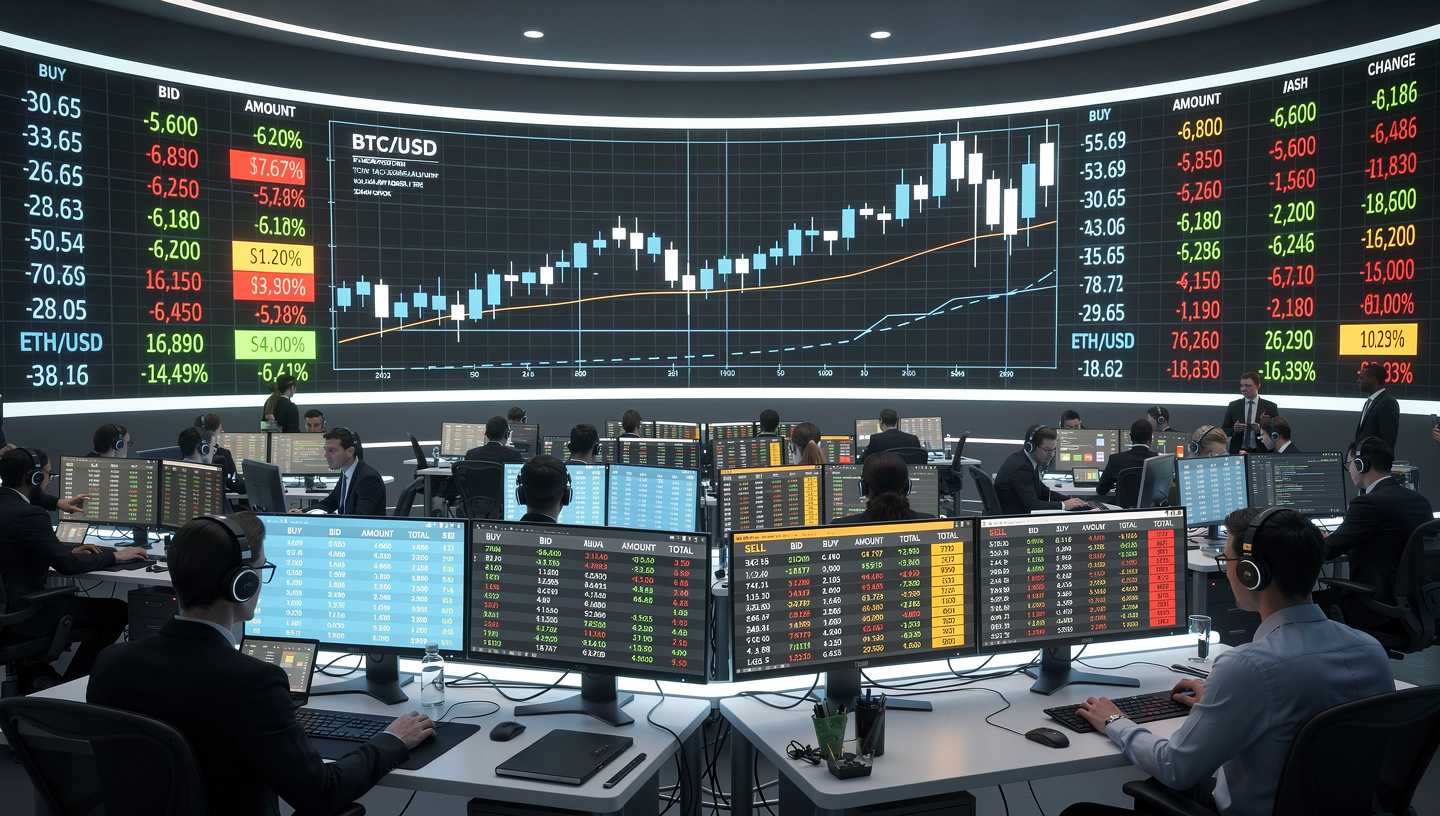
The market doesn’t move because of news headlines. It doesn’t move because of charts. And it certainly doesn’t move because someone on social media says “bullish.”
It moves because two opposing forces—buyers and sellers—continuously negotiate price in real time.
Every candle you see. Every breakout. Every violent liquidation cascade.
All of it originates from a single structure most traders barely study deeply enough:
the order book.
Before price becomes history on a chart, it exists as intention inside an order book. Before momentum appears, liquidity has already shifted. Before volatility explodes, imbalance has already formed.
If you want to understand crypto price action at a professional level, you don’t start with indicators.
You start with market microstructure.
This article dissects how order books actually influence crypto prices—mechanically, psychologically, and structurally—so you can understand what’s really happening underneath every move.
No folklore. No trading clichés. Just how the engine works.
The Order Book Is the Market
An order book is not a passive list of bids and asks. It is the market.
At any moment, it contains:
- Limit buy orders (bids) — traders willing to buy at specific prices
- Limit sell orders (asks) — traders willing to sell at specific prices
Between them sits the spread, and inside that spread trades occur via market orders.
Price doesn’t move because someone predicts it will.
Price moves because market orders consume liquidity.
That’s it.
When aggressive buyers overwhelm resting sell orders, price rises.
When aggressive sellers overwhelm resting buy orders, price falls.
Everything else—technical analysis, indicators, narratives—is downstream of this mechanism.
Liquidity: The Hidden Variable Behind Every Candle
Liquidity is the depth of available orders at each price level.
High liquidity means large size can transact without moving price much.
Low liquidity means small size can cause disproportionate movement.
Crypto markets are structurally low-liquidity compared to traditional equities or FX. That’s why:
- Wick extremes happen frequently
- Stop hunts are easy to engineer
- Small capital can generate large volatility
If you’ve ever watched Binance or Coinbase during high-impact events, you’ve seen this live: thin books, violent jumps, cascading liquidations.
This is not randomness.
It’s liquidity collapse.
When the order book thins, price becomes hypersensitive.
Price Discovery Happens Through Order Flow
Charts show results. Order books show process.
Price discovery occurs when:
- Market orders hit the book
- Resting liquidity absorbs or fails to absorb that flow
- Price shifts to the next available level
This sequence repeats thousands of times per minute.
If sell-side liquidity absorbs buy pressure, price stalls.
If sell-side liquidity evaporates, price accelerates upward.
Traders often ask, “Why did price suddenly explode?”
The answer is almost always the same:
because there was nothing left to trade against.
Bid Walls and Ask Walls: Psychological and Structural Barriers
Large clusters of orders at specific price levels are called walls.
- Bid wall = large buy liquidity
- Ask wall = large sell liquidity
These walls act as:
- Temporary support/resistance
- Psychological anchors
- Liquidity magnets
But here’s the critical point:
Most walls are not real.
They are frequently placed by large players to influence behavior:
- To slow price
- To induce front-running
- To bait retail participation
- To mask true intent
This practice is often referred to as spoofing or liquidity signaling.
In crypto, where regulation is fragmented and surveillance inconsistent, this behavior is widespread.
Walls appear, disappear, and relocate constantly.
Traders who blindly trust visible liquidity get trapped.
Professionals watch how liquidity behaves—not just where it sits.
Market Orders Are the Only Thing That Moves Price
Limit orders provide liquidity.
Market orders consume it.
Only market orders move price.
This distinction matters more than most realize.
Retail traders tend to place limit entries and stare at charts.
Institutions and whales move price by executing market orders in size—or by forcing others to do so via stop cascades.
When price suddenly surges:
- It’s not because “buyers stepped in”
- It’s because aggressive flow overwhelmed passive liquidity
This is why volume spikes often precede or accompany large moves.
Volume is evidence of liquidity consumption.
Stop Losses Are Invisible Orders Waiting to Become Market Orders
Stops do not appear in the order book.
But they are very real.
Clusters of stops tend to accumulate:
- Below obvious support
- Above obvious resistance
- Around round numbers
These zones represent latent market orders.
Once triggered, they convert into immediate buy or sell pressure.
This creates:
- Liquidity vacuums
- Slippage
- Cascade effects
Experienced operators deliberately push price into these zones.
They’re not chasing momentum.
They’re harvesting trapped positioning.
Slippage: When the Book Can’t Absorb You
Slippage occurs when your order is larger than available liquidity at your desired price.
Your execution spills across multiple levels.
In fast markets, this compounds:
- One large order eats several levels
- Price jumps
- Others react
- Liquidity pulls
- Spread widens
Retail feels this as “bad fills.”
Professionals anticipate it.
In crypto, slippage is not a bug—it’s a feature of thin books.
Why Breakouts Work (And Why They Fail)
Breakouts succeed when:
- Resting liquidity is thin above resistance
- Stops are stacked
- Momentum traders enter simultaneously
This creates a chain reaction:
Stops → Market buys → Liquidity collapse → Vertical move
Breakouts fail when:
- Sell-side liquidity is thick
- Large players fade the move
- Aggressive buying gets absorbed
Same chart pattern.
Completely different order book conditions.
Charts alone cannot tell you this.
Iceberg Orders: Hidden Size Beneath the Surface
Large participants often hide their true position size using iceberg orders—small visible quantities that refresh automatically.
To the public book, it looks like modest liquidity.
In reality, massive size sits behind it.
This allows institutions to:
- Accumulate without moving price
- Distribute without alerting traders
- Absorb flow quietly
You’ll recognize iceberg behavior when price repeatedly trades into a level without breaking—and volume keeps printing.
That’s absorption.
The Spread Reveals Urgency
A widening spread signals:
- Liquidity withdrawal
- Increased uncertainty
- Elevated risk
A tight spread signals:
- Competitive market making
- High participation
- Stable conditions
Before major moves, spreads often widen first.
Liquidity providers step back.
Volatility follows.
How Whales Engineer Price Moves
Large players don’t “buy low and sell high.”
They engineer conditions.
Common tactics include:
- Pulling liquidity to induce slippage
- Flashing walls to manipulate sentiment
- Triggering stop clusters
- Using derivatives to amplify spot moves
Crypto’s fragmented venues make this easier than in traditional markets.
Cross-exchange arbitrage spreads these effects rapidly.
Price moves appear spontaneous.
They are not.
Order Books vs Candlesticks: Cause vs Effect
Candlesticks are historical summaries.
Order books are live intent.
A candle shows what already happened.
An order book shows what might happen.
Most traders analyze aftermath.
Professionals study pressure.
This is the difference.
Case Study: High-Volatility Assets
Assets like Bitcoin and Ethereum regularly experience violent intraday swings not because of fundamentals—but because their books thin dramatically during active sessions.
When liquidity fragments, even moderate order flow causes outsized movement.
This is why crypto behaves more like a leveraged derivatives market than a traditional asset class.
Why Retail Consistently Misreads Market Strength
Retail interprets:
- Rising price = strength
- Falling price = weakness
But order books tell a different story.
Rising price with collapsing liquidity is fragile.
Falling price with aggressive absorption is often accumulation.
Without seeing the book, traders misclassify both.
Algorithms Dominate Short-Term Price
Human traders do not set microstructure.
Algorithms do.
Market-making bots constantly:
- Adjust spreads
- Rebalance inventory
- Detect momentum
- Front-run flow
They react in milliseconds.
By the time a human clicks, the book has already reshaped.
Manual traders operate on higher timeframes.
Short-term price is machine territory.
The Narrative Layer: Why Headlines Lag Structure
Public figures like Elon Musk can spark attention—but attention only matters if it converts into order flow.
Tweets don’t move markets.
Orders do.
News simply catalyzes participation.
Liquidity decides magnitude.
Practical Takeaways for Serious Traders
If you trade crypto and ignore order books, you are operating blind.
You don’t need to stare at Level II all day—but you must understand these principles:
- Price moves through liquidity consumption
- Stops are future market orders
- Walls are often deceptive
- Thin books amplify volatility
- Breakouts depend on depth, not patterns
- Absorption signals professional activity
Once you internalize this, charts become context—not gospel.
Final Thoughts: Markets Are Negotiations, Not Predictions
Crypto price action is not mystical.
It’s transactional.
Every move reflects a temporary imbalance between urgency and availability.
Order books reveal that imbalance in real time.
If you want to evolve beyond retail-level analysis, stop asking where price should go.
Start asking:
- Where is liquidity concentrated?
- Where will forced orders appear?
- Who benefits from this structure?
Markets don’t reward opinions.
They reward understanding.