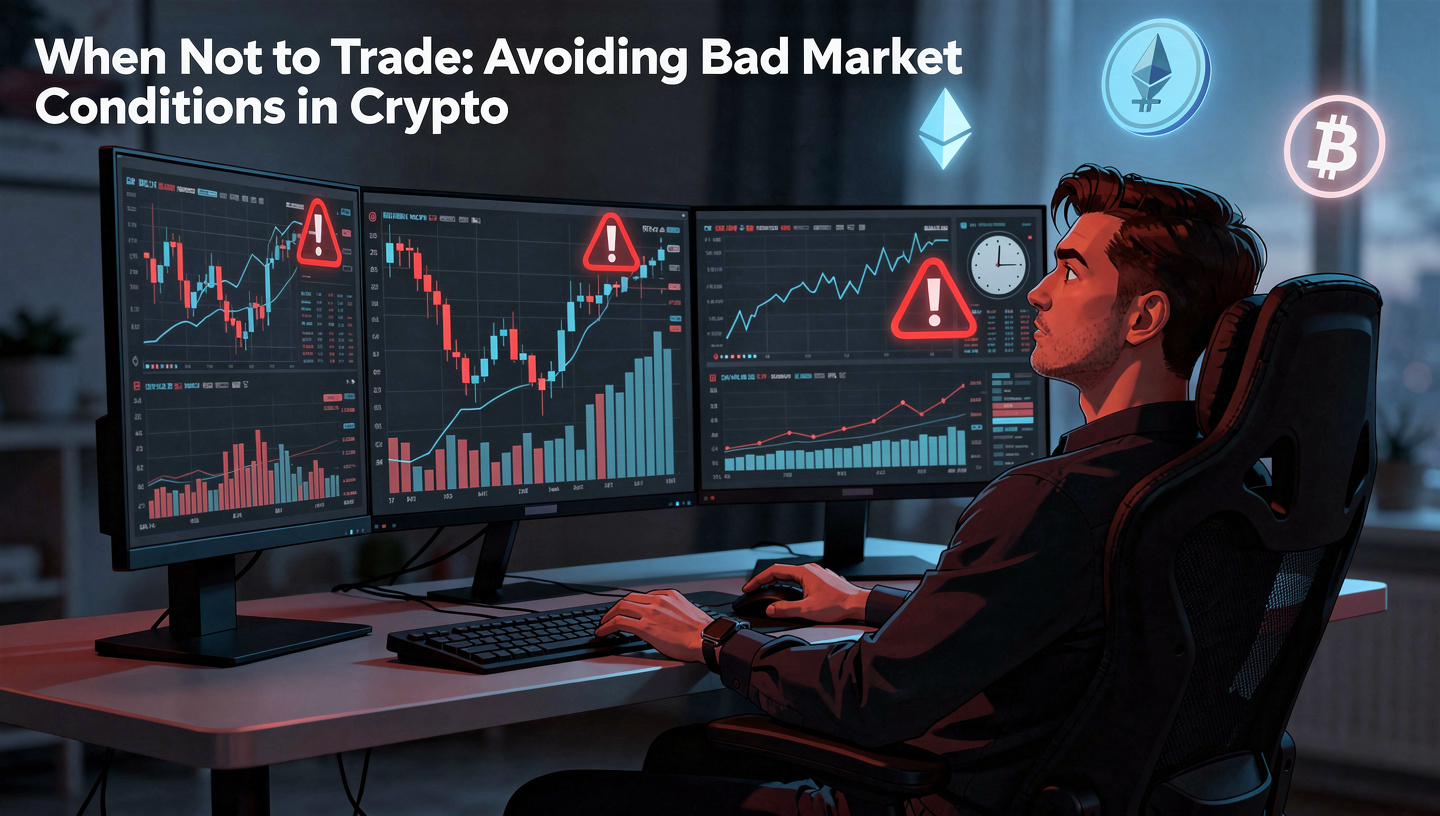
One moment, price behaves like a system. The next, it behaves like weather.
Most traders obsess over entries. Professionals obsess over conditions. The difference between long-term survival and slow capital erosion rarely comes down to strategy complexity—it comes down to knowing when not to participate.
That discipline is what separates operators from gamblers.
This article is not about indicators, setups, or winning trades. It is about something far more valuable: identifying environments where probability collapses, edge disappears, and even good strategies stop working.
If you internalize this properly, you will trade less—and make more.
Trading Is Optional. Risk Is Not.
Crypto markets operate 24/7. That alone creates a psychological trap: because opportunity is always present, traders feel they must act.
They don’t.
Every position exposes capital to uncertainty. Every click commits emotional bandwidth. Every trade consumes risk budget.
Professional traders treat inactivity as a position. Cash is a stance. Observation is a strategy.
The goal is not to trade often.
The goal is to trade only when conditions support asymmetric outcomes.
Everything else is noise.
The Structural Reality of Crypto Markets
Before discussing specific “don’t trade” scenarios, it matters to understand what makes crypto uniquely hostile:
- Thin order books compared to traditional equities
- Extreme reflexivity (price influences narrative, narrative influences price)
- Retail-dominated participation
- High leverage availability
- Algorithmic liquidity that vanishes under stress
- No circuit breakers
- Constant global macro exposure
Assets like Bitcoin and Ethereum trade inside an ecosystem that amplifies emotion and compresses time.
This is not a slow market. It is a compression chamber.
Which means bad conditions propagate faster—and destroy accounts quicker.
Condition #1: Low-Volume Chop (The Capital Grinder)
This is one of the most common and most expensive environments.
Price oscillates inside a tight range. Wicks hunt both sides. Breakouts fail. Momentum indicators flip constantly. Social media alternates between bullish and bearish narratives every few hours.
Volume remains suppressed.
This environment quietly bleeds traders through:
- Repeated stop-outs
- Overtrading
- Strategy degradation
- Emotional fatigue
Low-volume chop is not neutral. It is actively hostile.
Why?
Because spreads widen, slippage increases, and micro-moves dominate structure. Algorithms feast on retail impatience. Your edge disappears into noise.
Do not trade when:
- Volume is declining while price remains range-bound
- ATR compresses across multiple sessions
- Breakouts repeatedly fail within minutes or hours
This is market digestion. Let it digest.
Condition #2: News-Driven Volatility Without Structure
Crypto reacts violently to headlines: regulatory leaks, ETF rumors, exchange issues, geopolitical events.
The problem isn’t volatility.
The problem is unstructured volatility.
In these moments:
- Liquidity pulls back
- Spreads widen
- Price jumps through levels without respect
- Technicals lose relevance
Retail traders mistake movement for opportunity.
Professionals recognize randomness.
If price is moving because of information asymmetry, you are already late.
This includes:
- Sudden regulatory announcements
- Exchange solvency rumors
- Emergency macro statements
- Unexpected liquidations
Unless you are operating at institutional latency with privileged information, this is not your battlefield.
Sit out.
Condition #3: Post-Parabolic Exhaustion
Every crypto cycle produces vertical moves.
Retail piles in late. Influencers turn euphoric. Leverage explodes. Funding rates spike. Longs dominate.
Then the market stalls.
This phase is lethal.
After parabolic runs:
- Risk-reward collapses
- Mean reversion probability spikes
- Late buyers become forced sellers
- Whales distribute into strength
You’ll recognize this environment by:
- Extreme funding rates
- Social sentiment at euphoric extremes
- Price making marginal highs on declining volume
- Large wicks rejecting continuation
This is not continuation territory.
This is distribution.
Trading here is betting against entropy.
Condition #4: Major Macro Event Windows
Crypto does not exist in isolation.
Liquidity is global. Risk appetite is macro.
Key events—interest rate decisions, inflation releases, employment data—inject uncertainty across all risk assets.
When central banks speak, crypto listens.
During these windows:
- Correlations spike
- Algorithms dominate flow
- Technical setups fail
- Stops get swept
If you are not positioned before the event with defined risk—or trading volatility intentionally—you are speculating.
Markets often move irrationally for hours after these releases.
Let the dust settle.
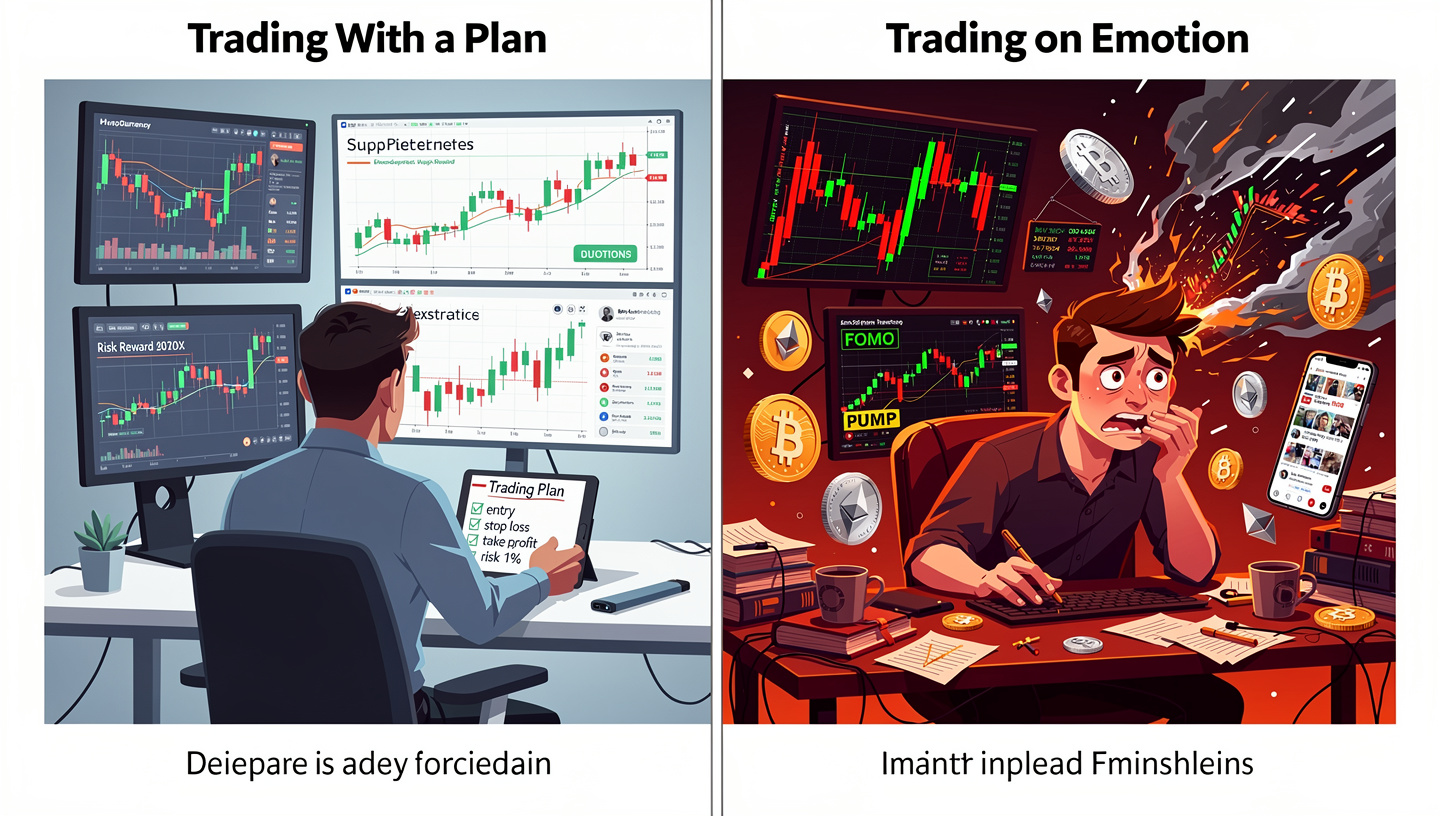
Condition #5: When You Are Emotionally Compromised
This is not a market condition.
It is a personal one.
It matters more than everything else combined.
Do not trade when:
- You just took multiple losses
- You feel urgency to “make it back”
- You are tired
- You are distracted
- You are emotionally elevated
- You are bored
Your strategy does not operate through your charting platform.
It operates through your nervous system.
Once that system is destabilized, edge evaporates.
The market does not care how you feel.
Your account will reflect it anyway.
The Liquidity Illusion
Crypto appears liquid—until it isn’t.
Order books look deep in calm conditions. Then a single aggressive order cascades price through multiple levels.
This is especially dangerous during:
- Weekend sessions
- Asian market transitions
- Exchange maintenance periods
Liquidity providers step away. Volatility increases. Slippage becomes unpredictable.
Retail traders enter thinking spreads are stable.
They aren’t.
Avoid thin sessions unless your strategy explicitly accounts for microstructure risk.
Condition #6: Overcrowded Consensus Trades
When everyone sees the same setup, it stops working.
Crypto is narrative-driven. Once a thesis becomes dominant, it attracts leverage.
That leverage becomes fuel—for reversals.
Signs of overcrowding:
- One-sided funding
- Identical chart screenshots everywhere
- Influencers repeating the same targets
- Extreme long/short ratios
Markets move to maximize pain.
They punish consensus.
If the trade feels obvious, it usually isn’t.
The “Influencer Market” Trap
Crypto has a unique pathology: price moves driven by personalities.
A single tweet from Elon Musk has historically moved billions in market capitalization.
This creates an environment where:
- Fundamentals become irrelevant short-term
- Retail chases momentum
- Whales fade excitement
These moves are not tradable edges for retail.
They are liquidity events.
Do not attempt to front-run attention.
Trade structure, not spectacle.
Condition #7: Strategy-Environment Mismatch
Every strategy has a preferred regime:
- Trend-following requires expansion
- Mean reversion requires compression
- Breakouts require buildup
Most traders fail because they apply the same approach everywhere.
If you trade breakouts during range compression, you bleed.
If you mean-revert during strong trends, you get steamrolled.
Before placing any trade, answer one question:
What regime am I in?
If your strategy is not designed for the current regime, stand aside.
The Hidden Cost of Overtrading
Most crypto losses do not come from catastrophic trades.
They come from accumulation:
- Small losses
- Commissions
- Slippage
- Mental fatigue
- Reduced selectivity
Over time, this compounds negatively.
Professional traders protect clarity as much as capital.
They trade less in bad conditions to preserve decision quality for good ones.
A Practical Filter: The Three-Gate Rule
Before entering any crypto trade, run this simple framework:
Gate 1: Market Structure
Is price trending, ranging, or chaotic?
If chaotic: no trade.
Gate 2: Liquidity
Is volume expanding in the direction of your bias?
If not: no trade.
Gate 3: Personal State
Are you calm, focused, and objective?
If not: no trade.
All three must be open.
One closed gate cancels the position.
This alone eliminates a majority of low-quality trades.
Why Sitting Out Is a Skill
Inactivity feels unproductive.
It isn’t.
Waiting is work.
It requires discipline, emotional control, and confidence in your process.
The best traders do not feel pressure to participate.
They feel pressure to protect capital.
They understand something most retail traders never internalize:
You don’t get paid for activity.
You get paid for precision.
The Meta-Truth About Crypto Trading
Crypto rewards patience disproportionately.
Opportunities arrive in clusters. Explosive moves follow long compressions. Clean trends emerge after extended consolidation.
If you waste capital and energy during dead zones, you will not be positioned when real opportunity appears.
The market offers very few high-quality windows each year.
Your job is to stay solvent until they arrive.
Final Thoughts
Knowing when not to trade is the invisible foundation of every profitable system.
Avoid:
- Low-volume chop
- News-driven randomness
- Post-parabolic euphoria
- Macro uncertainty windows
- Emotional decision-making
- Overcrowded narratives
- Strategy-regime mismatch
Treat cash as a position.
Treat patience as leverage.
Crypto does not reward constant participation. It rewards selective engagement.
Survival comes first.
Opportunity comes later.
Everything else is noise.