Markets don’t care how confident you feel. They don’t reward conviction, optimism, or gut instinct. They respond only to structure: liquidity, volatility, positioning, and time.
Crypto makes this reality impossible to ignore.
One moment your screen is green. The next, a cascade of red candles erases weeks of progress in minutes. There is no closing bell. No circuit breaker that saves you from yourself. Just you, your capital, and a market that moves faster than human emotion can keep up with.
This is where most traders fail—not because they lack intelligence, but because they substitute planning with feeling.
They react instead of execute.
They chase instead of wait.
They hope instead of manage risk.
Crypto trading exposes the raw psychology of decision-making more brutally than any other asset class. It amplifies fear. It magnifies greed. It punishes hesitation. And it rewards only one thing consistently: disciplined, repeatable process.
This article breaks down—at a professional level—the difference between trading with a plan and trading on emotion in crypto. Not motivational fluff. Not vague mindset advice. Real mechanics. Real psychology. Real structure.
Crypto Is an Emotional Accelerator
Traditional markets already test discipline. Crypto multiplies that pressure.
Why?
Because crypto combines:
- Extreme volatility
- 24/7 global access
- Social-media-driven narratives
- Retail-dominated order flow
- Rapid cycles of euphoria and despair
A stock trader may face a few major emotional moments per year. A crypto trader experiences them daily.
Assets like Bitcoin and Ethereum regularly swing 5–15% in hours. Altcoins can move 30–80% in a single session. Leverage multiplies those moves.
Every price tick becomes a psychological stimulus.
Without a predefined plan, your nervous system becomes your strategy.
That never ends well.
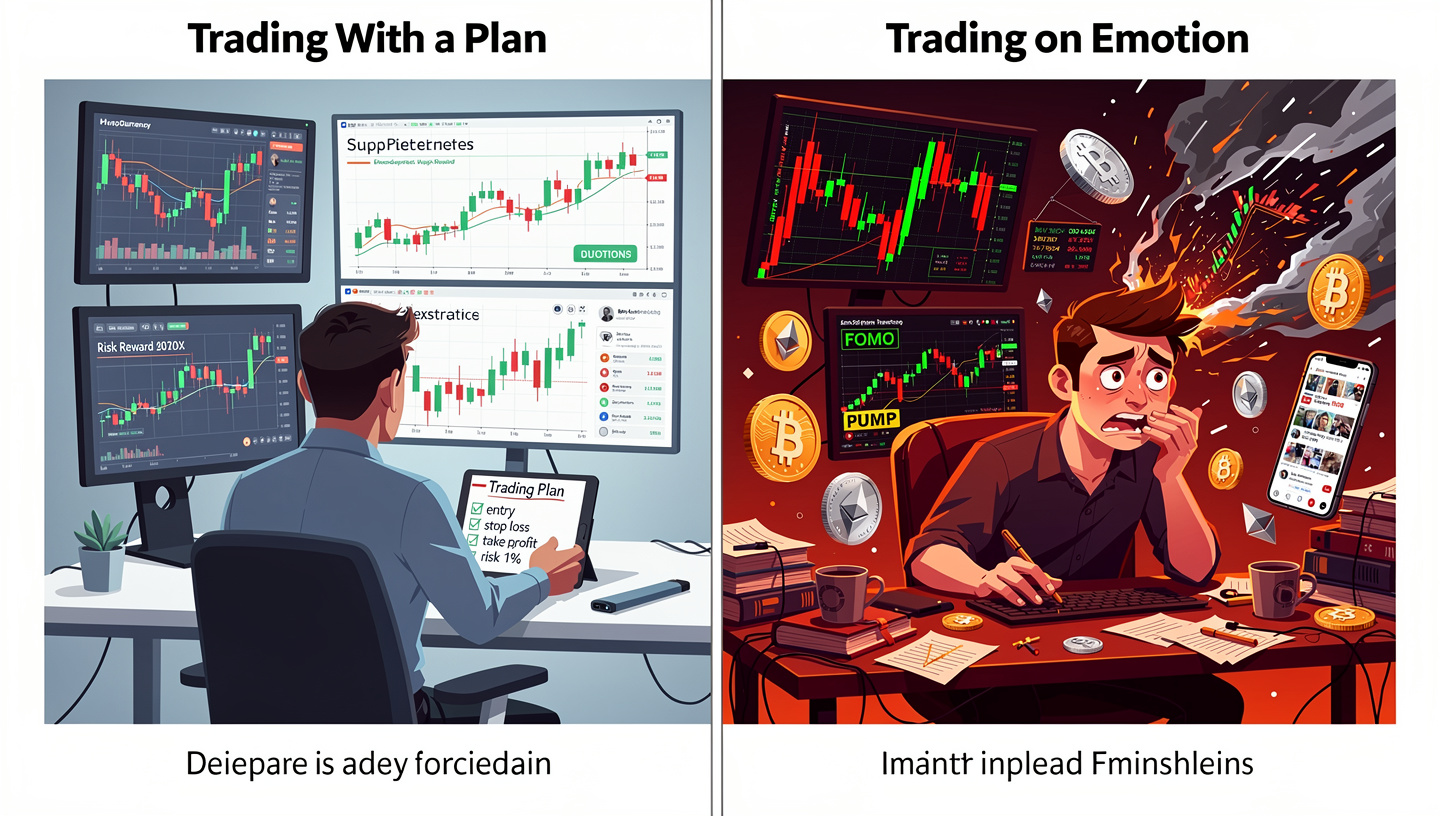
What “Trading With a Plan” Actually Means
A trading plan is not a vague intention like:
“I’ll buy dips and take profits.”
A real plan is a complete operating system for capital deployment. It defines every decision before money is at risk.
At minimum, a professional-grade crypto trading plan includes:
1. Market Selection Rules
Which assets are eligible?
- High-liquidity majors only?
- Specific altcoin sectors?
- Volatility thresholds?
- Volume filters?
Random asset hopping destroys consistency.
2. Entry Criteria
Exact technical or structural conditions that must be present before entering:
- Support/resistance reactions
- Break-and-retest patterns
- Trend alignment across timeframes
- Momentum confirmation
- Order flow shifts
No signal = no trade.
3. Position Sizing Logic
How much capital is deployed per trade.
Not based on confidence.
Based on math.
Common professional frameworks risk 0.25%–2% of account equity per setup. This ensures no single trade can materially damage long-term performance.
4. Stop-Loss Placement
Every trade has an invalidation point.
Not emotional stops.
Structural stops—where the trade thesis is objectively wrong.
Stops exist to protect capital, not comfort.
5. Profit-Taking Strategy
Predetermined exits:
- Fixed risk-to-reward targets
- Partial scaling
- Trailing stops
- Structure-based exits
You decide this before entering.
6. Maximum Daily and Weekly Drawdown
A circuit breaker for your own psychology.
Professional traders stop trading after hitting predefined loss limits. This prevents emotional spirals.
7. Trade Journal
Every trade is logged:
- Setup
- Execution
- Outcome
- Emotional state
- Lessons learned
You cannot improve what you don’t measure.
Trading with a plan means execution becomes mechanical. The emotional burden is reduced because decisions are already made.
What Trading on Emotion Looks Like in Practice
Emotional trading rarely announces itself clearly. It sneaks in through subtle behaviors.
Here’s how it typically manifests.
Chasing Green Candles
Price is exploding upward. Social feeds light up. Influencers scream “breakout.”
You enter late.
This is FOMO—fear of missing out.
You’re not trading a setup. You’re reacting to movement.
These trades usually top out shortly after entry.
Panic Selling Red Candles
Price dumps suddenly.
You exit impulsively—often right into support—only to watch price bounce immediately after.
That’s loss aversion overriding logic.
Revenge Trading
You take a loss.
Instead of stepping away, you immediately open another position to “make it back.”
This compounds mistakes.
Moving Stops
Your stop is hit—but instead of accepting the loss, you widen it.
Now a small loss becomes a large one.
Overtrading
You feel the need to always be in a position.
Flat markets become expensive.
Ignoring Risk Limits
You increase size after wins.
You double down after losses.
Variance takes control.
These behaviors share one root cause: decisions made after emotions are activated.
Once adrenaline enters the system, rational thinking collapses.
The Neuroscience Behind Emotional Trading
This isn’t weakness. It’s biology.
Financial risk triggers the amygdala—the brain’s threat detection center. When activated:
- Cortisol increases
- Heart rate rises
- Tunnel vision develops
- Impulse control drops
Your prefrontal cortex—the part responsible for logic and planning—goes offline.
You literally become less intelligent under stress.
This is why experienced traders design systems that minimize discretionary decision-making.
They don’t rely on willpower.
They rely on structure.
Why Crypto Magnifies Psychological Errors
Crypto introduces unique distortions:
1. Narrative Whiplash
Tweets, headlines, and viral posts create rapid sentiment flips. Even figures like Elon Musk have historically moved markets with single comments.
This destabilizes emotional traders.
2. Continuous Trading
No weekends.
No breaks.
Fatigue accumulates.
Decision quality degrades.
3. Leverage Accessibility
Most exchanges offer leverage with minimal friction.
This accelerates account destruction for emotional traders.
4. Lack of Fundamental Anchors
Crypto often trades on momentum rather than valuation. Without intrinsic reference points, emotions dominate.
Planned Trading Creates Statistical Edge
Trading is not about predicting price.
It’s about executing positive expectancy over large sample sizes.
Edge comes from:
- Defined setups
- Controlled risk
- Consistent execution
- Long-term probability
Individual trades don’t matter.
Your process does.
A planned trader thinks in distributions. An emotional trader thinks in outcomes.
That difference determines survival.
Professional Traders Think in Systems, Not Trades
Institutional desks don’t care about any single position. They operate portfolios of probabilities.
They know:
- 40–55% win rates are normal
- Drawdowns are inevitable
- Losing streaks happen
Their advantage comes from:
- Risk asymmetry
- Capital preservation
- Process fidelity
Retail traders often do the opposite: oversized positions, inconsistent execution, emotional exits.
The Role of Rules-Based Execution
Rules remove ambiguity.
For example:
- “I enter only on 4H trend alignment + daily support.”
- “I risk 1% per trade.”
- “I stop trading after two losses.”
- “I journal every setup.”
These constraints feel restrictive—until you realize they’re what keep you solvent.
Freedom in markets comes from discipline.
Why Most Crypto Traders Never Become Consistently Profitable
Not because strategies don’t work.
Because they abandon them.
They jump systems.
They override rules.
They let emotions dictate entries and exits.
They mistake activity for progress.
Consistency requires boredom.
Boredom requires discipline.
Discipline requires structure.
Building Your Own Trading Plan (Framework)
You don’t need complexity. You need clarity.
Start with:
- One market (e.g., BTC or ETH pairs)
- One timeframe combination
- One entry model
- Fixed risk per trade
- Fixed stop methodology
- Defined take-profit logic
Trade that framework for 100 executions before changing anything.
Most traders never give a system enough time to prove itself.
Emotional Control Is a Skill, Not a Personality Trait
You don’t eliminate emotion.
You design around it.
Practical techniques:
- Pre-session checklists
- Automated stops
- Reduced screen time
- Scheduled breaks
- Trade limits
- Journaling
Professionals engineer environments that reduce impulsive behavior.
Capital Preservation Is the Real Goal
Profit comes later.
First, survive.
Blown accounts don’t compound.
Every elite trader prioritizes downside protection above upside fantasy.
Final Thoughts: Process Over Feeling
Crypto does not reward excitement.
It rewards preparation.
The difference between trading with a plan and trading on emotion is the difference between operating a system and gambling on sensation.
One is slow, structured, and statistically grounded.
The other is fast, reactive, and destructive.
If you want longevity in this market, stop trying to feel your way through price action.
Build rules.
Define risk.
Execute consistently.
Let probability—not emotion—do the heavy lifting.
That is how real traders last.