The crypto market doesn’t whisper before it moves.
It snaps.
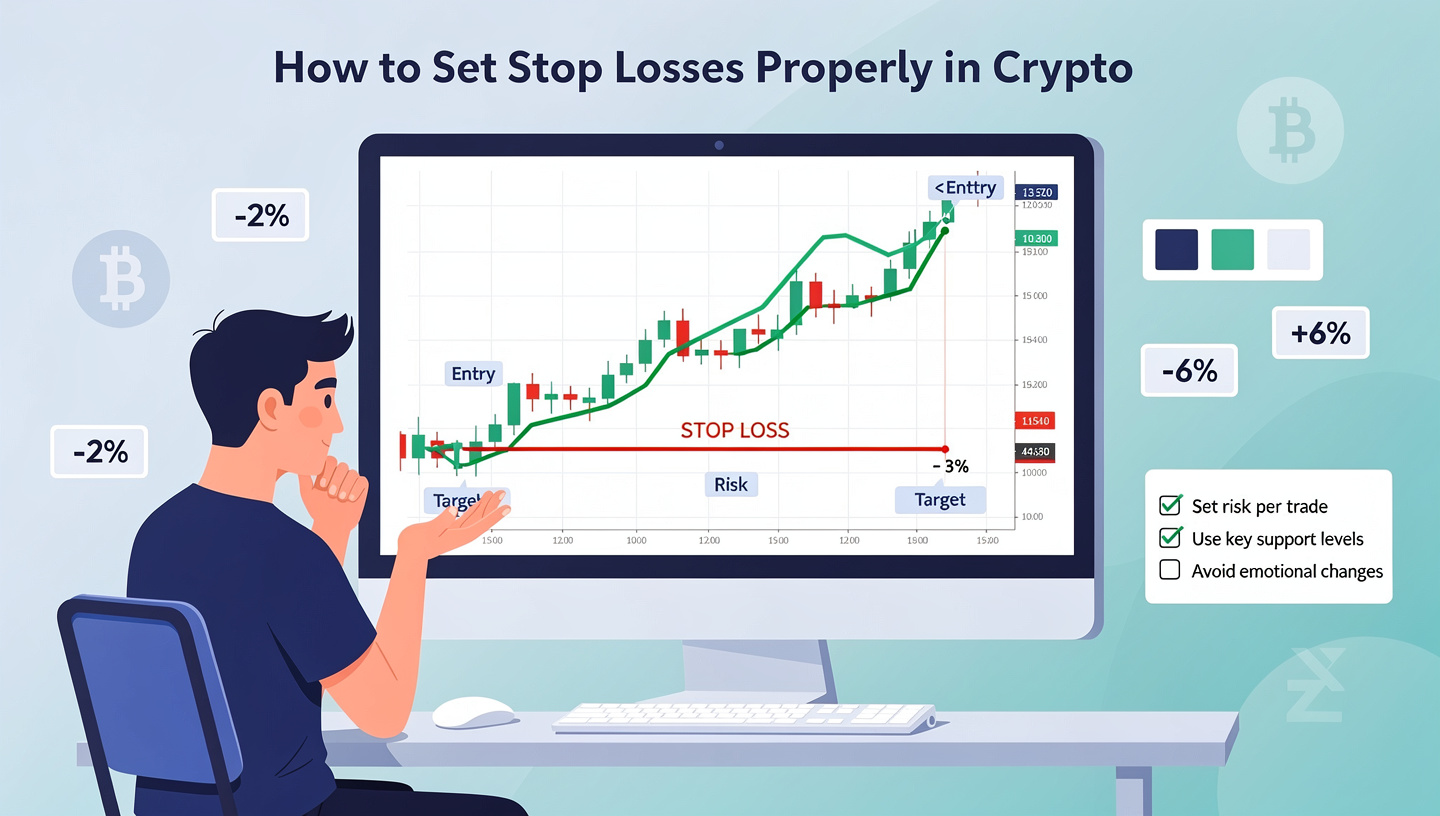
One moment price action feels anesthetized—tight candles, low volume, bored traders scrolling X. The next moment, liquidity evaporates, order books thin, and a 6% wick appears from nowhere. No warning. No mercy. Just velocity.
This is why stop losses are not optional in crypto. They are not a “risk management feature.” They are structural survival equipment.
In traditional markets, you can sometimes get away with sloppy exits. In crypto, you cannot. Twenty-four hour trading, fragmented liquidity, leveraged retail flows, and reflexive narratives create an environment where price can travel farther in five minutes than stocks move in five days.
If you trade without predefined exits, you are not trading—you are improvising under stress.
This article is a complete, research-driven guide to setting stop losses properly in crypto. Not generic advice. Not platitudes about “protecting capital.” Real frameworks used by professional traders. You will learn:
- Why most retail stop losses fail
- The mathematics behind correct placement
- Volatility-based, structure-based, and liquidity-aware methods
- How to size positions around stops (not the other way around)
- Psychological traps that sabotage exits
- Advanced techniques like trailing, time stops, and soft stops
By the end, you’ll understand that a stop loss is not a single line on a chart. It is part of a complete trade architecture.
Why Stop Losses Matter More in Crypto Than Any Other Market
Crypto is not equities. It is not FX. It is not commodities.
Crypto is a hybrid of:
- retail-dominant order flow
- high leverage availability
- shallow spot liquidity outside majors
- narrative-driven volatility
- constant global trading
This combination produces extreme price behavior.
A routine funding imbalance can cascade into liquidation chains. A single whale market order can dislocate price across multiple venues. Weekend liquidity gaps routinely cause multi-percent slippage.
Even large assets like Bitcoin and Ethereum regularly experience intraday swings that would trigger circuit breakers in traditional markets.
Stop losses exist to protect you from:
- Adverse volatility
- Black swan headlines
- Liquidity vacuum events
- Your own emotional overrides
If you do not define risk before entering a trade, the market will define it for you.
And the market is not generous.
The Core Principle: You Don’t Place Stops Based on Pain — You Place Them Based on Structure
Most beginners set stops where it “feels reasonable.”
Examples:
- “I’ll risk 3%.”
- “If it drops a bit more, I’m out.”
- “Just below my entry.”
These are emotional stops. They are not market-aware.
Professional traders do the opposite:
They first identify where the trade idea becomes invalid.
Only then do they calculate position size.
This distinction is everything.
A correct stop loss answers one question:
At what price is my thesis objectively wrong?
Not uncomfortable. Wrong.
If you can’t articulate that level, you are guessing.
The Three Categories of Stop Losses
Every effective stop strategy falls into one of three families.
1. Structure-Based Stops
These use market structure:
- Swing highs/lows
- Support and resistance
- Range boundaries
- Trendline breaks
- Market structure shifts (higher lows → lower lows)
Example:
You go long after a higher low forms. The stop belongs below that higher low. If price breaks it, the trend structure failed.
Advantages:
- Conceptually clean
- Aligned with price logic
- Widely used by discretionary traders
Disadvantages:
- Obvious levels attract stop hunts
- Can be wide in volatile markets
Structure stops are ideal for swing trading and higher timeframes.
2. Volatility-Based Stops
These adapt to market conditions using indicators like:
- ATR (Average True Range)
- Standard deviation
- Historical volatility
Instead of arbitrary distances, stops expand and contract with volatility.
A common method:
Stop = Entry − (1.5 × ATR)
When volatility rises, stops widen. When volatility compresses, stops tighten.
Advantages:
- Dynamic and adaptive
- Reduces random noise stop-outs
- Works well for systematic strategies
Disadvantages:
- Can drift far from logical structure
- Requires indicator calibration
Volatility stops are preferred in algorithmic and rules-based systems.
3. Time-Based Stops
These exit trades that fail to perform within a defined window.
Example:
“If price hasn’t moved in my favor after 12 candles, I exit.”
This handles opportunity cost and dead capital.
Advantages:
- Prevents capital stagnation
- Reduces chop exposure
Disadvantages:
- Can exit before breakout
- Requires patience and discipline
Time stops are powerful when combined with structure or volatility stops.
Why Most Crypto Stops Get Hit (Even When the Trade Was Right)
Retail traders love obvious levels.
So do market makers.
Crypto markets routinely sweep:
- Equal lows
- Round numbers
- Recent candle wicks
- Clean support lines
These areas accumulate clustered stops.
Liquidity seeks clusters.
If your stop sits exactly at textbook support, you are providing exit liquidity for larger participants.
This is not conspiracy. It is microstructure.
To mitigate this:
- Place stops beyond structure, not on it
- Use volatility buffers
- Avoid round numbers
- Accept slightly larger risk to avoid noise
A stop 0.5% wider that survives is infinitely better than a tight stop that dies early.
Position Sizing Comes After Stop Placement — Never Before
This is where most traders invert logic.
They decide:
“I’ll trade $1,000.”
Then they pick a stop.
Correct process:
- Define entry
- Define invalidation (stop)
- Calculate distance to stop
- Size position so risk equals fixed percentage of capital
Formula:
Position Size = Account Risk ÷ Stop Distance
If you risk 1% of a $10,000 account ($100) and your stop is 4% away:
Position = $100 ÷ 0.04 = $2,500
Not negotiable.
This ensures:
- Every trade risks the same capital
- Losses are bounded
- Drawdowns are mathematically survivable
Without this, stops are cosmetic.
Fixed Percentage Stops: Why They Underperform
Many guides recommend fixed stops like 2% or 5%.
This ignores volatility regimes.
A 2% stop on a meme coin is meaningless.
A 2% stop on a low-vol large cap might be excessive.
Markets breathe differently.
Static percentages create asymmetric outcomes:
- Too tight in volatile conditions
- Too loose in calm conditions
Use market information, not arbitrary numbers.
Trailing Stops: Tool, Not Crutch
Trailing stops move with price.
They are excellent for:
- Trend capture
- Hands-off trade management
- Protecting profits
But they have limitations.
Tight trailing stops exit early in strong trends.
Loose trailing stops give back large unrealized gains.
Professional approach:
- Initial hard stop for protection
- Partial profit at predefined levels
- Trailing stop only after structure confirms continuation
Never trail immediately after entry.
Let the trade earn the right to be protected.
Hard Stops vs Soft Stops
Hard Stops
Placed directly on the exchange.
Pros:
- Automatic execution
- Protection during disconnects
Cons:
- Visible to order book
- Vulnerable to stop hunts
Necessary when trading leveraged products on venues like Binance or Coinbase.
Soft Stops
Mental or alert-based exits.
Pros:
- Invisible to market
- Flexible
Cons:
- Require discipline
- Fail during fast crashes
Suitable only for experienced traders watching charts in real time.
Most retail traders should use hard stops.
Slippage and Liquidity: The Hidden Cost of Bad Stops
In crypto, your stop price is not always your fill price.
During rapid moves:
- Order books thin
- Market orders cascade
- Slippage increases
To reduce damage:
- Avoid stops during low-liquidity hours
- Use limit-stop hybrids when available
- Trade assets with deep books
- Accept wider stops on illiquid pairs
Ignoring liquidity transforms controlled losses into uncontrolled ones.
Common Stop Loss Mistakes That Destroy Accounts
1. Moving Stops Further Away
This converts planned risk into emotional risk.
Once moved, discipline collapses.
2. Removing Stops After Entry
This turns trades into prayers.
3. Tight Stops With Large Size
This creates death by a thousand paper cuts.
4. Random Stops
Stops placed without structural or volatility logic.
5. Revenge Re-Entries
Re-entering immediately after being stopped out, without new setup.
Advanced Techniques Used by Professionals
Scaling Stops
Instead of one stop, traders reduce exposure in stages.
Example:
- 50% exit at structure break
- Remaining stopped at deeper invalidation
This smooths outcomes.
Volatility Expansion Filters
Avoid initiating trades when ATR spikes above historical norms. High volatility increases stop failure rates.
Session-Based Stops
Crypto trades globally, but liquidity concentrates during US and EU overlaps.
Stops during Asian hours behave differently than during NY open.
Time awareness matters.
R-Multiple Tracking
Every trade is measured in R (risk units).
+2R, −1R, +3R.
This standardizes performance across strategies.
Professional journals are built around R, not percentages.
Psychological Engineering: Why Stops Fail in the Mind Before They Fail on the Chart
Most traders intellectually understand stop losses.
Emotionally, they resist them.
Loss aversion causes:
- Stop widening
- Hesitation
- Hope trading
The solution is process automation:
- Predefined rules
- Position sizing formulas
- Written trading plans
- Journaling outcomes
You are not here to be right.
You are here to execute.
A Practical Stop Loss Workflow (Repeatable)
For every trade:
- Identify setup
- Mark invalidation level
- Measure stop distance
- Calculate position size
- Place stop immediately
- Log trade
- Do nothing until exit or target
This is not glamorous.
It is professional.
Why Great Traders Obsess Over Losses, Not Wins
Wins take care of themselves.
Losses compound.
If your average loss is controlled and your winners exceed it, profitability becomes mathematical, not emotional.
This is how durable trading careers are built.
Not from prediction.
From risk architecture.
Final Thoughts: Stop Losses Are Not Defensive — They Are Offensive
A stop loss is not a sign of weakness.
It is a declaration of control.
It allows you to:
- Trade larger over time
- Survive volatility
- Avoid catastrophic drawdowns
- Stay mentally stable
- Compound capital
Every elite trader understands this.
Every blown account ignored it.
Crypto rewards discipline and punishes improvisation.
Set your stops based on structure. Size your positions based on risk. Accept losses without negotiation. Let winners run. Repeat.
That is not retail behavior.
That is professional behavior.
And in a market as unforgiving as crypto, professionalism is the only edge that compounds.