At some point in every trader’s evolution, a quiet realization arrives:
It isn’t your entry that determines your survival.
It isn’t your indicator stack.
It isn’t even your win rate.
It’s how much you put on the line when you’re wrong.
Crypto markets have a talent for exposing illusions. They don’t reward conviction; they reward calibration. They don’t care about narratives or bravado. They care about sizing.
You can be directionally correct and still go broke.
You can be wrong half the time and build wealth.
The difference lives in position sizing.
This article is not about signals. It is not about chart patterns. It is not about which coin is “next.” It is about the single mechanical decision that quietly determines whether your trading career compounds—or collapses.
Why Position Sizing Is the Real Edge
Most crypto traders obsess over entries. Professionals obsess over exposure.
That distinction matters.
Entry determines where you participate.
Position size determines whether you survive.
In traditional markets, leverage is constrained, volatility is dampened, and drawdowns unfold slowly. Crypto removes all of those guardrails. Assets routinely swing 5–15% in a single day. Liquidations cascade. Funding flips. Correlations spike during stress.
In that environment, improper sizing is not a mistake—it is a structural liability.
Consider two traders:
- Trader A risks 20% of capital per trade with a 60% win rate.
- Trader B risks 1.5% per trade with a 45% win rate.
Trader A feels confident. Trader B feels boring.
Six months later, Trader A is gone. Trader B is still compounding.
This is not hypothetical. It is mathematics.
Position sizing governs:
- Maximum drawdown
- Recovery time
- Psychological stability
- Strategy viability
- Long-term expectancy
Without disciplined sizing, even excellent strategies decay.
The Hidden Geometry of Losses
Losses are nonlinear.
Lose 10% and you need 11% to recover.
Lose 25% and you need 33%.
Lose 50% and you need 100%.
Lose 80% and you need 400%.
Crypto traders routinely underestimate this asymmetry.
Large position sizes feel efficient during winning streaks. They feel catastrophic during volatility expansions—which crypto delivers on schedule.
Your goal is not to avoid losses. Your goal is to make losses irrelevant.
That requires mathematical containment.
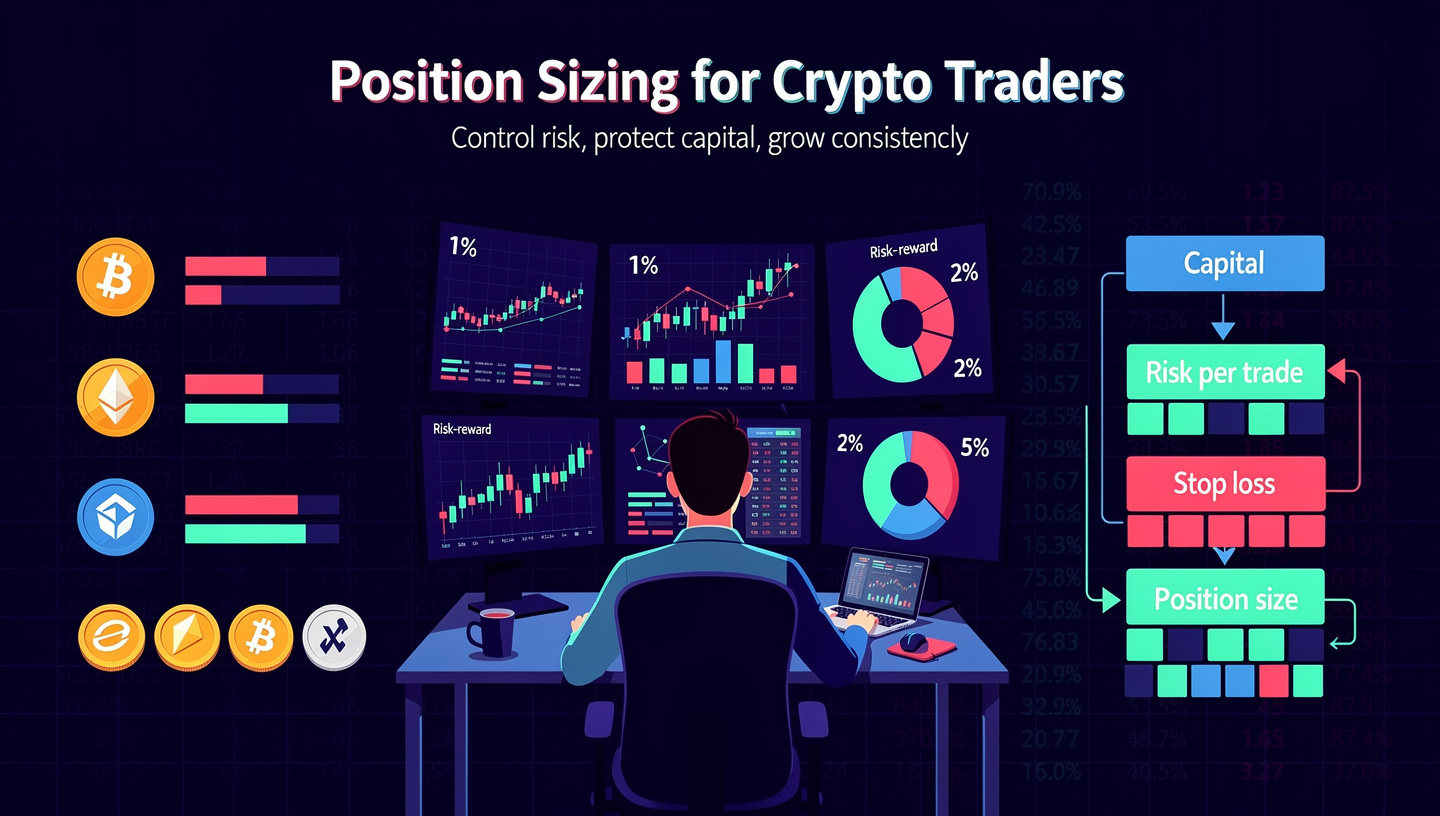
Fixed Percentage Risk: The Foundation Model
The most durable sizing framework is simple:
Risk a fixed percentage of your account on every trade.
Not position size.
Not leverage.
Actual risk—defined as capital lost if your stop is hit.
Example:
- Account size: $50,000
- Risk per trade: 1% ($500)
- Entry: $100
- Stop: $95 (5% distance)
Position size = $500 / 5% = $10,000
So you allocate $10,000 to the trade.
If price hits your stop, you lose $500—no more.
This approach:
- Normalizes volatility
- Prevents emotional overexposure
- Automatically scales as your account grows or shrinks
- Keeps drawdowns mathematically survivable
Most professionals operate between 0.5% and 2% risk per trade. Anything above 3% dramatically increases ruin probability in volatile markets like crypto.
Why Most Crypto Traders Oversize (and Don’t Realize It)
Crypto culture subtly encourages oversized risk:
- Perpetual futures with 20x–100x leverage
- Social feeds celebrating massive PnL screenshots
- Influencers modeling reckless exposure
- Exchanges like Binance and Coinbase making leverage frictionless
The result: traders measure position size in notional value instead of risk.
They say:
“I opened a $50,000 position.”
Instead of:
“I risked 1.2% of my account.”
This framing error is fatal.
Notional size is meaningless. Risk defines reality.
Volatility-Adjusted Position Sizing
Crypto assets exhibit radically different volatility profiles.
A 3% stop on one token may be noise. On another, it may be unreachable.
Professional traders adapt size to volatility using metrics like Average True Range (ATR).
The logic:
- Wider stops for volatile assets
- Tighter stops for stable assets
- Constant account risk across both
Formula:
Position Size = Account Risk ÷ Stop Distance (ATR-adjusted)
This prevents you from unintentionally concentrating risk in high-beta assets.
It also solves a common problem: traders using identical sizes across wildly different coins.
That is not diversification. That is accidental leverage.
The Kelly Criterion (and Why You Should Only Use a Fraction)
The Kelly Criterion is a mathematical formula that maximizes long-term capital growth based on edge and win rate.
In theory, it provides optimal sizing.
In practice, full Kelly is suicidal in crypto.
Why?
Because:
- Your win rate is an estimate
- Your payoff ratio changes
- Market regimes shift
- Fat tails exist
Using full Kelly assumes stable probabilities. Crypto offers none.
Professionals who reference Kelly typically apply 0.25x or 0.5x Kelly at most.
For retail traders, fixed fractional sizing is safer, simpler, and more robust.
Kelly belongs in hedge fund research models—not retail crypto accounts.
Correlation Risk: The Silent Position Multiplier
You think you have five positions.
You actually have one.
Crypto assets correlate heavily during stress events. When liquidity disappears, everything trades together.
Holding:
- BTC
- ETH
- SOL
- AVAX
- OP
…is not diversification.
It is a single macro bet expressed five ways.
Proper position sizing must account for correlation clusters.
If your portfolio is concentrated in one narrative or ecosystem, your effective exposure is much higher than it appears.
Professional desks cap total correlated risk, not just individual trade risk.
Scaling In and Out Without Destroying Risk Structure
Many traders scale entries. Fewer scale exits properly.
Scaling in increases exposure. Scaling out reduces it. Both must preserve predefined risk.
Correct approach:
- Define total risk upfront (e.g., 1%).
- Divide that risk across planned entries.
- Recalculate stops dynamically as size changes.
Incorrect approach:
- Add size because price moves against you
- “Average down” without adjusting risk
- Let winning trades balloon unchecked
The first method is engineering.
The second is gambling.
Position Sizing for Spot vs Futures
Spot Trading
Risk is capped at 100% of allocated capital.
Still dangerous, but bounded.
Sizing focuses on:
- Portfolio allocation
- Drawdown control
- Opportunity cost
Futures Trading
Risk is theoretically unlimited.
Here, sizing must incorporate:
- Liquidation price
- Maintenance margin
- Funding rates
- Slippage during volatility
A 2% account risk on futures can become 5% in fast markets if stops slip.
Professional futures traders size smaller than spot traders for this reason.
Drawdown-Based Dynamic Sizing
Advanced traders reduce risk during losing streaks.
Example rule:
- Normal risk: 1%
- After 5% drawdown: reduce to 0.75%
- After 10% drawdown: reduce to 0.5%
- Restore gradually after recovery
This protects psychological capital and prevents tilt from compounding damage.
You do not trade the same when you’re down 12%. Your sizing should reflect that.
Risk of Ruin: The Metric Nobody Tracks (But Should)
Risk of ruin estimates the probability your account hits a critical drawdown level given:
- Win rate
- Risk per trade
- Payoff ratio
Small increases in risk per trade dramatically raise ruin probability.
For example:
- 1% risk: survivable
- 3% risk: dangerous
- 5% risk: statistically terminal over enough trades
Crypto traders often operate at implicit 10–20% risk without realizing it.
That is not trading. That is time-delayed liquidation.
Psychological Capital Is Real Capital
Oversizing doesn’t just damage your account. It damages your decision-making.
Large positions create:
- Emotional attachment to trades
- Hesitation on exits
- Revenge trading
- Strategy abandonment
Small, consistent risk keeps you objective.
Professionals optimize for decision quality, not excitement.
The Institutional Perspective
Quant firms and crypto funds don’t ask:
“Is this trade good?”
They ask:
“How does this exposure affect portfolio variance?”
They model:
- Maximum adverse excursion
- Expected shortfall
- Cross-asset correlation
- Liquidity under stress
Retail traders can’t replicate institutional infrastructure—but they can adopt institutional discipline:
- Predefined risk
- Consistent sizing
- Correlation awareness
- Drawdown controls
These principles scale from $1,000 accounts to nine-figure portfolios.
A Note on Narrative Risk and Public Influence
Crypto markets are uniquely sensitive to public figures.
A single post from Elon Musk has historically moved entire sectors.
This creates headline-driven volatility spikes that invalidate tight stops and punish oversized positions.
Position sizing is your only defense against narrative shock.
You cannot predict tweets.
You can control exposure.
Practical Position Sizing Framework (Actionable)
Here is a battle-tested baseline:
- Risk 0.5%–1.5% of account per trade
- Define stop before entry
- Calculate position size from stop distance
- Cap total correlated exposure at 3%–5%
- Reduce risk after drawdowns
- Never increase size to recover losses
- Journal risk, not just PnL
If you follow this consistently, you will outperform 90% of crypto traders regardless of strategy.
Why Position Sizing Beats Strategy Hopping
Most traders cycle through systems.
They don’t need new strategies.
They need stable risk.
A mediocre strategy with excellent sizing beats a brilliant strategy with reckless exposure.
Every time.
The Final Truth
Crypto rewards patience disguised as discipline.
Position sizing is not glamorous. It doesn’t produce screenshots. It doesn’t trend on social media. It doesn’t feel heroic.
But it works.
It keeps you solvent during chaos.
It lets probability play out.
It converts volatility from threat into raw material.
Markets don’t care how smart you are.
They care how much you risk when you’re wrong.
Master that, and everything else becomes optional.