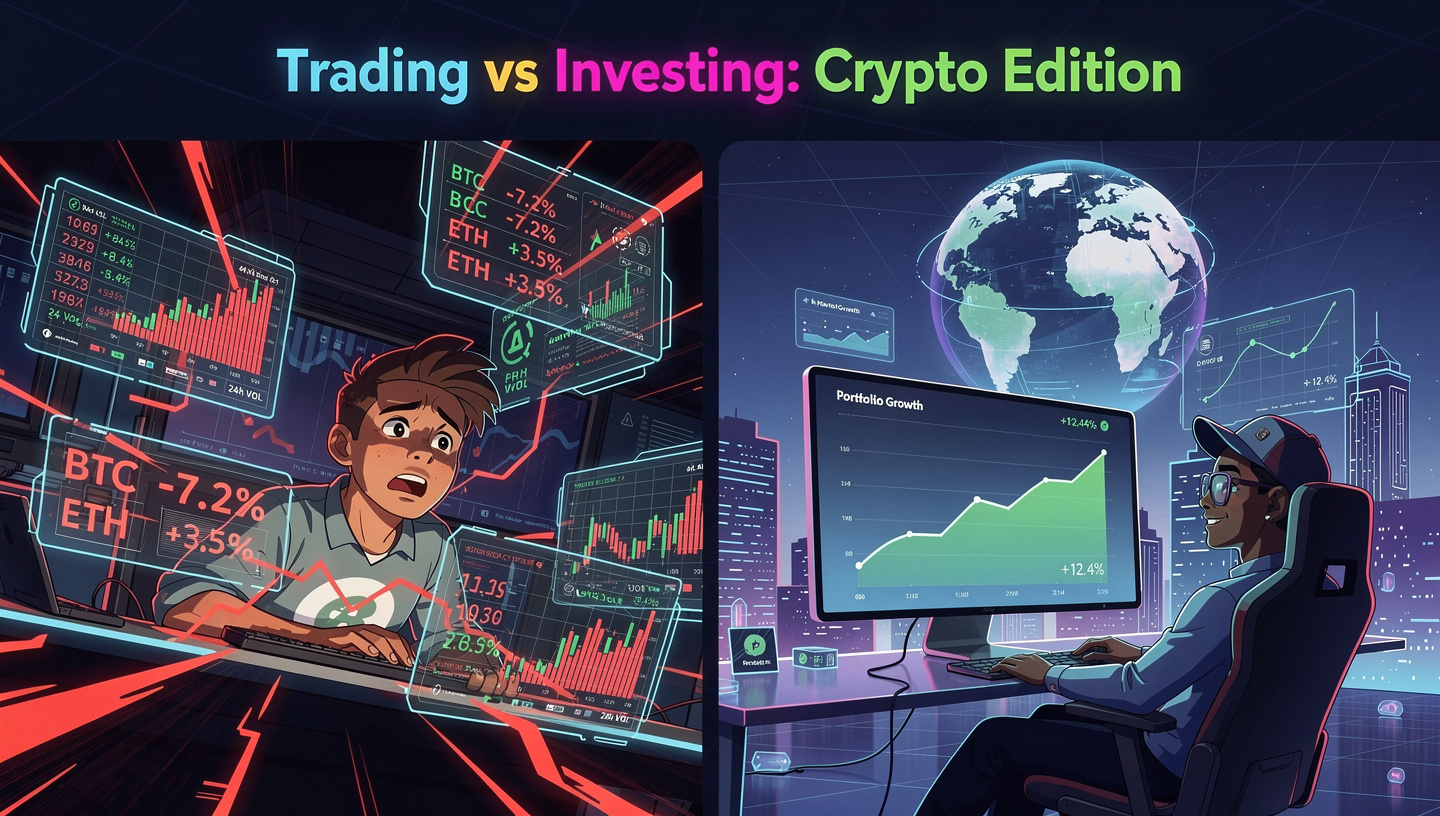
The crypto market doesn’t announce itself with a bell. It breathes—quietly at first—then suddenly accelerates, compressing months of price discovery into a single afternoon. Blocks are mined, transactions are finalized, and somewhere in the background, code executes without asking permission. This is not Wall Street. This is a parallel financial system running in real time, twenty-four hours a day, governed by math, incentives, and human emotion.
In that environment, two archetypes collide every minute:
- the trader, reacting to volatility
- the investor, positioning for structural change
They often hold the same assets. They sometimes use the same tools. But their philosophies, time horizons, and risk profiles are fundamentally different.
Understanding that difference—deeply and practically—is the fastest way to stop losing money in crypto.
This article dissects both approaches with technical precision, behavioral realism, and market context. No motivational fluff. No recycled clichés. Just a clear framework for deciding how you should operate in digital assets.
Crypto Is Not a Market. It’s an Engine.
Traditional finance moves on schedules. Crypto moves on consensus.
Every ten minutes, Bitcoin finalizes another block. Smart contracts on Ethereum execute autonomously. Liquidity migrates globally with a wallet signature. Capital formation happens in Discord servers. Governance proposals pass while you sleep.
This creates three properties that radically change strategy design:
- Continuous price discovery
- Reflexive narratives
- Permissionless participation
In equities, trading and investing exist on the same infrastructure. In crypto, they exist inside a living system that rewrites itself.
That’s why applying traditional stock-market thinking here usually fails.
Definitions That Actually Matter
Let’s remove the vague terminology.
Crypto Trading
Trading is the act of extracting profit from price movement.
Key characteristics:
- Short to medium time horizons (minutes to weeks)
- Heavy reliance on technical analysis and order flow
- Frequent entries and exits
- Capital efficiency over conviction
- High sensitivity to volatility
A trader doesn’t care what the protocol does. A trader cares where liquidity sits and how price reacts to it.
Crypto Investing
Investing is the act of allocating capital to long-term network growth.
Key characteristics:
- Long time horizons (months to years)
- Focus on fundamentals and adoption curves
- Low turnover
- Conviction over timing
- Exposure to asymmetric upside
An investor doesn’t care about today’s RSI divergence. An investor cares whether a protocol will still matter in five years.
Same market. Entirely different game.
The Structural Difference: Velocity vs Gravity
Think in physics terms.
Trading operates on velocity: momentum, acceleration, short-term imbalance.
Investing operates on gravity: network effects, developer activity, economic throughput.
Velocity creates opportunity. Gravity creates wealth.
Most retail participants confuse the two—and pay for it.
How Crypto Traders Actually Make Money
Professional crypto traders do not “buy dips and sell rips.” That’s retail folklore.
They operate on:
1. Liquidity Mapping
Price moves toward liquidity. Always.
Traders identify:
- Equal highs/lows
- Stop clusters
- Funding imbalances
- Open interest expansions
They position where forced orders are likely to execute.
This is why price often moves irrationally right before reversing—it’s harvesting leverage.
2. Volatility Compression and Expansion
Crypto cycles between low-volatility ranges and explosive breakouts.
Traders profit by:
- Accumulating during compression
- Distributing during expansion
They don’t chase. They wait.
3. Market Structure
Higher highs, higher lows. Lower highs, lower lows.
Sounds simple. In practice, it requires discipline under extreme emotional pressure.
4. Derivatives and Leverage
Perpetual futures amplify both gains and losses.
Most retail traders blow up here.
Professionals treat leverage as a tool, not a multiplier.
Why Most Crypto Traders Fail
The data is brutal.
Over 80% of active retail traders lose money over time.
Primary causes:
- Overtrading
- Emotional entries
- No risk model
- Chasing narratives
- Excessive leverage
Crypto’s 24/7 nature destroys attention spans. People trade out of boredom. That alone is enough to bankrupt accounts.
If you cannot execute a rule-based system without improvisation, trading is not for you.
The Investor’s Edge: Asymmetry
Investing in crypto is not about picking tops and bottoms.
It’s about capturing asymmetric payoff structures.
You risk 1x. You potentially gain 20x, 50x, or more.
This only exists because crypto networks are still early in their adoption lifecycle.
Early investors in Satoshi Nakamoto’s experiment weren’t rewarded for timing. They were rewarded for conviction.
What Crypto Investors Analyze
Serious investors don’t read headlines. They analyze systems.
Key dimensions:
1. Token Economics
- Supply schedule
- Emission rate
- Burn mechanisms
- Utility vs speculation
Bad token design kills good technology.
2. Developer Activity
GitHub commits matter more than Twitter followers.
Sustained development signals long-term viability.
3. Network Usage
Daily active addresses. Transaction volume. Fee generation.
Usage precedes price.
4. Governance and Decentralization
Who controls upgrades? Who holds voting power?
Centralized protocols carry regulatory and operational risk.
5. Regulatory Surface Area
Projects operating in gray zones face existential threats, especially from bodies like the U.S. Securities and Exchange Commission.
Exchanges Are Not Neutral Infrastructure
Where you trade matters.
Platforms like Binance and Coinbase shape liquidity, listings, and market psychology.
Listing announcements move markets. Delistings destroy projects.
An investor treats exchanges as distribution channels.
A trader treats them as battlegrounds.
Time Horizon Is Strategy
This is the single most overlooked variable.
- Traders operate on hours to days
- Swing traders operate on weeks
- Investors operate on years
Problems arise when people mix timeframes.
They enter long-term positions with short-term expectations. Then they panic sell during normal drawdowns.
Decide your horizon first. Everything else follows.
Portfolio Construction: Two Buckets
Advanced participants separate capital into:
Core (Investment Capital)
- Long-term holdings
- Cold storage
- Rarely touched
This is where conviction lives.
Active (Trading Capital)
- High turnover
- Strict risk rules
- Acceptable loss tolerance
This is where skill is tested.
Blending these destroys both.
Risk Management Is the Business Model
Not alpha. Not narratives.
Risk.
Professional traders think in distributions, not outcomes.
They define:
- Max loss per trade
- Max daily drawdown
- Position sizing rules
Investors define:
- Portfolio allocation
- Rebalancing thresholds
- Thesis invalidation points
Without this, you’re not participating in markets—you’re gambling.
Taxes, Fees, and Slippage: The Silent Killers
Every trade incurs friction:
- Exchange fees
- Bid/ask spread
- Slippage
- Tax liability
High-frequency strategies collapse under these costs unless executed at scale.
Investors benefit from low turnover.
This is another structural advantage of long-term positioning.
Narrative Cycles Drive Crypto
Crypto does not move on earnings. It moves on stories.
- DeFi
- NFTs
- Layer-2s
- AI tokens
- Real-world assets
Traders ride narratives.
Investors evaluate whether narratives become infrastructure.
Most don’t.
Psychological Load: Trading vs Investing
Trading demands constant attention and emotional regulation.
Investing demands patience and intellectual honesty.
Both are difficult. In different ways.
Trading burns you out.
Investing tests your ability to sit still while your portfolio swings 40%.
Choose your stress.
Hybrid Approaches: Can You Do Both?
Yes—but only with separation.
Successful hybrids:
- Hold long-term positions
- Trade around them with small size
- Never risk core capital
- Keep distinct wallets/accounts
Most people fail here because they emotionally merge the buckets.
Which Path Is Right for You?
Answer honestly:
- Do you enjoy execution under pressure?
- Can you follow rules without deviation?
- Do you have time to monitor markets daily?
If yes: explore trading.
If not:
- Accumulate quality assets
- Study fundamentals
- Hold through cycles
There is no shame in investing.
There is only poor alignment between personality and strategy.
Final Thoughts: Crypto Rewards Clarity
Crypto does not care about your hopes, your timing, or your favorite YouTuber.
It rewards:
- discipline
- patience
- research
- risk control
Trading and investing are not rivals. They are tools.
Used correctly, both can compound capital.
Used incorrectly, both will extract tuition.
Decide who you are in this ecosystem.
Then act accordingly.
That decision matters more than any chart pattern, token launch, or headline.
In a market that never sleeps, clarity is your edge.