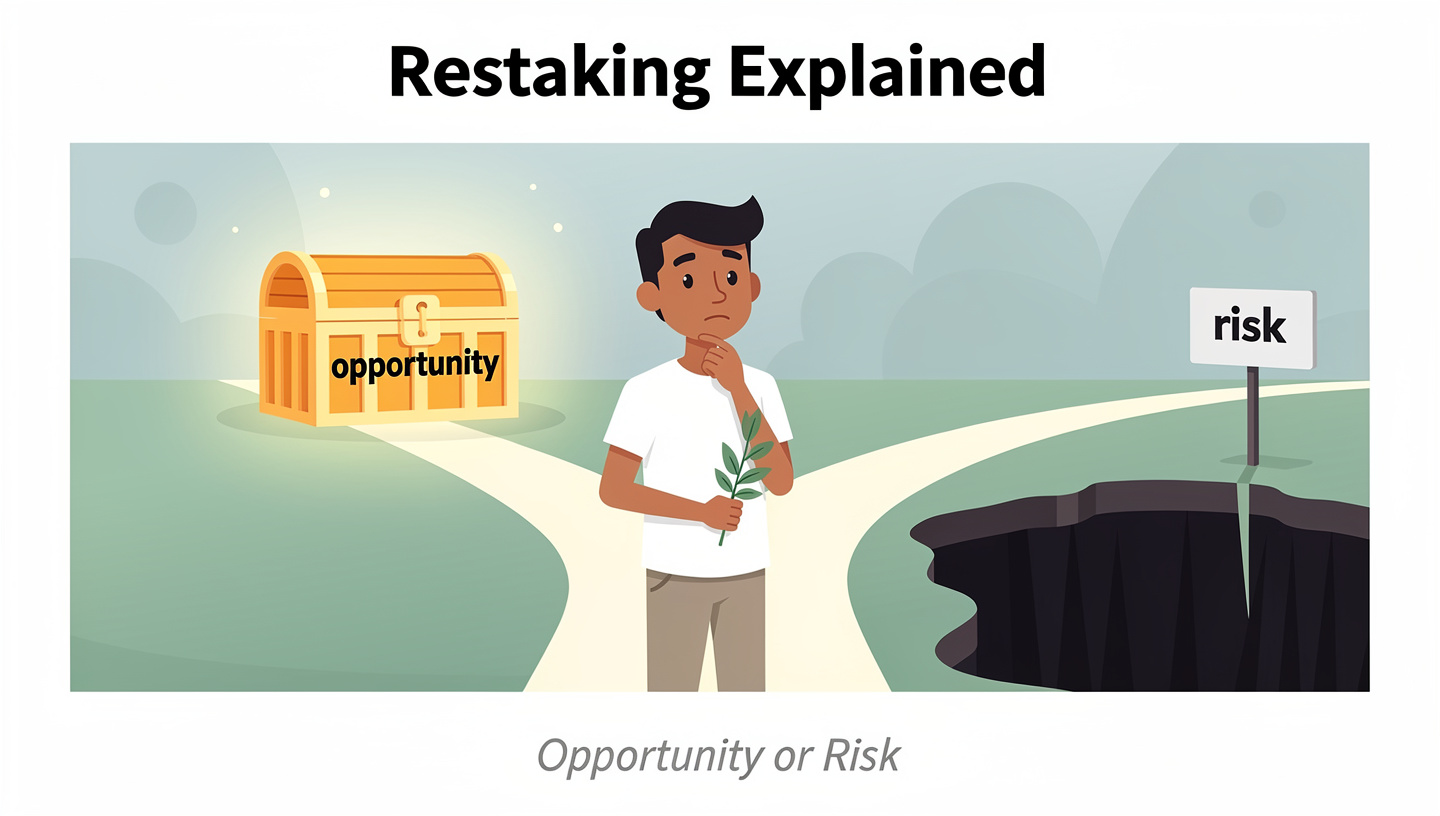
Before you think about APYs, before you chase the next protocol, before you optimize for yield, there is a simpler and more brutal equation that governs long-term success in crypto passive income:
One strategy failing should never threaten your entire portfolio.
This is not philosophy. It is arithmetic.
In traditional investing, diversification is taught as a defensive concept. In crypto, it becomes existential. Protocol risk, smart contract risk, market volatility, liquidity shocks, governance failures, regulatory changes—these are not edge cases. They are routine.
Passive income in crypto is not about finding the best yield.
It is about constructing a system where multiple independent income engines operate simultaneously—each with different risk vectors, cash flow mechanics, and market sensitivities.
The goal is not maximum APY.
The goal is durable compounding.
This article presents a structured framework for diversifying crypto passive income streams with institutional thinking: separating yield sources, mapping risks, allocating capital rationally, and building resilience across cycles.
What “Diversification” Actually Means in Crypto Passive Income
Most retail investors misunderstand diversification.
They believe holding five tokens instead of one counts as diversification.
It does not.
True diversification in crypto passive income operates across five dimensions:
- Yield Mechanism – how income is generated
- Protocol Layer – where value is extracted
- Asset Type – what capital is deployed
- Risk Class – what can go wrong
- Market Correlation – when it performs well or poorly
If two strategies fail under the same conditions, they are not diversified.
Let’s break this down.
Dimension 1: Diversifying by Yield Mechanism
Every passive income strategy ultimately derives yield from one of four economic engines:
1. Network Security (Staking)
Examples:
- Ethereum staking
- Solana validators
- Cosmos zones
Yield source:
- Block rewards
- Transaction fees
Characteristics:
- Generally predictable
- Inflationary rewards
- Dependent on network adoption
Primary risks:
- Slashing
- Token price depreciation
- Validator centralization
Staking represents productive infrastructure yield—you are paid for securing a network.
This should form the foundation of most passive portfolios.
2. Liquidity Provision
Examples:
- Uniswap pools
- Curve stablecoin pools
- Balancer weighted pools
Yield source:
- Trading fees
- Incentive emissions
Characteristics:
- Variable income
- Sensitive to volume
- Exposed to impermanent loss
Primary risks:
- IL (impermanent loss)
- Reward dilution
- Pool imbalance
Liquidity provision is effectively market-making income.
It performs best during high volatility and high trading activity.
3. Lending and Borrowing
Examples:
- Aave
- Compound
- Spark
- Morpho
Yield source:
- Borrower interest
- Incentives
Characteristics:
- Conservative relative to LP
- Depends on leverage demand
Primary risks:
- Bad debt (rare but catastrophic)
- Oracle failures
- Liquidation cascades
Lending produces credit-based yield, analogous to fixed income.
4. Protocol Revenue Sharing
Examples:
- GMX
- Gains Network
- Pendle
- dYdX
Yield source:
- Platform fees
- Trading revenue
- Protocol cash flow
Characteristics:
- Direct exposure to protocol success
- Often tokenized
Primary risks:
- Governance capture
- Revenue decline
- Tokenomics changes
This is closest to equity-like yield.
Strategic Principle
A robust passive portfolio includes all four mechanisms.
If your income comes from only staking or only LPs, you are structurally fragile.
Dimension 2: Diversifying Across Protocol Layers
Crypto income exists across multiple infrastructure layers:
Layer 1 Networks
Ethereum, Solana, Avalanche
Layer 2s
Arbitrum, Optimism, Base
DeFi Protocols
DEXs, lending markets, derivatives platforms
Middleware
Oracles, bridges, liquid staking providers
Each layer fails differently.
Ethereum staking risk is not Uniswap LP risk.
Chain risk is not protocol governance risk.
Allocating capital across layers reduces correlated failure.
Dimension 3: Asset-Based Diversification
Never generate yield from only one asset class.
At minimum, your portfolio should include:
Native Tokens
ETH, SOL, ATOM
Stablecoins
USDC, DAI, FRAX
LSDs (Liquid Staking Derivatives)
stETH, rETH, cbETH
Yield Tokens
Pendle PT/YT
GLP
Protocol LP tokens
Each reacts differently to market stress.
Stablecoins protect during crashes.
Native tokens outperform during expansions.
LSDs improve capital efficiency.
Yield tokens allow duration management.
Asset diversification smooths income volatility.
Dimension 4: Risk-Class Separation
Every crypto yield strategy falls into one of these buckets:
Low Risk
- ETH staking
- Blue-chip lending
- Stablecoin LPs
Medium Risk
- Incentivized LPs
- LSD strategies
- Revenue-sharing protocols
High Risk
- New protocols
- Farming emissions
- Experimental primitives
Professional allocators cap high-risk exposure at 10–20%.
Retail investors often reverse this ratio.
That is why most retail portfolios implode.
Dimension 5: Market Regime Sensitivity
Different strategies thrive in different environments:
| Market Condition | Best Performing Strategy |
|---|---|
| Bull market | LP + revenue tokens |
| Sideways | Lending + staking |
| High volatility | LP fees |
| Bear market | Stablecoin yield |
Diversification ensures income continuity across regimes.
A Practical Allocation Framework
Here is a rational baseline for most long-term investors:
35% — Core Staking
ETH + one alt L1
25% — Lending
USDC + ETH lending
20% — Liquidity Provision
Stable pools + blue-chip pairs
10% — Protocol Revenue
GMX, Pendle, similar
10% — Opportunistic Yield
Rotating incentives, new protocols
Rebalance quarterly.
Reduce exposure to emissions-heavy strategies over time.
The Role of Liquid Staking in Capital Efficiency
Liquid staking derivatives deserve special attention.
They allow you to:
- Earn staking yield
- While using the same asset in DeFi
- Without sacrificing liquidity
Example:
Stake ETH → receive stETH → lend stETH → earn dual yield.
This is not leverage.
It is capital reuse.
Used conservatively, LSDs dramatically improve portfolio efficiency.
Abused aggressively, they cause cascading liquidations.
Moderation matters.
Geographic Diversification via Chains
Avoid concentration on a single ecosystem.
Spread across:
- Ethereum mainnet
- One high-throughput L1
- One Layer 2
Chain-specific outages happen regularly.
Multi-chain exposure is operational insurance.
Risk Management Is Income Management
Passive income collapses without risk control.
Non-negotiable practices:
- Hardware wallets
- Multiple wallets for isolation
- No single protocol >20%
- Audit verification
- Governance monitoring
- Yield source tracking
Passive does not mean unattended.
It means systematized.
Compounding Strategy: Harvest, Rotate, Reinvest
Professional yield operators follow a cycle:
- Harvest rewards
- Convert volatile emissions
- Reallocate into core assets
- Re-deploy
Leaving emissions unconverted increases drawdown risk.
Cash flow must be managed.
Common Mistakes That Destroy Passive Portfolios
Chasing APY
High yields signal high risk.
Always.
Over-concentration
One exploit should not wipe you out.
Ignoring Token Inflation
Nominal yield is meaningless without supply analysis.
Staying Static
Protocols evolve. So must allocations.
Measuring Real Performance
Track:
- Net yield after impermanent loss
- Token dilution
- USD-denominated returns
- Drawdowns
- Correlation between strategies
APY dashboards lie.
Your portfolio does not.
Final Thoughts: Crypto Passive Income Is Portfolio Engineering
Diversifying passive income in crypto is not about collecting strategies.
It is about engineering a resilient system.
You are constructing a miniature financial institution:
- With staking as infrastructure
- Lending as credit markets
- LPs as market-making
- Revenue tokens as equity
- Stablecoins as reserves
Each part plays a role.
Each has limits.
The investor who survives longest is not the one with the highest APY.
It is the one who understands risk before reward, structure before speculation, and discipline before opportunity.
Crypto offers extraordinary income potential.
But only to those who approach it with professional restraint.
Passive income is not passive.
It is designed.