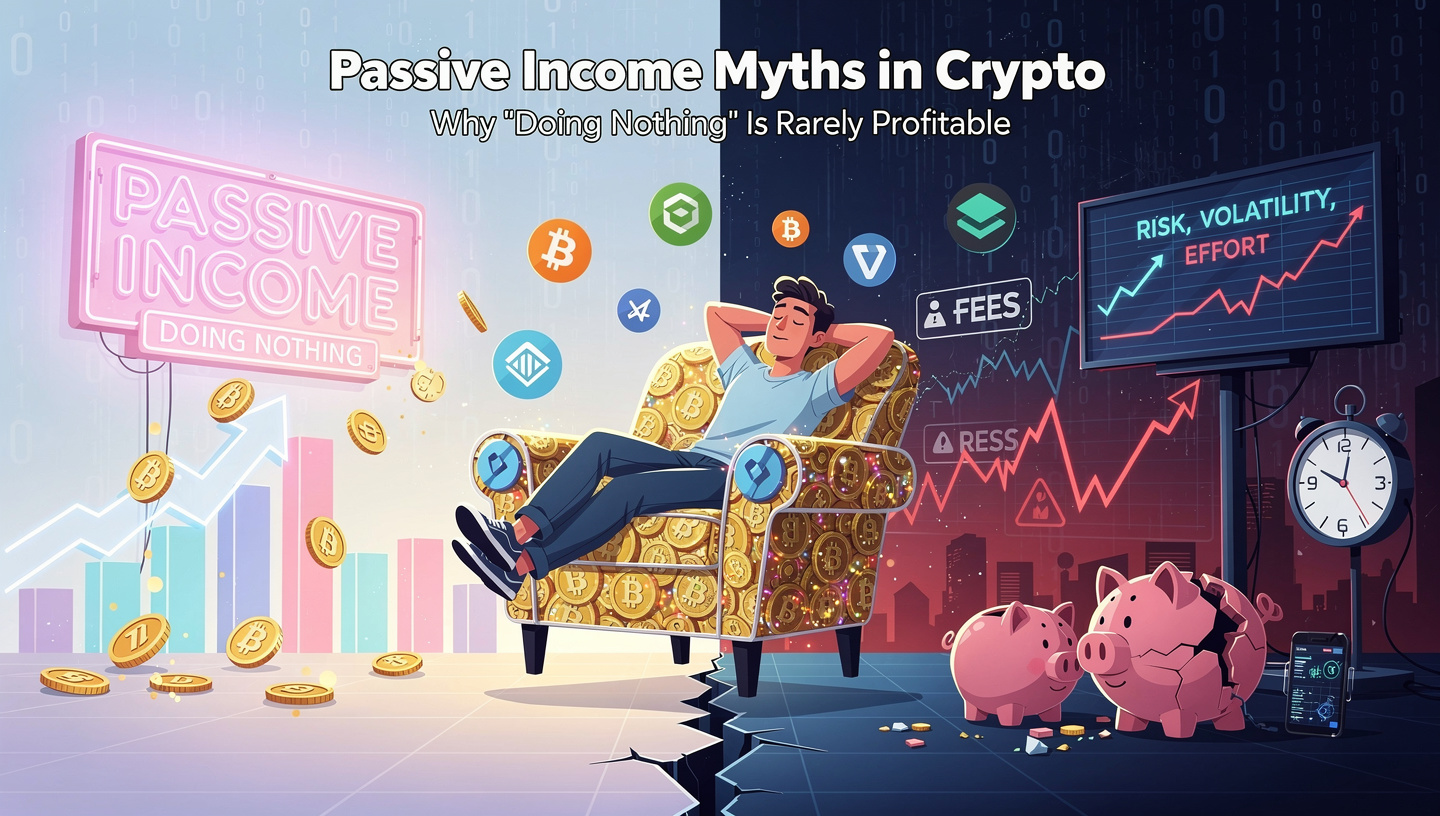
Markets do not reward stillness.
They reward judgment.
This is a truth as old as capital itself, yet in crypto it is routinely ignored. Somewhere between yield dashboards and influencer threads, a seductive narrative took hold: that you can deploy capital once, walk away, and watch money compound itself while you sleep.
This idea survives because it sounds efficient. It appeals to modern impatience. And it fits neatly into the broader mythology of crypto as an automated financial revolution.
But markets don’t care about mythology.
They care about risk, incentives, liquidity, and human behavior.
In traditional investing, no serious professional confuses inactivity with passivity. A stock held for ten years still requires continuous reassessment. Bonds are monitored. Businesses are analyzed. Even index funds demand periodic rebalancing and macro awareness.
Crypto is no different—except volatility is higher, failure rates are brutal, and incentives change faster.
So when crypto platforms promise “passive income,” what they are really selling is delegated labor. Someone, somewhere, is actively managing risk. You’re just choosing not to see it.
This article dismantles the major myths surrounding crypto passive income, explains how yield is actually generated, and shows why “doing nothing” almost always leads to underperformance—or worse.
Not emotionally. Structurally.
What Passive Income Actually Means (And What Crypto Changed)
In classical finance, passive income refers to earnings generated with limited operational involvement after initial deployment. Examples include dividend-paying equities, rental properties under professional management, or royalty streams.
But even these require oversight:
- Dividend stocks can cut payouts
- Properties suffer vacancies and maintenance
- Royalties depend on demand
Passive never meant risk-free or maintenance-free. It meant lower marginal effort over time.
Crypto rebranded this concept.
Instead of businesses producing cash flow, we now have protocols emitting tokens.
Instead of profits, we have incentives.
Instead of regulated balance sheets, we have smart contracts.
Yield in crypto usually comes from one of four sources:
- Inflation (new tokens minted)
- Fees (paid by users)
- Leverage (borrowed capital amplifying returns)
- Speculation (price appreciation masking structural losses)
Only one of these—fees—resembles sustainable income.
The rest are temporary mechanisms.
Understanding this distinction is the foundation of rational crypto investing.
Myth #1: Staking Is Passive Income
Staking is often marketed as the crypto equivalent of earning interest.
You lock tokens.
The network rewards you.
Simple.
But staking is not interest. It is compensation for economic security provision.
Validators stake capital to protect the network. In return, they receive newly issued tokens and transaction fees.
This introduces three unavoidable realities:
1. Inflation Dilution
Most staking rewards come from token emissions.
If a network inflates supply by 8% annually and you earn 8% staking, your real purchasing power stays flat—before considering price movement.
You’re being paid in the same asset that’s being diluted.
That’s not income. That’s maintenance.
2. Price Risk Dominates Yield
A 10% staking reward is irrelevant if the token drops 40%.
In traditional finance, income instruments are designed to reduce volatility. Crypto staking amplifies it.
Yield does not hedge price risk. It compounds exposure.
3. Active Validator Risk
Even delegated staking requires:
- Monitoring validator uptime
- Watching slashing conditions
- Evaluating decentralization health
- Tracking governance changes
Ignore these, and you risk penalties or systemic degradation.
Staking is not passive. It is outsourced infrastructure management.
Myth #2: DeFi Yield Farming Is Automated Wealth
Yield farming became famous during DeFi Summer when triple-digit APYs were common.
What few understood was where those yields came from.
Almost always:
- Temporary liquidity incentives
- Unsustainable token emissions
- Reflexive leverage loops
Liquidity providers were not earning profits.
They were being paid in governance tokens whose value depended on continued speculation.
Meanwhile, they absorbed:
- Impermanent loss
- Smart contract risk
- Oracle manipulation
- Governance attacks
High APY masked negative expectancy.
This is a classic market pattern: early participants earn from late participants. Once emissions slow, yields collapse. Capital exits. Token prices fall.
The system works—until it doesn’t.
Real passive income cannot depend on constant inflows of new speculators.
Myth #3: Lending Protocols Are Crypto Savings Accounts
Platforms like Aave or Compound allow users to deposit assets and earn interest.
This appears straightforward.
But these systems rely on continuous borrowing demand. When leverage dries up, yields evaporate.
More importantly, lenders assume layered risk:
- Smart contract vulnerabilities
- Oracle failures
- Liquidation cascades
- Stablecoin depegging
- Governance exploits
Unlike banks, there is no deposit insurance.
When failures occur, losses are final.
Calling this passive income ignores the embedded fragility of on-chain credit.
You are not depositing money.
You are providing raw capital to an algorithmic margin system.
That requires monitoring.
Myth #4: “Set and Forget” Strategies Survive Market Cycles
Crypto markets evolve at a speed unfamiliar to traditional investors.
Tokenomics change.
Protocols fork.
Incentives shift.
Narratives rotate.
A strategy that worked six months ago is often obsolete today.
Passive investors assume stability.
Crypto offers none.
Even Bitcoin—often treated as a long-term store of value—experiences drawdowns exceeding 70%. Altcoins routinely lose 90%+.
If you are not actively reviewing:
- Project fundamentals
- Token supply schedules
- Developer activity
- Competitive landscape
- Regulatory risk
then you are not investing.
You are speculating on inertia.
Markets do not reward that.
Where Crypto Yield Really Comes From
Strip away marketing language, and crypto yield originates from three core mechanisms:
1. User Fees
DEX trading fees, bridge fees, NFT marketplace fees.
This is closest to traditional revenue.
But volumes fluctuate wildly, and most protocols struggle to maintain consistent usage.
Few produce durable cash flow.
2. Token Inflation
The dominant yield source.
New tokens are minted and distributed to participants.
This is not wealth creation. It is redistribution.
Long-term returns depend entirely on token price appreciation.
3. Leverage Demand
Borrowers pay interest to amplify positions.
This works during bull markets.
It collapses during downturns.
Passive strategies tied to leverage inevitably fail when volatility spikes.
The Real Cost of “Doing Nothing”
The greatest risk in crypto is not volatility.
It is neglect.
Smart contracts do not pause for you.
Markets do not wait.
Exploits do not announce themselves.
Capital left unattended becomes exit liquidity.
Professional investors understand this intuitively. They rebalance. They hedge. They cut losses. They rotate sectors.
Retail passive investors anchor to APY dashboards and hope.
Hope is not a strategy.
What Sustainable Crypto Income Actually Looks Like
If passive income in crypto exists, it looks nothing like influencer marketing.
It is slow.
Selective.
Boring.
It involves:
- Prioritizing fee-generating protocols over emission-driven ones
- Avoiding leverage-dependent yield
- Diversifying across chains and assets
- Actively monitoring protocol health
- Reinvesting selectively
- Holding significant stablecoin reserves
- Accepting lower headline returns in exchange for survivability
Most importantly, it requires continuous judgment.
You are managing capital in an adversarial environment.
Automation does not replace responsibility.
A Buffett-Style Principle for Crypto
Warren Buffett often emphasizes understanding how money is made.
Not price charts.
Not narratives.
Not community hype.
Mechanics.
In crypto, ask:
- Who pays this yield?
- Why do they pay it?
- What happens when they stop?
If you cannot answer those questions clearly, the yield is temporary.
And temporary yield is not income.
It is speculation with better branding.
Final Thoughts: Passive Is a Marketing Term, Not an Investment Strategy
Crypto did not eliminate financial reality.
It merely accelerated it.
Every yield opportunity embeds risk. Every protocol embeds incentives. Every reward stream depends on human behavior somewhere in the system.
There is no such thing as earning money by doing nothing.
There is only choosing where the work happens—and whether you are paying attention.
The investors who survive crypto long-term are not the ones chasing APY.
They are the ones who treat capital like a business.
They study.
They monitor.
They adapt.
That is not passive.
That is disciplined.
Discipline, not automation, is what compounds.