Dividends compensate for equity risk.
Bonds compensate for duration risk.
Real estate rent compensates for illiquidity and management friction.
Crypto did not reinvent this law.
It merely repackaged it.
Yet much of the crypto industry presents passive income as something novel — almost magical. Stake a token, click a button, receive yield. No factories. No employees. No customers. Just numbers increasing on a dashboard.
That framing is misleading.
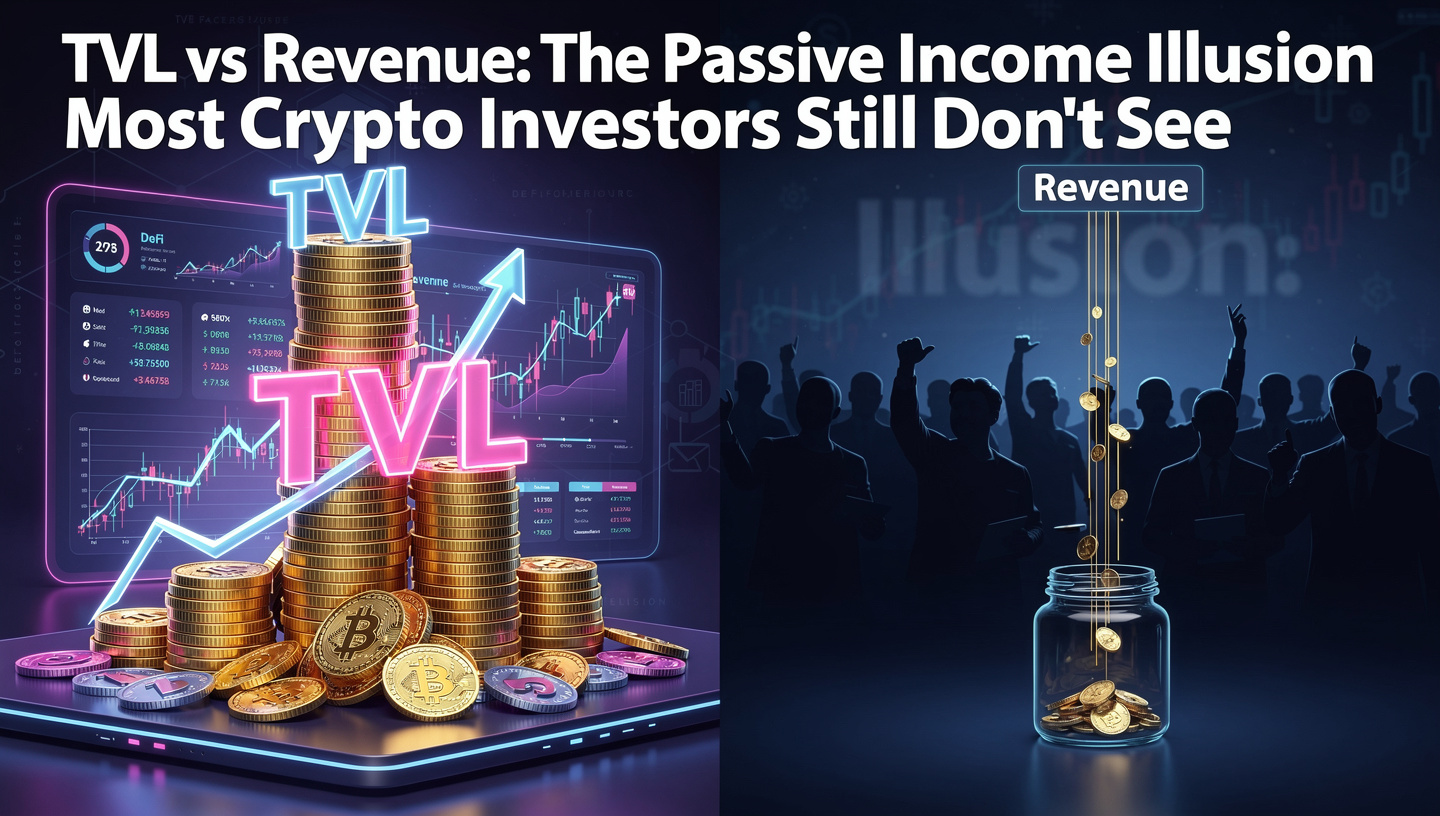
Crypto passive income is not free money. It is a redistribution mechanism inside volatile, reflexive markets. Every yield source is funded by someone else’s behavior — traders, borrowers, speculators, or protocol incentives. Understanding who pays you is the difference between sustainable income and temporary illusion.
This article breaks down the real categories of crypto passive income, how each works, where returns originate, and what risks accompany them. No hype. No fantasies of effortless wealth. Just mechanics.
What “Passive Income” Actually Means in Crypto
Let’s establish a precise definition.
Crypto passive income is any strategy where:
- Capital is deployed once
- Returns accrue without active trading
- Income is generated programmatically or contractually
However, “passive” does not mean:
- Risk-free
- Set-and-forget
- Independent of market conditions
Every crypto yield stream exists because:
- Someone needs liquidity
- Someone needs leverage
- Someone needs security validation
- Or a protocol is subsidizing growth
Those are the only four sources.
Everything else is marketing.
With that in mind, let’s examine each major category.
1. Staking: Income From Network Security
Core Mechanism
Proof-of-Stake blockchains (Ethereum, Solana, Cosmos, Avalanche, Polkadot) require validators to lock tokens to secure the network. In exchange, they receive newly issued tokens and transaction fees.
When you stake, you are:
- Delegating capital to validators
- Participating indirectly in consensus
- Being compensated for economic security
Your yield comes from:
- Inflation (new token issuance)
- Network fees
Typical Returns
Annualized returns range from:
- 3–5% on Ethereum
- 6–10% on Solana
- 10–20% on smaller chains
Higher yields almost always correlate with higher inflation or weaker ecosystems.
Risks
- Token price volatility
- Slashing (validator misconduct penalties)
- Lock-up periods
- Chain-level governance risk
Staking is structurally closest to dividend investing — predictable, protocol-defined, and long-term oriented.
But unlike equities, staking rewards are paid in the same asset that may depreciate.
Yield denominated in a falling currency is not income.
2. Lending: Getting Paid for Providing Liquidity
Core Mechanism
Crypto lending platforms (Aave, Compound, Morpho, Venus) allow users to deposit assets that borrowers take out as overcollateralized loans.
Borrowers pay interest.
Lenders receive that interest.
Simple.
Your returns come from:
- Traders seeking leverage
- Arbitrageurs
- Market makers
- Speculators avoiding taxable sales
Typical Returns
- Stablecoins: 3–12%
- Blue-chip crypto: 1–6%
- Volatile assets: varies widely
Rates change dynamically based on utilization.
Risks
- Smart contract risk
- Oracle failure
- Liquidation cascades
- Platform governance attacks
Unlike banks, these protocols have no lender of last resort.
When liquidity vanishes, it vanishes instantly.
Crypto lending is efficient, transparent — and unforgiving.
3. Liquidity Providing (LP): Market Making for the Masses
Core Mechanism
Decentralized exchanges like Uniswap, Curve, and PancakeSwap require liquidity pools to function.
Liquidity providers deposit paired assets (e.g., ETH/USDC). Traders swap against these pools and pay fees. LPs earn a share of those fees.
In effect, LPs become automated market makers.
Revenue Sources
- Trading fees
- Sometimes token incentives
Typical Returns
Anywhere from:
- 5% on stable pairs
- 20%+ on volatile pairs
But headline APRs hide the real cost.
Impermanent Loss
If one asset moves significantly relative to the other, LPs underperform simply holding.
This is not theoretical. It is mathematical.
LP strategies only outperform in:
- Sideways markets
- High volume environments
- Tight price ranges
Otherwise, impermanent loss quietly eats your gains.
LPing is not passive income.
It is quantitative trading with exposure disguised as yield.
4. Yield Farming: Incentivized Liquidity Extraction
Yield farming layers token rewards on top of lending or LP positions.
Protocols distribute governance tokens to bootstrap liquidity.
Your income comes from:
- Emissions
- Speculative token demand
This is temporary by design.
Most yield farms follow the same lifecycle:
- High APYs attract capital
- Token supply expands
- Price declines
- Early participants exit
- Late participants absorb losses
Unless the protocol builds real usage, farming rewards dilute faster than value accrues.
Yield farming is not income.
It is venture speculation with vesting schedules.
5. Masternodes and Validator Operations
Advanced participants can run nodes directly.
This involves:
- Infrastructure setup
- Uptime management
- Slashing responsibility
- Capital requirements
Returns exceed delegated staking but require technical competence.
This is active business disguised as passive income.
6. Stablecoin Strategies: Synthetic Fixed Income
Stablecoins (USDC, USDT, DAI, FRAX) enable crypto’s closest approximation to bonds.
Income strategies include:
- Lending
- LPing on stable pairs
- Treasury-backed yield protocols
Returns range from 4–15%.
But stablecoins introduce their own risks:
- Depegging
- Custodial exposure
- Regulatory action
- Reserve transparency
They are not equivalent to cash.
They are shadow banking instruments.
7. Real Yield Protocols: Fees Over Emissions
A newer category focuses on distributing actual protocol revenue, not inflation.
Examples include:
- GMX
- Gains Network
- Pendle
- Lido
Income comes from:
- Trading fees
- Options premiums
- Borrowing costs
This resembles equity ownership more than farming.
Real yield is sustainable.
Emission yield is not.
Comparative Overview
| Method | Yield Source | Sustainability | Risk Level |
|---|---|---|---|
| Staking | Inflation + fees | Medium | Medium |
| Lending | Borrower interest | Medium | Medium |
| LP | Trading fees | Low–Medium | High |
| Farming | Token emissions | Low | Very High |
| Stablecoin yield | Leverage demand | Medium | Medium |
| Real yield | Protocol revenue | High | Medium |
The Critical Variable: Token Appreciation vs Income
A 12% APY means nothing if the asset loses 40%.
Crypto passive income must always be evaluated in total return terms.
Traditional investors understand this.
Crypto participants often do not.
Income is only meaningful if principal survives.
Portfolio Construction for Crypto Income
A rational allocation might look like:
- 40% ETH staking
- 30% stablecoin lending
- 15% real yield protocols
- 10% conservative LP
- 5% experimental strategies
Not optimized for maximum APY.
Optimized for survival.
Yield chasers blow up.
Capital preservers compound.
Final Thoughts
Crypto did not eliminate financial gravity.
It merely compressed time.
Every passive income stream is someone else’s active risk.
Understand the mechanism.
Trace the cash flow.
Identify who pays you.
Measure sustainability.
If you cannot answer those questions, you are not earning income.
You are participating in a redistribution event.
Those always end the same way.
Quietly.