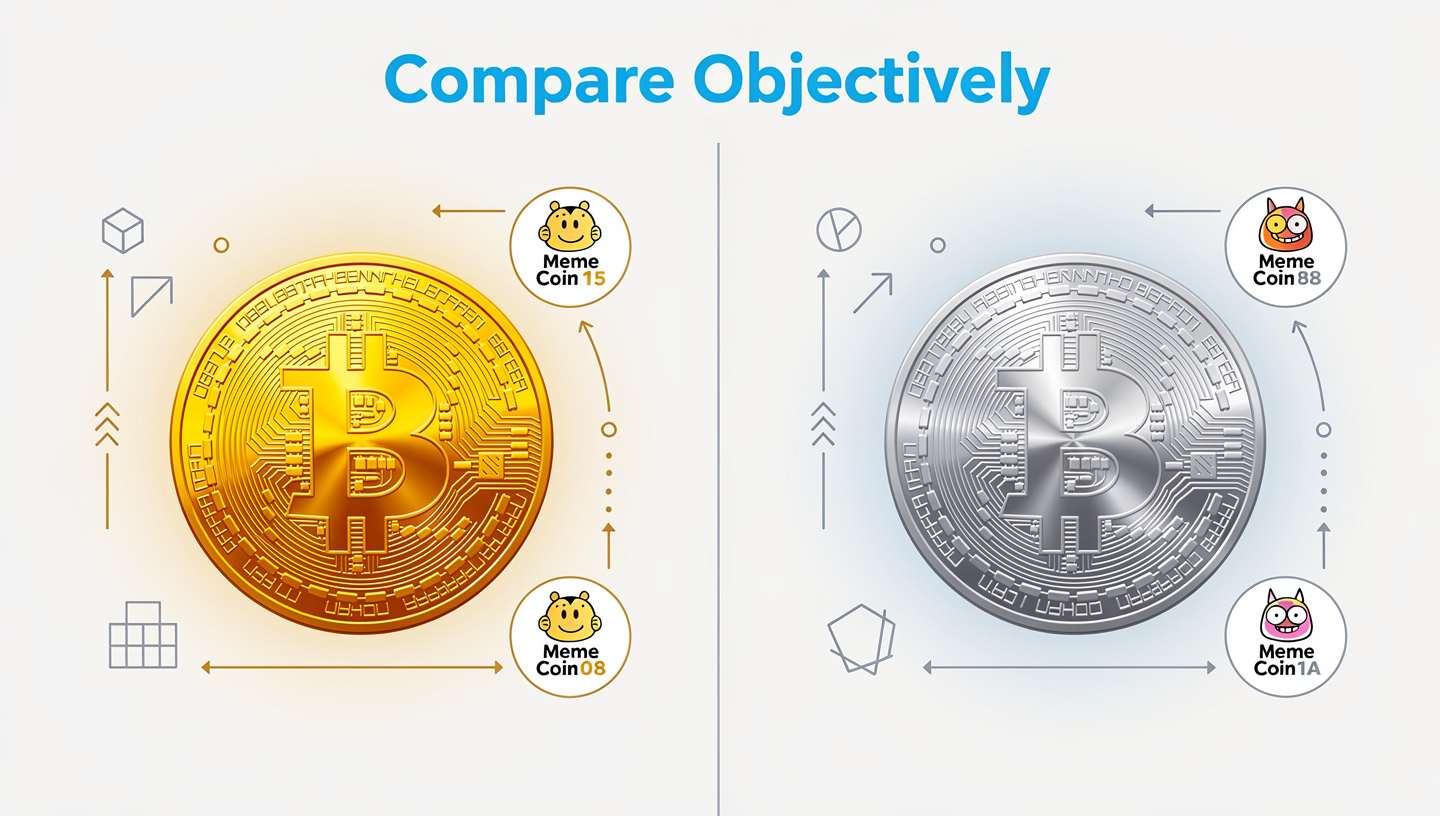
Meme coins are often dismissed as irrational, purely narrative-driven assets. That dismissal is lazy. While meme coins do not follow traditional valuation models like discounted cash flow or revenue multiples, they do follow repeatable on-chain, behavioral, and liquidity patterns. The problem is not that meme coins are impossible to analyze; it is that most investors rely on subjective bias rather than structured comparison.
Comparing two meme coins objectively requires abandoning vibes, personal attachment, and social media echo chambers. It requires treating each token as a system—a combination of token distribution, liquidity design, holder behavior, contract constraints, and market reflexivity.
This article presents a practical, repeatable framework to compare any two meme coins side by side, regardless of chain, theme, or narrative. The goal is not to predict which coin will “moon” tomorrow. The goal is to identify which coin has a higher probability of sustaining attention, liquidity, and price discovery over time.
Step 1: Normalize the Comparison (Eliminate False Advantages)
Before comparing two meme coins, you must first remove misleading advantages that distort judgment.
Market Cap Context Matters
Comparing a $5M meme coin to a $200M meme coin is rarely meaningful. Lower market cap coins naturally exhibit higher volatility and upside but also higher structural risk.
To compare objectively:
- Adjust expectations based on relative market cap
- Compare rate of growth, not absolute price
- Focus on efficiency metrics (volume per market cap, holders per market cap)
A smaller coin outperforming a larger one on efficiency metrics is often more informative than raw percentage gains.
Time Since Launch Must Be Aligned
A coin launched yesterday should not be compared directly to one that has survived multiple market cycles.
Normalize by:
- Comparing behavior during the same lifecycle phase (first 7 days, first 30 days)
- Observing how each coin behaves after initial hype fades
Survivability is one of the most underappreciated metrics in meme coin evaluation.
Step 2: Token Distribution — The Foundation of All Outcomes
Token distribution is not glamorous, but it quietly determines almost everything that follows.
Holder Concentration Analysis
Two meme coins with identical narratives can have radically different outcomes based purely on holder structure.
Key questions:
- What percentage of supply is held by the top 10 wallets?
- Are those wallets externally funded or internally linked?
- Is distribution flattening or concentrating over time?
A meme coin with slower price action but improving distribution is often structurally healthier than a faster-moving coin dominated by a few wallets.
Wallet Behavior Over Static Snapshots
Static holder charts are insufficient. What matters is wallet behavior:
- Are large holders gradually trimming or aggressively dumping?
- Do mid-sized wallets accumulate during pullbacks?
- Are new wallets retaining tokens or flipping immediately?
Behavioral patterns often reveal intent long before price reacts.
Step 3: Liquidity Quality, Not Just Liquidity Size
Liquidity is commonly reduced to a single number. That is a mistake.
Depth vs. Stability
A $1M liquidity pool can be fragile if:
- It is highly concentrated near the current price
- A single wallet can remove a large portion
- Liquidity providers are short-term participants
Compare:
- Liquidity as a percentage of market cap
- Liquidity changes during drawdowns
- Slippage for standardized trade sizes
A meme coin with smaller but stable and sticky liquidity is often more resilient than one with larger but mercenary liquidity.
Liquidity Ownership and Risk
Ask:
- Is liquidity locked or burned?
- Who controls the LP tokens?
- Has liquidity been removed before?
Liquidity trust is not binary. It exists on a spectrum, and comparing where each coin sits on that spectrum is critical.
Step 4: Volume Efficiency and Transaction Quality
Raw volume numbers are easy to fake. Efficiency is harder.
Volume-to-Market-Cap Ratio
This ratio helps answer:
- Is the coin actively traded relative to its size?
- Is interest organic or artificially inflated?
Two coins may show similar volume, but the one with higher volume efficiency often has better price discovery and narrative reach.
Transaction Composition
Look beyond volume totals:
- Are trades dominated by micro transactions or meaningful size?
- Is buy volume distributed or driven by a few wallets?
- Do sell transactions cluster after pumps?
Healthy meme coins tend to show broad participation, not isolated spikes.
Step 5: Contract Constraints and Structural Risk
While most meme coins share simple contracts, subtle differences matter.
Transfer Restrictions and Owner Privileges
Compare:
- Ownership renouncement status
- Ability to modify fees or blacklist wallets
- Hidden transfer conditions
A meme coin with fewer mutable parameters carries lower tail risk, even if its narrative is weaker.
Tax Mechanics and Friction
High taxes can:
- Suppress organic trading
- Incentivize short-term behavior
- Reduce long-term liquidity depth
Comparing tax structures objectively helps explain why two coins with similar attention diverge in performance.
Step 6: Social Metrics — Signal vs. Noise
Social presence is necessary but not sufficient.
Growth Rate Over Absolute Size
A smaller community growing faster often outperforms a larger stagnant one.
Compare:
- Daily follower growth
- Engagement per post
- Ratio of unique contributors to total members
Dead communities can look large. Living communities leave traces of continuous interaction.
Narrative Coherence
Ask:
- Is the narrative consistent across platforms?
- Can holders articulate why the coin exists?
- Does the meme evolve or stagnate?
Narrative decay often precedes liquidity decay.
Step 7: Reflexivity and Feedback Loops
Meme coins are reflexive assets. Price, attention, and belief reinforce each other.
Positive Reflexivity Indicators
Compare:
- Whether price appreciation leads to new holders
- Whether new holders increase content creation
- Whether content leads to sustained volume
Coins that convert attention into participation are structurally stronger than those that only attract spectators.
Step 8: Comparative Stress Testing
The most revealing comparisons happen during stress.
Behavior During Market Drawdowns
Observe:
- Holder retention during red days
- Liquidity reaction to panic selling
- Social tone during pullbacks
A coin that holds structure under stress is objectively stronger, regardless of short-term underperformance.
Recovery Characteristics
Compare:
- Speed of recovery
- Quality of volume during rebounds
- Distribution changes post-drawdown
Not all recoveries are equal. Some are dead-cat bounces; others signal genuine resilience.
Step 9: Synthesis — Building a Comparative Scorecard
Objectivity emerges from synthesis, not single metrics.
Create a simple comparative matrix:
- Distribution health
- Liquidity quality
- Volume efficiency
- Contract risk
- Social vitality
- Stress behavior
You are not looking for perfection. You are identifying relative structural advantage.
Common Comparison Mistakes to Avoid
- Overweighting narrative aesthetics
- Ignoring wallet behavior
- Comparing coins at different lifecycle stages
- Confusing price volatility with strength
- Treating social hype as durability
Most losses in meme coins come not from bad luck, but from bad comparison frameworks.
Objectivity Is a Competitive Edge
In meme coin markets, information is abundant but understanding is rare.
Objectively comparing two meme coins does not eliminate risk. It reallocates risk toward coins with better internal mechanics, healthier participation, and stronger feedback loops. Over time, that edge compounds.
The irony is that meme coins, often labeled irrational, reward the most disciplined analysis. Those who learn to compare structure instead of stories stop chasing pumps and start positioning ahead of them.
The market will always be noisy. Your framework does not have to be.