Blockchains were never designed to speak.
They were designed to record.
Every transaction, every state change, every byte of value transferred across a decentralized network is etched permanently into an immutable ledger. This immutability is often celebrated as blockchain’s greatest strength—but it is also its greatest limitation. A ledger that cannot forget also cannot interpret. It stores truth, but it does not explain it.
And herein lies the paradox of modern crypto markets:
We are drowning in perfect data, yet starving for intelligence.
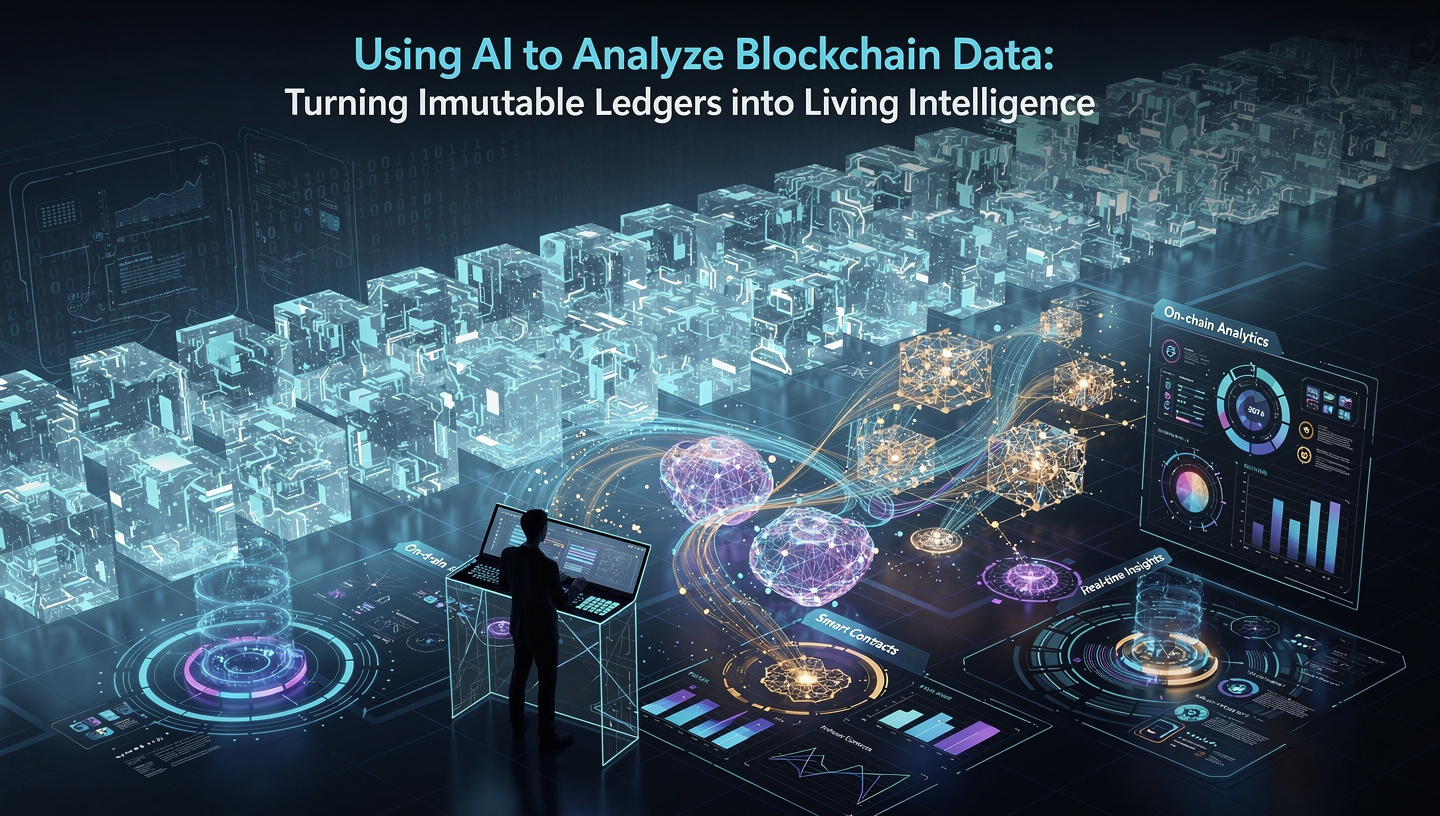
Artificial Intelligence is not an optional enhancement to blockchain analytics—it is the missing cognitive layer. Without AI, blockchain data remains static, historical, and fragmented. With AI, it becomes adaptive, contextual, and predictive. The ledger stops being a database and starts behaving like a living system.
This article examines how AI transforms raw blockchain data into actionable intelligence, why traditional analytics fail at blockchain scale, and how machine learning, graph analysis, and autonomous agents are redefining on-chain research, risk assessment, and market structure.
1. The Nature of Blockchain Data: Immutable, Transparent, and Overwhelming
Blockchain data is fundamentally different from traditional financial data.
It is:
- Public by default
- Append-only
- Structurally heterogeneous
- Behavioral rather than declarative
Unlike balance sheets or trade confirmations, blockchain data does not tell you why something happened. It shows only that it happened—encoded in transactions, smart contract calls, event logs, and state transitions.
The Core Challenges
- Volume at Scale
Major blockchains process millions of transactions daily. Manual or rule-based analysis does not scale. - Pseudonymity
Wallet addresses are not identities. One entity may control thousands of addresses; one address may represent an exchange, DAO, bot, or individual. - Non-Linear Relationships
Value does not move in straight lines. It flows through bridges, mixers, liquidity pools, and smart contracts, creating complex dependency graphs. - Temporal Complexity
Blockchain behavior is time-sensitive. The same transaction pattern may signal accumulation in one regime and distribution in another.
These characteristics render traditional SQL dashboards and static metrics insufficient. Blockchain data requires interpretation, not aggregation.
2. Why Classical Analytics Fails On-Chain
Most blockchain analytics platforms rely on deterministic heuristics:
- Threshold-based alerts
- Known address labeling
- Predefined transaction patterns
This approach works—until it doesn’t.
Structural Limitations
- Rule brittleness: As soon as behavior changes, rules break.
- Lagging insight: Heuristics detect what already happened, not what is forming.
- Blind to emergence: New protocols, exploits, or coordination patterns appear before they are labeled.
In adversarial environments—where actors actively try to evade detection—static logic is a losing strategy.
Markets evolve. Adversaries adapt. Intelligence must learn.
3. AI as the Cognitive Layer of the Blockchain Stack
Artificial Intelligence introduces three capabilities blockchain analytics fundamentally lacks:
- Pattern discovery without prior assumptions
- Generalization across unseen behaviors
- Continuous learning from new data
AI does not replace blockchain transparency. It interprets it.
Core AI Paradigms Applied to Blockchain
3.1 Machine Learning (ML)
Used to classify, cluster, and predict behaviors based on historical data.
Examples:
- Wallet clustering
- Transaction classification
- Risk scoring models
3.2 Graph Intelligence
Blockchains are transaction graphs. Graph neural networks (GNNs) are uniquely suited to analyze:
- Fund flow topology
- Centrality and influence
- Coordination and collusion
3.3 Natural Language Processing (NLP)
Applied indirectly, NLP bridges on-chain and off-chain intelligence:
- Governance proposals
- Developer communications
- Social sentiment aligned with on-chain actions
3.4 Reinforcement Learning
Used in:
- MEV strategy modeling
- Automated trading agents
- Dynamic gas optimization
Together, these form an adaptive intelligence layer over an immutable base.
4. Turning Addresses into Entities: AI-Based Wallet Attribution
One of the most valuable applications of AI in blockchain analytics is entity resolution.
The Problem
Addresses are not users. They are tools.
Exchanges rotate wallets. Whales fragment holdings. Bots generate thousands of ephemeral addresses. Any analysis that treats addresses as independent actors is structurally flawed.
The AI Solution
Machine learning models cluster addresses into entities based on:
- Transaction timing correlations
- Gas usage fingerprints
- Shared counterparty behavior
- Smart contract interaction patterns
This transforms analysis from:
“Address A sent funds to Address B”
into:
“A centralized exchange offloaded inventory to market makers during declining liquidity conditions.”
This is not cosmetic improvement. It is ontological correction.
5. Behavioral Intelligence: Detecting Intent, Not Just Activity
The true power of AI lies not in describing what happened, but in inferring intent.
Examples of Intent Modeling
- Accumulation vs Distribution
Similar volumes, radically different implications depending on counterparties and timing. - Organic Demand vs Wash Trading
AI can detect self-referential loops invisible to volume metrics. - Strategic Liquidity Provision
Distinguishing yield farming capital from mercenary liquidity.
By modeling behavior as sequences rather than isolated events, AI captures strategy, not just action.
6. Predictive On-Chain Intelligence: From Forensics to Foresight
Most blockchain analytics today are forensic. AI enables predictive analysis.
Use Cases
6.1 Market Stress Signals
- Rising leverage combined with declining liquidity depth
- Correlated behavior across previously independent entities
6.2 Exploit Early Warning
- Anomalous contract interactions
- Repeated probing transactions
- Unusual gas bidding behavior
6.3 Systemic Risk Mapping
- Bridge dependency graphs
- Stablecoin collateral concentration
- Cross-chain contagion paths
Prediction does not require certainty. It requires probabilistic awareness—something AI excels at and static dashboards cannot provide.
7. AI and DeFi: Intelligence in a Composable Financial System
DeFi is not just transparent—it is programmable. This makes it uniquely compatible with AI-driven analysis.
Intelligent DeFi Analytics Include:
- Automated protocol health scoring
- Real-time liquidation risk modeling
- Dynamic yield sustainability analysis
- MEV impact assessment
In a composable environment, local changes propagate globally. AI models trained on system-level data can detect second- and third-order effects long before price reacts.
8. The Strategic Implication: Intelligence Is the New Moat
Blockchains are open. Code is forkable. Data is public.
Intelligence is not.
The competitive advantage in crypto does not come from accessing data—it comes from interpreting it faster, deeper, and more accurately than others.
AI-driven blockchain analytics create:
- Information asymmetry in an open system
- Early signal extraction in reflexive markets
- Strategic clarity in chaotic environments
In a world where everyone sees the same ledger, understanding becomes the scarce resource.
9. Risks, Limitations, and the Discipline of AI Use
AI is powerful—but not infallible.
Key Risks
- Overfitting historical regimes
- False confidence from opaque models
- Garbage-in, garbage-out data pipelines
Responsible use of AI in blockchain research requires:
- Model transparency
- Continuous retraining
- Human-in-the-loop validation
AI should augment judgment, not replace it.
From Records to Reason
Blockchain gave us truth without interpretation.
AI gives us interpretation without centralization.
Together, they form something unprecedented:
A transparent financial system that can think.
The future of crypto will not be decided by who controls the data—because no one does. It will be decided by who can transform immutable records into living intelligence.
And in that transformation, AI is not a tool.
It is the lens through which the entire system becomes legible.