Crypto markets do not primarily destroy capital through price crashes.
They destroy capital through bad reasoning.
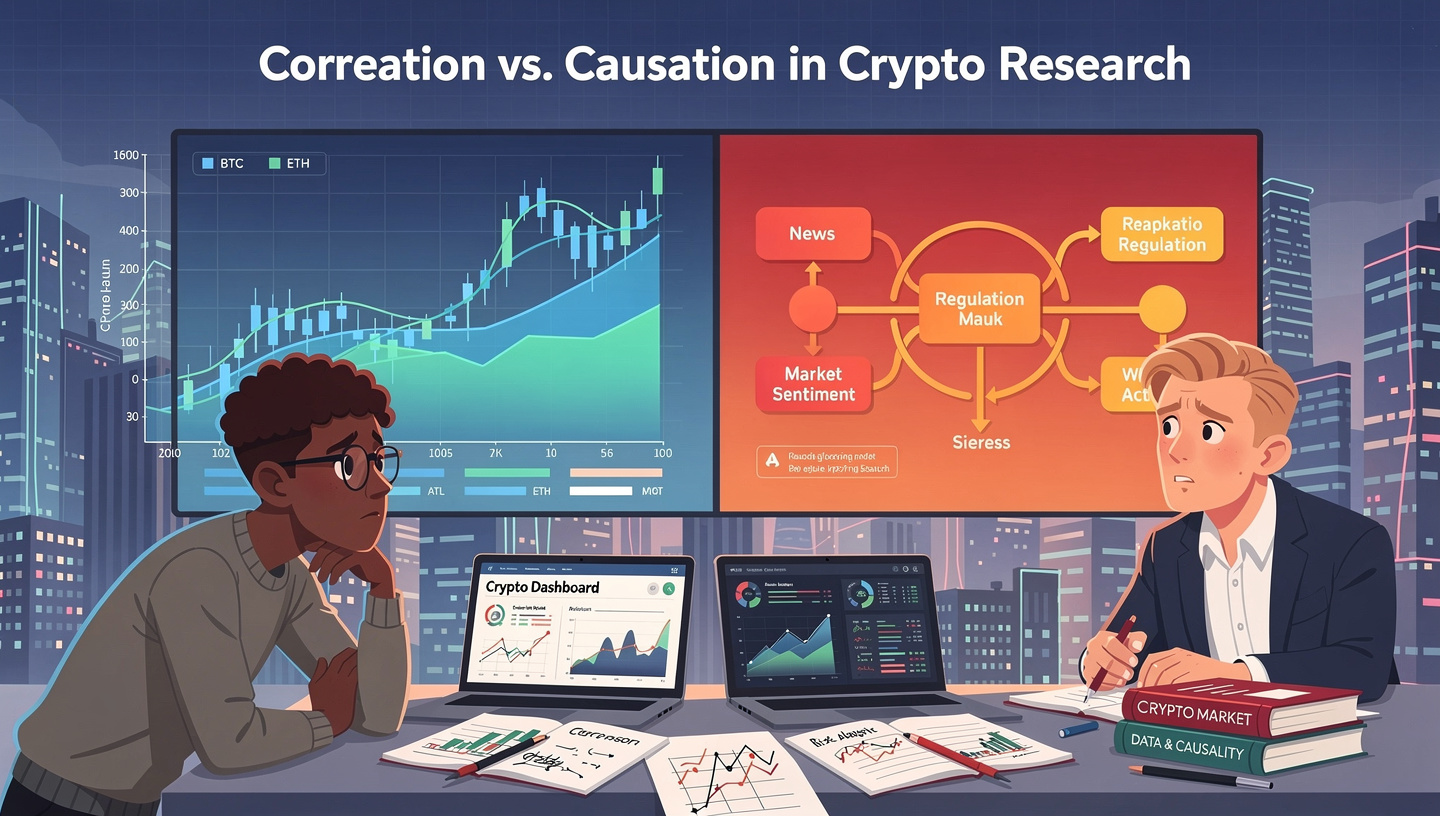
Every cycle, the same pattern repeats: analysts publish charts showing two variables moving together, social media amplifies the visual alignment, narratives form, capital rotates, and eventually the relationship collapses—leaving participants confused, liquidated, or disillusioned. The root cause is rarely market manipulation or bad luck. It is a fundamental analytical failure: confusing correlation with causation.
In traditional finance, this mistake is costly.
In crypto, it is existential.
Crypto is a reflexive, thin-liquidity, narrative-driven system where feedback loops amplify weak signals into dominant beliefs. When correlation is mistaken for causation, research becomes propaganda, indicators become superstition, and decision-making becomes collective hallucination.
This article dissects the difference between correlation and causation specifically within crypto research. Not as a textbook statistics lesson, but as a practical framework for analysts, investors, and builders who want to separate signal from noise—and survive multiple market regimes.
1. Defining the Terms Is Necessary but Insufficient
Correlation: Statistical Co-Movement, Nothing More
Correlation measures the degree to which two variables move together.
It answers a narrow question:
“When X changes, does Y tend to change as well?”
It does not answer:
- Why the movement occurs
- Whether one variable influences the other
- Whether the relationship is stable
- Whether the relationship will persist under regime shifts
In crypto, correlations are easy to find because:
- Markets are globally synchronized
- Liquidity flows are highly reflexive
- Assets share common denominators (USD, BTC, ETH)
- Narratives synchronize behavior
High correlation is common. Meaningful correlation is rare.
Causation: Directional Influence With Mechanism
Causation implies that:
- Variable A directly influences Variable B
- There is a mechanism, not just co-movement
- The relationship is directional
- The effect persists when controlling for confounders
In crypto research, causation is hard because:
- Data is incomplete and noisy
- Market structure changes rapidly
- Participant behavior adapts to the research itself
- Feedback loops blur directionality
Causation requires theory + evidence + falsifiability.
Most crypto research stops at visualization.
2. Why Crypto Is a Perfect Environment for False Causality
Crypto is not just volatile—it is epistemically hostile.
2.1 Reflexivity Breaks Linear Reasoning
In reflexive systems:
- Belief influences price
- Price reinforces belief
- Research influences behavior
- Behavior invalidates research
For example:
- An analyst claims “Funding rates predict tops”
- Traders front-run the signal
- The signal stops working
- A new correlation appears
- The cycle repeats
Correlation becomes self-consuming.
2.2 Narrative Compression Creates Illusions of Causality
Crypto narratives compress complexity into slogans:
- “Fed liquidity drives Bitcoin”
- “ETH gas predicts price”
- “Whales are accumulating”
- “On-chain activity leads price”
These statements often rely on post-hoc correlation:
- Price moves
- A correlated metric is identified
- A causal story is retrofitted
This is not research. It is narrative arbitrage.
2.3 Shared Inputs Create Spurious Correlation
Many crypto variables are correlated because they share the same drivers:
- Global liquidity
- Risk-on / risk-off sentiment
- USD strength
- Leverage availability
Example:
- Bitcoin price
- NFT volume
- DeFi TVL
- Exchange balances
All may rise together—not because they cause each other, but because capital conditions changed.
Mistaking shared input correlation for causation is one of the most common analytical failures in crypto.
3. Classic Correlation Traps in Crypto Research
3.1 On-Chain Metrics and Price
Common claim:
“On-chain activity increased before price rose, therefore on-chain activity causes price appreciation.”
Reality:
- Price increases incentivize activity
- Speculation increases transactions
- Rising volatility drives on-chain movement
In many cases, price leads on-chain, not the other way around.
Without establishing time precedence and mechanism, correlation is meaningless.
3.2 Social Sentiment and Market Direction
Sentiment indicators often correlate with price because:
- Humans react to price movement
- Social volume increases after volatility
- Extreme sentiment reflects positioning, not foresight
Bullish sentiment peaking at tops is not causal—it is symptomatic.
3.3 Macro Variables and Crypto Prices
Yes, Bitcoin correlates with:
- Global M2
- Tech equities
- Real yields
- Liquidity indices
But correlation does not imply:
- Immediate causation
- Linear transmission
- Short-term predictability
Macro variables operate on longer time horizons.
Using them for short-term crypto predictions is a category error.
4. What Causation Actually Looks Like in Crypto
True causation in crypto has identifiable characteristics.
4.1 Structural Mechanism
There must be a clear path of influence.
Example:
- Liquidations → forced market orders → price impact
This is causal because:
- The mechanism is mechanical
- The direction is unambiguous
- The effect is immediate
4.2 Time Precedence That Holds Across Regimes
If X causes Y:
- X must consistently precede Y
- Across bull and bear markets
- Across volatility regimes
- Across liquidity conditions
Most crypto correlations fail this test.
4.3 Persistence After Controlling for Confounders
Causal relationships survive when:
- Market beta is removed
- USD moves are controlled
- BTC dominance is isolated
- Liquidity conditions are normalized
If the relationship disappears after adjustment, it was not causal.
5. Framework: How to Test Correlation vs. Causation in Crypto Research
Step 1: Identify the Hypothesis Clearly
Bad hypothesis:
“Metric X predicts price.”
Good hypothesis:
“Changes in X mechanically force behavior Y, which impacts price under conditions Z.”
Precision matters.
Step 2: Map the Mechanism
Ask:
- Who acts on this signal?
- Why would they act?
- What constraints exist?
- What incentives are involved?
If no actor exists, no causation exists.
Step 3: Test Directionality
Use:
- Lead-lag analysis
- Event-based analysis
- Structural breaks
If direction flips across regimes, abandon the causal claim.
Step 4: Stress-Test the Narrative
Ask:
- When does this fail?
- Under what market conditions?
- Who benefits from believing this?
- Would this still hold if widely known?
Markets arbitrage simplicity.
6. Why Correlation Is Still Useful — If You Respect Its Limits
Correlation is not useless. It is dangerous only when overinterpreted.
Proper uses of correlation:
- Regime identification
- Risk clustering
- Portfolio construction
- Stress testing assumptions
Correlation answers:
“What tends to move together right now?”
It does not answer:
“What will cause the next move?”
7. The Cost of Getting This Wrong
Misinterpreting correlation as causation leads to:
- Overfitting strategies
- Fragile theses
- Narrative-driven investing
- Capital misallocation
- Loss of analytical credibility
In crypto, bad research spreads faster than good research because it is easier to visualize, easier to explain, and more emotionally satisfying.
Truth requires restraint.
Causation Is Rare, Correlation Is Everywhere, Discipline Is Optional
Crypto does not lack data.
It lacks epistemic discipline.
The market does not reward those who find the most correlations.
It rewards those who understand structure, incentives, and mechanism.
Correlation is a starting point.
Causation is a conclusion earned through rigor.
The future of serious crypto research will not belong to louder charts or prettier dashboards. It will belong to analysts who can say:
“This moves with price — but this moves price.”
That distinction is not academic.
It is the difference between speculation and understanding.