Price is an outcome. Volume is activity.
Open Interest is commitment.
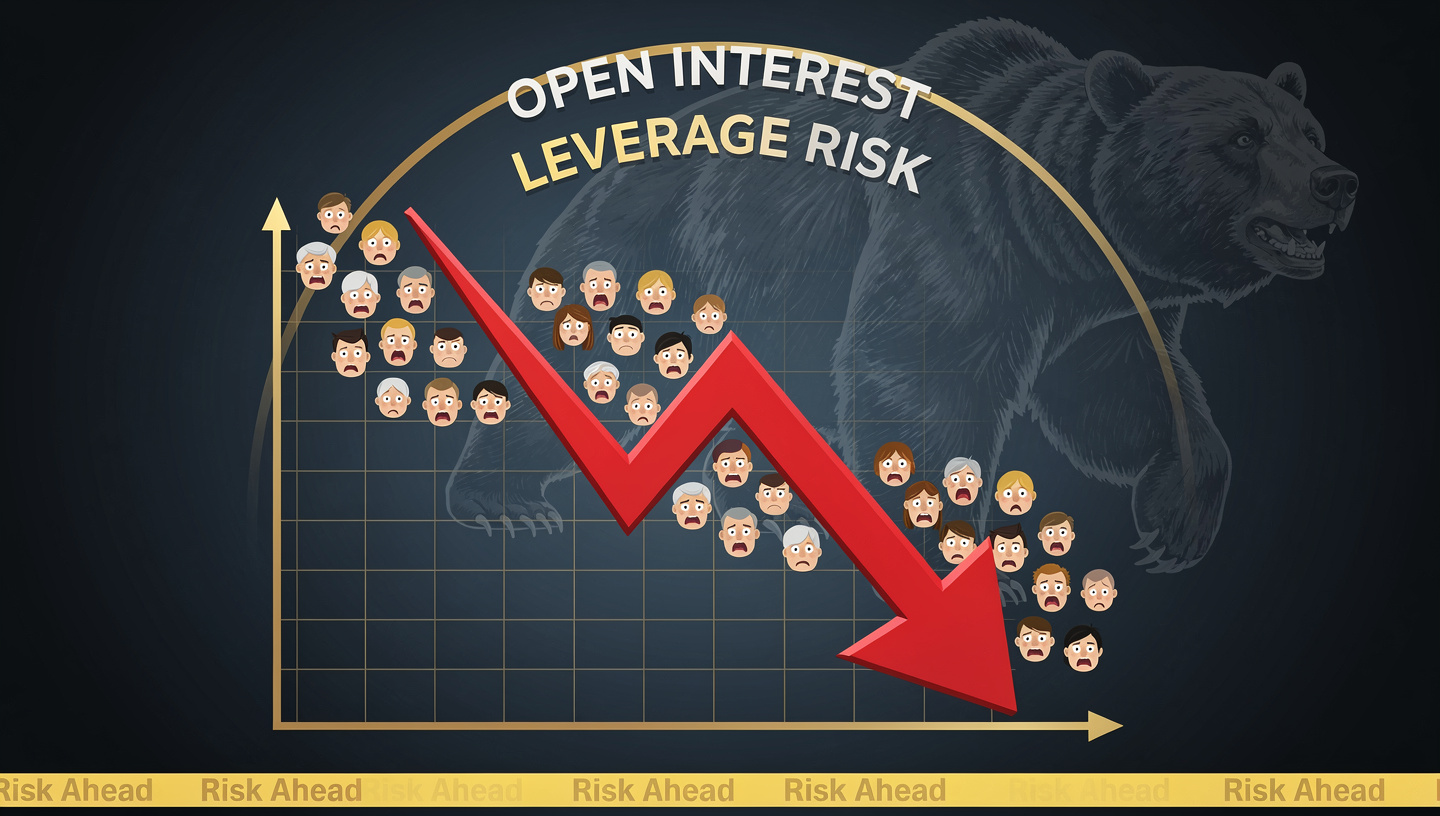
If price is the surface of the ocean, Open Interest is the pressure accumulating miles below—silent, compressive, and indifferent to belief. It does not care whether traders are bullish or bearish. It only measures how much risk has been locked into existence.
In crypto, where leverage is cheap, perpetuals never expire, and liquidation engines operate at machine speed, Open Interest is not just a metric. It is a systemic stress gauge.
This article explains Open Interest and leverage risk not as isolated concepts, but as a single mechanical system—one that repeatedly transfers capital from the impatient to the disciplined, from the overconfident to the solvent.
1. What Open Interest Really Measures (And What It Does Not)
Open Interest (OI) represents the total number of outstanding derivative contracts—futures or perpetual swaps—that remain open and unsettled.
Key clarifications:
- Every contract has one long and one short
- OI increases when new positions are opened
- OI decreases when positions are closed or liquidated
- OI does not indicate direction by itself
This last point is widely misunderstood.
High Open Interest does not mean the market is bullish.
Low Open Interest does not mean the market is safe.
OI simply answers one question:
How much leveraged exposure is currently active in the system?
In crypto derivatives markets—particularly perpetual swaps—this exposure can remain open indefinitely, compounding risk over time rather than resetting through expiration.
2. Leverage: The Risk Multiplier the Market Never Forgives
Leverage allows traders to control a larger position with a smaller amount of collateral.
- 2× leverage doubles exposure
- 10× leverage reduces liquidation distance to ~10%
- 50× leverage makes price noise existential
Leverage is not inherently evil.
But leverage + crowding is.
The real danger is not leverage in isolation—it is synchronized leverage, where thousands of positions share:
- Similar entry zones
- Similar liquidation thresholds
- Similar emotional assumptions
This is where Open Interest becomes critical.
High OI means:
- Capital is locked
- Liquidation thresholds are defined
- The system has stored potential energy
Markets do not move violently because of opinions.
They move violently because of forced exits.
3. Open Interest vs Volume: Commitment vs Activity
Volume measures transactions.
Open Interest measures exposure.
A market can have:
- High volume, low OI → active but flexible
- Low volume, high OI → rigid and fragile
- Rising price + rising OI → leverage entering
- Rising price + falling OI → shorts closing, risk reducing
This distinction matters because volume disappears after execution.
Open Interest persists.
Persistent leverage is what creates liquidation cascades, not momentary trading activity.
4. The Leverage Feedback Loop
Crypto derivatives markets operate under a self-reinforcing mechanism:
- Price trends upward
- Traders add leveraged longs
- Open Interest increases
- Liquidation levels cluster below price
- A small reversal triggers forced selling
- Forced selling accelerates price decline
- More liquidations occur
- Open Interest collapses
- Volatility spikes
This is not market psychology.
This is market physics.
Exchanges are not neutral observers in this system. Liquidation engines execute market orders automatically, converting risk into immediate sell or buy pressure.
The market moves because it must, not because it wants to.
5. Why High Open Interest Is a Warning, Not a Signal
Retail traders often treat rising OI as confirmation:
- “Money is flowing in”
- “Smart traders are positioning”
- “The trend is strong”
Professionals interpret it differently.
Rising Open Interest means:
- Risk concentration is increasing
- Exit paths are narrowing
- The market is becoming less forgiving
The more leverage embedded in the system, the less tolerance it has for surprise.
High OI markets are not strong.
They are brittle.
6. Long Squeezes, Short Squeezes, and the Myth of Directional Justice
Liquidations do not care about narrative.
A long squeeze occurs when:
- Excessive leveraged longs exist
- Price moves slightly downward
- Forced selling cascades
A short squeeze occurs when:
- Excessive leveraged shorts exist
- Price moves upward
- Forced buying cascades
Both are expressions of the same truth:
Crowded leverage always loses.
Markets do not punish bulls or bears.
They punish consensus leverage.
7. Funding Rates: The Cost of Staying Wrong Longer
Funding rates connect Open Interest to time.
When:
- Funding is highly positive → longs pay shorts
- Funding is highly negative → shorts pay longs
Extreme funding signals:
- One side is overcrowded
- Conviction is being subsidized
- Risk is not leaving the system
High OI + extreme funding is not bullish or bearish.
It is unstable.
Eventually, price moves not to reward conviction, but to eliminate imbalance.
8. Open Interest Collapse: Healthy or Harmful?
A sharp drop in Open Interest usually indicates:
- Liquidations
- Position closures
- Risk reset
Paradoxically, OI collapses often stabilize markets.
After leverage is flushed:
- Volatility decreases
- Price discovery improves
- Trends become more organic
Markets move best when they are underleveraged.
They move worst when they are believed in too strongly.
9. Structural Differences: Crypto vs Traditional Futures
Crypto derivatives amplify leverage risk due to structural features:
- No expiration (perpetuals)
- 24/7 trading
- Retail-dominated leverage
- Automated liquidations
- Thin spot liquidity during stress
Traditional futures markets periodically reset risk through settlement.
Crypto does not.
As a result, Open Interest in crypto can accumulate far beyond what spot markets can absorb, increasing the probability of violent repricing.
10. Interpreting Open Interest Like a Risk Analyst
Serious analysis focuses on change, not absolute numbers.
Key observations:
- Rising OI during consolidation → pressure building
- Rising OI during parabolic moves → fragility increasing
- Falling OI during pullbacks → healthy deleveraging
- Flat OI during price moves → spot-driven, more stable
Open Interest should be read as a stress indicator, not a directional compass.
11. The Core Insight Most Traders Miss
Leverage does not predict price.
It predicts how price will move when it moves.
High Open Interest does not tell you where the market is going.
It tells you how painful the journey will be.
Markets with low leverage drift.
Markets with high leverage snap.
Final Perspective: Open Interest as a Measure of Collective Hubris
Every leveraged position is a declaration:
“I am confident enough to borrow conviction.”
Open Interest is the aggregate of those declarations.
When too many traders borrow certainty, the market eventually calls the loan.
Not because it is malicious.
Not because it is unfair.
But because risk must clear.
Understanding Open Interest is not about predicting the next candle.
It is about understanding when the market is fragile, when it is resilient, and when it is structurally incapable of moving gently.
Those who ignore leverage risk trade opinions.
Those who respect Open Interest trade reality.