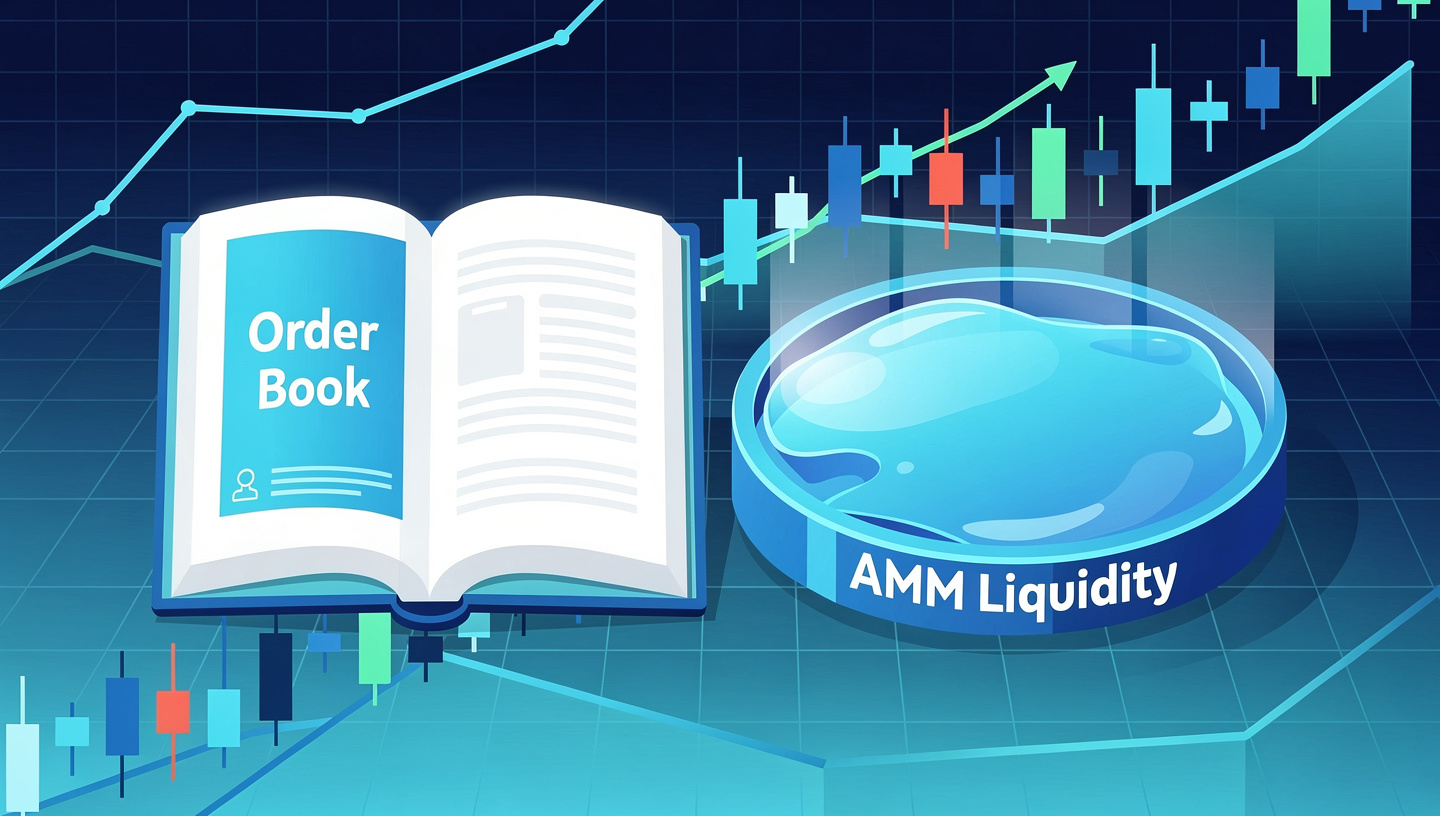
Liquidity is often described as a property of a market. That framing is insufficient. Liquidity is the market. It determines price discovery, capital efficiency, volatility, trader behavior, and ultimately whether a financial system can scale without collapsing under its own reflexivity.
In crypto, two liquidity architectures dominate the landscape: order book–based markets and automated market makers (AMMs). They are frequently compared at a surface level—centralized exchanges versus decentralized finance, professionals versus retail, efficiency versus accessibility. These binaries obscure the deeper reality.
Order books and AMMs are not merely different implementations of liquidity. They encode fundamentally different economic assumptions about information, capital, time, and risk. Understanding these assumptions is essential for researchers, traders, protocol designers, and long-term allocators.
This article presents a rigorous, research-driven comparison of order book liquidity and AMM liquidity—examining their mechanics, strengths, structural weaknesses, and long-term implications for crypto market design.
Defining the Two Paradigms
What Is Order Book Liquidity?
An order book is a discrete, price-based coordination mechanism. Participants submit limit orders specifying price and quantity, or market orders that consume existing liquidity.
Liquidity in an order book emerges from:
- The density of resting limit orders across price levels
- The depth available at each level
- The speed at which new orders update the book
Order books externalize liquidity provision to market participants. There is no guarantee of liquidity at any price—only incentives.
This architecture dominates traditional finance and centralized crypto exchanges because it enables:
- Explicit price discovery
- Advanced trading strategies
- Tight bid-ask spreads under competitive conditions
However, order books are not neutral systems. They privilege speed, information, and scale.
What Is AMM Liquidity?
An automated market maker replaces explicit price quotes with a deterministic pricing function. The most common example is the constant-product formula:x⋅y=k
Liquidity is provided by depositing assets into a pool, not by placing orders. Prices adjust automatically as trades rebalance the pool.
AMMs internalize liquidity. Capital is always available, but at a price that worsens with trade size.
Key properties:
- Continuous liquidity across all prices
- No need for counterparties
- Permissionless participation for liquidity providers
AMMs were not designed to outperform order books. They were designed to exist where order books fail—in low-liquidity, trust-minimized, on-chain environments.
Capital Efficiency: The Core Trade-Off
Order Books: Capital Is Precisely Deployed
In an order book, liquidity providers choose where to place capital. A professional market maker may quote tightly around the mid-price, maximizing fee capture per unit of capital.
Advantages:
- High capital efficiency in liquid markets
- Minimal exposure outside chosen price ranges
- Ability to dynamically adjust inventory
However, this efficiency is conditional. When volatility spikes or information asymmetry increases, liquidity evaporates. Order books are fragile under stress.
AMMs: Capital Is Always On, Always Exposed
In classic AMMs, liquidity is uniformly distributed across the entire price curve—from zero to infinity. This is mathematically elegant and economically inefficient.
Implications:
- Most capital sits idle most of the time
- Large trades incur significant slippage
- Liquidity providers are exposed to adverse selection continuously
Concentrated liquidity AMMs (e.g., Uniswap v3) partially address this by allowing LPs to define price ranges, but this reintroduces:
- Active management complexity
- Order-book-like behavior without order-book tooling
AMMs trade capital efficiency for availability and simplicity.
Price Discovery and Information Flow
Order Books: Information-Dense, Reflexive Systems
Order books aggregate information from many participants:
- Limit orders express valuation
- Cancellations signal changing beliefs
- Depth reveals conviction
This makes order books powerful price discovery engines—but also highly reflexive. Skilled traders can infer intent, front-run large orders, and exploit latency.
Price discovery is efficient because it is competitive—and adversarial.
AMMs: Price Follows Flow, Not Belief
AMMs do not discover prices. They inherit them.
Arbitrageurs align AMM prices with external markets. The AMM itself is passive. It reacts mechanically to order flow.
Consequences:
- Prices lag during fast moves
- Liquidity providers subsidize arbitrage
- External markets dictate internal state
AMMs function as liquidity reservoirs, not informational hubs.
Adverse Selection and Risk Allocation
Order Books: LPs Bear Selection Risk, but Can Defend
In order books, adverse selection occurs when informed traders trade against stale quotes. Professional market makers mitigate this via:
- Fast repricing
- Inventory limits
- Predictive models
Risk is dynamic and defensible—if you have the tools.
Retail liquidity providers do not.
AMMs: Adverse Selection Is Structural
In AMMs, every informed trade is adverse selection by definition. The pool cannot refuse trades or adjust prices preemptively.
Impermanent loss is not a side effect. It is the mechanism by which informed traders extract value from passive liquidity.
This shifts risk from traders to liquidity providers, often without clear disclosure or understanding.
Market Stress and Liquidity Resilience
Order Books Under Stress: Liquidity Disappears
During volatility spikes:
- Spreads widen
- Depth collapses
- Market orders cause outsized impact
Order books are brittle. They require confidence and competition.
AMMs Under Stress: Liquidity Persists, Cost Explodes
AMMs always provide liquidity. The question is price.
During stress:
- Slippage increases non-linearly
- LP losses accelerate
- Arbitrage drains value
Liquidity is technically present but economically punitive.
This distinction matters. Availability is not the same as usability.
Composability and Systemic Effects
Order Books: Isolated but Contained
Order book failures are localized. A broken market does not automatically propagate through the system.
Risk is segmented.
AMMs: Deeply Composable, Deeply Coupled
AMMs are building blocks:
- Used as price oracles
- Embedded in lending protocols
- Integrated into structured products
This composability amplifies efficiency—and systemic risk. A liquidity shock in one pool can cascade through the entire DeFi stack.
AMMs trade isolation for interoperability.
Long-Term Sustainability
Order books scale with:
- Infrastructure
- Professionalization
- Regulation
They converge toward efficiency but centralization.
AMMs scale with:
- Simplicity
- Permissionlessness
- Automation
They converge toward accessibility but structural value leakage.
Neither model is universally superior. Each optimizes for different constraints.
The False Dichotomy
The future is not order books versus AMMs. It is hybridization.
Emerging designs combine:
- On-chain order books with off-chain matching
- RFQ systems with AMM backstops
- Dynamic liquidity curves informed by order flow
The market is converging on a single truth:
Liquidity mechanisms must adapt to context, not ideology.
Liquidity Is a Design Choice, Not a Moral One
Order books and AMMs reflect different philosophies of markets.
Order books assume:
- Informed participants
- Competitive equilibrium
- Defensible advantage
AMMs assume:
- Permissionless access
- Mechanical fairness
- Passive capital
Choosing between them is not about decentralization versus centralization. It is about where you want risk to live, who you want to subsidize whom, and how much inefficiency you are willing to tolerate to achieve openness.
In crypto, liquidity is not neutral. It encodes values.
Over time, markets select the designs that survive reality.