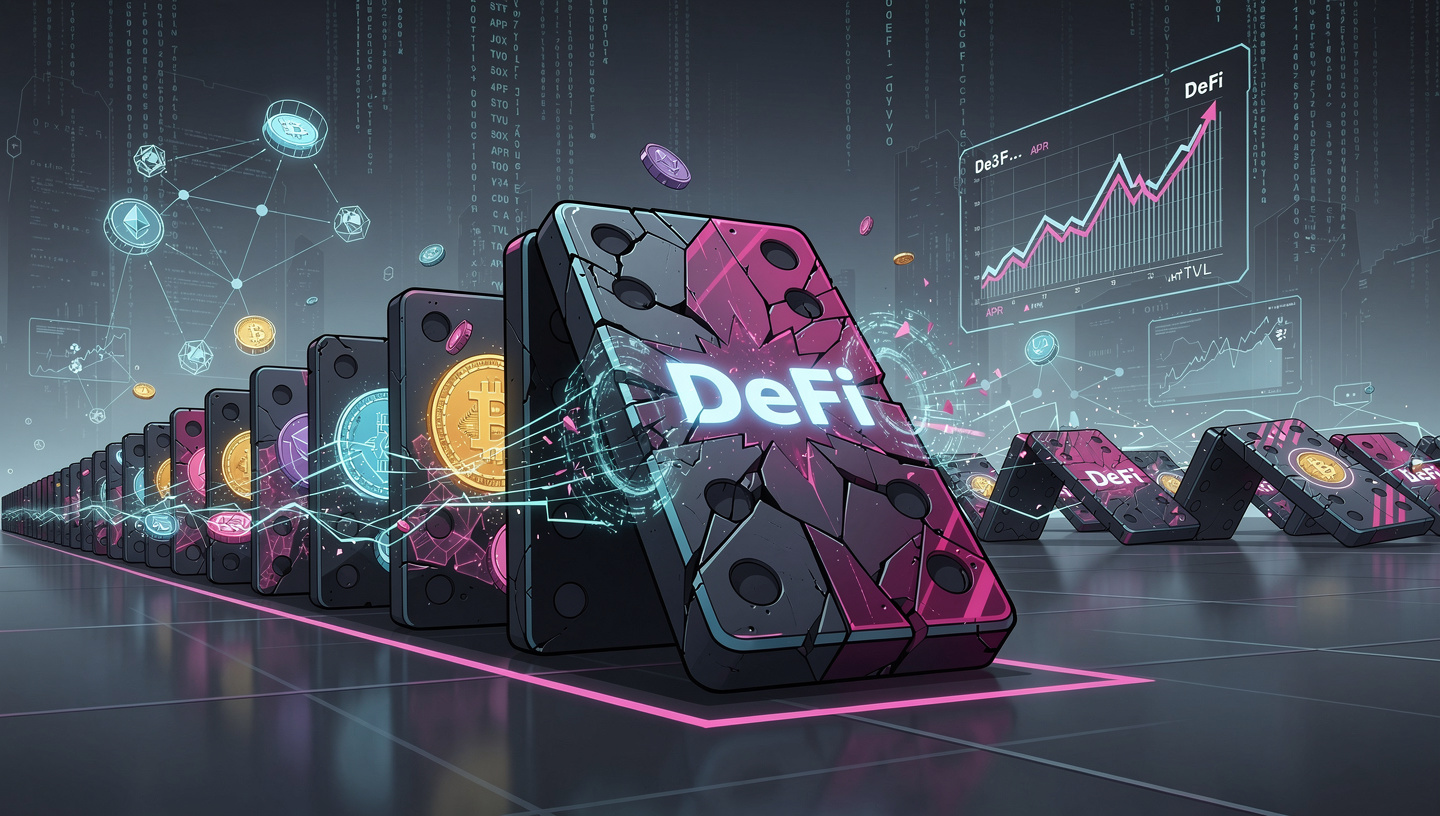
Decentralized Finance did not eliminate intermediaries.
It eliminated excuses.
What DeFi actually did was more radical and more dangerous: it transformed financial risk from something institutional and opaque into something systemic and composable. In traditional finance, failure is siloed. In DeFi, failure is networked.
Every smart contract is not merely code.
It is a financial organism connected to dozens of others through incentives, collateral flows, oracle dependencies, and reflexive market behavior.
When people talk about “risk in DeFi,” they usually mean bugs, hacks, or rug pulls. Those are local failures. Important, yes — but incomplete.
The real question is not “Can this protocol fail?”
The real question is “If this protocol fails, who else goes with it?”
That is systemic risk. And DeFi is saturated with it.
This article dissects systemic risk in DeFi ecosystems from first principles — not as a list of past disasters, but as an analytical framework for understanding why interconnected on-chain finance behaves less like software and more like a fragile macroeconomic system.
1. What Systemic Risk Actually Means in DeFi
Systemic risk is not the probability of loss.
It is the probability of cascading loss.
In DeFi, systemic risk emerges when:
- Protocols depend on one another for core functionality
- Collateral is reused, rehypothecated, or recursively leveraged
- Prices, liquidity, and solvency are synchronized by shared primitives
A single failure does not stay isolated. It propagates.
Unlike TradFi, DeFi has:
- No circuit breakers
- No lender of last resort
- No balance sheet backstops
- No discretionary intervention
Code executes. Markets react. Liquidations fire. Feedback loops accelerate.
Systemic risk is not an edge case in DeFi.
It is the default condition.
2. Composability: DeFi’s Greatest Innovation and Primary Failure Mode
Composability is often marketed as a feature.
In reality, it is a risk multiplier.
When Protocol A deposits into Protocol B, which borrows from Protocol C, which prices assets using Oracle D, you do not have four independent systems.
You have one tightly coupled system with four failure points.
Hidden Correlation
Most DeFi protocols appear diversified on the surface:
- Multiple assets
- Multiple markets
- Multiple users
But underneath, they share:
- The same stablecoins
- The same oracles
- The same liquidity venues
- The same liquidation bots
Correlation in DeFi is structural, not accidental.
When stress arrives, diversification collapses.
3. Collateral Reuse and Recursive Leverage
One of the most underappreciated sources of systemic risk is collateral recursion.
A simplified chain:
- ETH is deposited into a lending protocol
- A stablecoin is borrowed
- That stablecoin is deposited into a yield protocol
- The yield token is used as collateral elsewhere
- Leverage compounds invisibly
Each step looks solvent in isolation.
The system as a whole becomes brittle.
The Illusion of Overcollateralization
DeFi prides itself on overcollateralization.
But recursive leverage erodes this protection.
When prices fall:
- Liquidations happen simultaneously
- Slippage spikes
- Oracle prices lag
- Collateral values collapse faster than models assume
Overcollateralization protects against static risk.
Systemic risk is dynamic.
4. Oracle Dependency: The Single Point of Truth That Isn’t
Every DeFi protocol claims decentralization.
Most outsource truth.
Oracles are systemic choke points:
- Price feeds
- Volatility signals
- Reference markets
When multiple protocols rely on:
- The same oracle provider
- The same DEX liquidity
- The same update cadence
You get synchronized failure.
Even without manipulation:
- Thin liquidity during stress
- Latency during congestion
- Feedback from liquidation trades
The oracle does not lie.
It simply reflects a market already on fire.
5. Liquidity Is Not Capital
Liquidity in DeFi is often mistaken for resilience.
It is not.
Liquidity is conditional:
- It disappears under volatility
- It migrates under incentives
- It fragments across chains and venues
Most DeFi liquidity is:
- Incentivized, not loyal
- Yield-sensitive, not mission-driven
- Shallow during stress
When volatility spikes:
- LPs withdraw
- Slippage explodes
- Liquidations worsen price impact
- More liquidations trigger
Liquidity amplifies both upside and collapse.
6. Stablecoins: The Systemic Load-Bearing Layer
If DeFi has a foundation, it is stablecoins.
They are:
- Unit of account
- Primary collateral
- Settlement layer
- Liquidity bridge
This concentration creates existential risk.
Types of Stablecoin Systemic Risk
- Centralized stablecoins
- Regulatory risk
- Blacklisting
- Custodial freezes
- Crypto-collateralized stablecoins
- Collateral volatility
- Liquidation spirals
- Oracle sensitivity
- Algorithmic stablecoins
- Reflexive death spirals
- Confidence-based solvency
- No terminal backstop
When a dominant stablecoin destabilizes, the shock propagates instantly across lending, derivatives, DEXs, and treasuries.
Stablecoins are not neutral plumbing.
They are systemic financial instruments.
7. Governance Risk as a Systemic Vector
Governance is often framed as decentralization.
In practice, it introduces:
- Coordination risk
- Voter apathy
- Whale dominance
- Slow crisis response
During stress:
- Votes take time
- Proposals lag markets
- Emergency powers are limited or controversial
Code is fast.
Governance is slow.
This mismatch matters when markets move in minutes.
Governance failure does not need corruption.
It only needs latency.
8. Cross-Chain Bridges: Contagion Accelerators
Bridges do not just move assets.
They move risk.
They connect:
- Different security models
- Different validator sets
- Different economic assumptions
When a bridge fails:
- Wrapped assets lose backing
- Liquidity fragments instantly
- Confidence evaporates across chains
Bridges collapse asymmetrically:
- Losses are localized
- Confidence damage is global
They are not merely infrastructure.
They are systemic risk conduits.
9. Reflexivity: Markets That Watch Themselves
DeFi markets are reflexive by design.
Prices influence:
- Collateral values
- Liquidation thresholds
- Borrowing capacity
- Risk parameters
Which in turn influence prices.
This creates nonlinear dynamics:
- Small shocks cause large effects
- Recovery is slower than collapse
- Volatility feeds on itself
Traditional finance hides reflexivity behind discretion.
DeFi encodes it.
10. Why Stress Testing in DeFi Is Mostly Theater
Many protocols publish:
- Risk dashboards
- VaR metrics
- Simulated scenarios
Most assume:
- Independent failures
- Normal distributions
- Static liquidity
- Cooperative markets
Systemic risk violates all four assumptions.
The hardest risks to model are:
- Correlated liquidations
- Behavioral panic
- Liquidity withdrawal
- Governance paralysis
If your model assumes calm markets, it will fail when you need it most.
11. How to Think About DeFi Systemic Risk Correctly
Serious analysis requires a shift in mindset.
Ask Second-Order Questions
- What does this protocol depend on indirectly?
- What happens if its largest dependency fails?
- How does it behave under congestion, not normal load?
Map Dependency Graphs
- Oracles
- Stablecoins
- Bridges
- Liquidity venues
Track Shared Assumptions
- Price stability
- Liquidity depth
- Rational arbitrage
- Continuous uptime
Systemic risk lives where assumptions overlap.
12. Systemic Risk Is Not a Bug — It Is the Price of Financial Innovation
DeFi is not broken because it has systemic risk.
It is dangerous because it is financially powerful without discretion.
This is not a moral judgment.
It is an engineering reality.
DeFi compresses:
- Time
- Transparency
- Settlement
- Leverage
And when systems compress, stress concentrates.
The solution is not to eliminate risk.
That is impossible.
The solution is to understand where risk accumulates, how it propagates, and when it becomes nonlinear.
Those who ignore systemic risk will keep asking why markets “suddenly” collapse.
Those who study it will realize collapse was never sudden — only misunderstood.
Final Thought
DeFi is not fragile because it is young.
It is fragile because it is honest.
Every assumption is on-chain.
Every dependency is inspectable.
Every failure is public.
Systemic risk is not hidden anymore.
In that transparency lies both the danger — and the opportunity.