Blockchains did not introduce anonymity. They introduced radical transparency wrapped in pseudonymity.
This distinction matters. It matters because an entire generation of market participants still misinterprets what it means to transact on-chain. A blockchain is not a black box; it is a globally replicated ledger, cryptographically sealed, publicly auditable, and permanently accessible. Every transaction ever made is still there. Every balance can be recomputed. Every movement of value leaves a trail.
The only missing piece is identity.
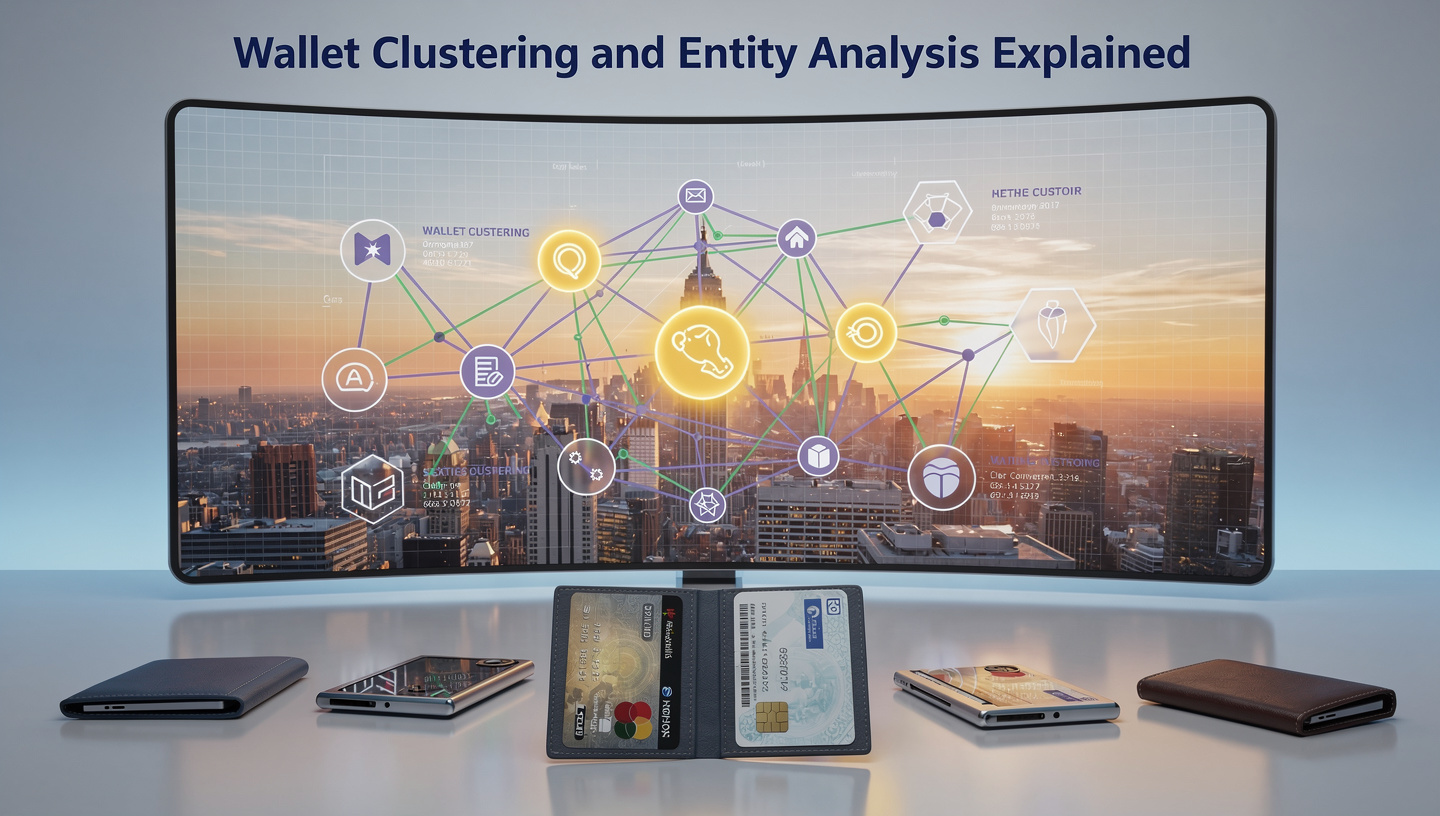
Wallet clustering and entity analysis exist to fill that gap—not by guessing, but by systematically inferring structure from behavior. They are the analytical disciplines that transform raw blockchain data into economic intelligence. They explain who is likely behind the addresses, how capital actually flows, and which actors meaningfully influence markets.
If price charts are the surface, wallet clustering is the anatomy.
This article explains wallet clustering and entity analysis from first principles to advanced applications: how they work, why they matter, where they fail, and how they are reshaping crypto market research, compliance, and strategic investing.
1. From Addresses to Entities: The Core Problem of On-Chain Analysis
At the protocol level, blockchains recognize only addresses, not people, companies, or institutions.
An address is:
- A cryptographic public key (or hash thereof)
- Capable of holding and transferring assets
- Cheap and trivial to generate at scale
A single human or organization can control:
- Hundreds of addresses
- Thousands of smart contract interactions
- Multiple chains simultaneously
Conversely, a single address can represent:
- An exchange hot wallet
- A DAO treasury
- A bridge contract
- A custodian holding funds for millions of users
Analyzing addresses in isolation is analytically useless.
Markets are driven by entities, not keys. Entity analysis is the discipline of reconstructing those entities by grouping addresses that are likely controlled by the same actor or operational system.
This grouping process is called wallet clustering.
2. Wallet Clustering: Definition and Conceptual Foundation
Wallet clustering is the process of algorithmically grouping blockchain addresses based on behavioral, transactional, and structural heuristics to infer common ownership or control.
A cluster represents a probable entity, not a guaranteed identity.
Key characteristics:
- Probabilistic, not deterministic
- Continuously updated as new data arrives
- Context-dependent (varies by chain and transaction model)
Clustering does not “de-anonymize” users in the traditional sense. Instead, it maps economic actors: exchanges, funds, miners, whales, DAOs, bridges, MEV bots, and market makers.
In practice, nearly all serious on-chain analytics—whale tracking, exchange flow analysis, smart money dashboards—are built on clustering.
3. Fundamental Clustering Heuristics (UTXO and Account Models)
3.1 Multi-Input Heuristic (UTXO Chains)
On UTXO-based blockchains like Bitcoin:
If multiple addresses are used as inputs in a single transaction, they are likely controlled by the same entity.
Rationale:
- Signing multiple inputs requires access to all private keys
- Common in wallet software performing coin consolidation
This heuristic forms the backbone of Bitcoin clustering.
Limitations:
- CoinJoin transactions intentionally break this assumption
- False positives possible in collaborative transactions
3.2 Change Address Detection
Most UTXO transactions:
- Spend more than needed
- Return “change” to a newly generated address
Identifying change outputs allows analysts to:
- Extend clusters
- Track wallet evolution over time
Modern wallets complicate this, but probabilistic models remain effective at scale.
3.3 Behavioral Heuristics (Account-Based Chains)
On Ethereum and similar chains, clustering relies less on transaction structure and more on behavioral consistency:
Common signals include:
- Repeated interactions with the same contracts
- Gas usage patterns
- Temporal regularity (e.g., batch operations)
- Nonce sequencing behavior
Smart contract wallets, bots, and institutional actors leave distinct operational fingerprints.
4. Entity Labeling: From Clusters to Economic Meaning
Clustering alone creates anonymous groups. Entity analysis adds semantic labels.
Examples:
- “Binance Hot Wallet”
- “Lido DAO Treasury”
- “Jump Trading”
- “Ethereum Foundation”
Labeling methods include:
- Public disclosures (exchange proof-of-reserves)
- Known deposit addresses
- Smart contract verification
- Transaction graph analysis
- Off-chain intelligence (court documents, GitHub, ENS, social data)
High-confidence labels transform clusters into actionable economic units.
5. Exchange Clustering and Why It Dominates Market Analysis
Centralized exchanges are:
- The largest liquidity hubs
- The primary fiat on/off-ramps
- Major sources of systemic risk
Exchange clusters typically include:
- Hot wallets (operational liquidity)
- Cold wallets (custodial reserves)
- Deposit wallets (user-facing)
Tracking net exchange flows requires accurate clustering:
- Inflows often correlate with sell-side pressure
- Outflows suggest accumulation or self-custody
Without clustering, exchange flow metrics are meaningless noise.
6. Whale Analysis: Capital Concentration vs Capital Control
A “whale” is not defined by balance alone.
True whale analysis asks:
- Is this balance actively managed?
- Is it custodial or proprietary?
- Does it represent one decision-maker or many?
Clustering distinguishes:
- Exchange-held assets (many owners)
- Custodian pools
- Individual high-conviction holders
- Long-dormant capital vs active traders
This distinction explains why headline wallet counts often mislead retail observers.
7. Smart Money Tracking and Fund Behavior
Professional funds exhibit identifiable patterns:
- Gradual accumulation
- Structured position sizing
- Early protocol interaction
- Participation in governance or staking
Entity analysis enables:
- Tracking fund rotation across sectors
- Identifying early capital in new protocols
- Measuring conviction via holding duration
Importantly, clustering prevents double-counting when funds rotate assets internally.
8. Network Health Through Entity Distribution
Decentralization is not ideological—it is measurable.
Entity analysis allows researchers to quantify:
- Token concentration by controlling entity
- Validator or miner dominance
- Governance power distribution
- Systemic dependencies
A network with many addresses but few entities is centralized in practice, regardless of rhetoric.
9. Compliance, Forensics, and Risk Assessment
Regulators and institutions rely heavily on entity analysis for:
- AML monitoring
- Sanctions enforcement
- Fraud detection
- Bridge exploit tracing
Clustering enables:
- Tracing funds across hops
- Identifying laundering patterns
- Differentiating victims from attackers
Contrary to popular belief, blockchains are often more traceable than traditional finance once entities are mapped.
10. Limitations and Adversarial Techniques
No clustering system is perfect.
Key challenges:
- Privacy tools (CoinJoin, Tornado-style mixers)
- Layer-2 abstractions
- Account abstraction and smart wallets
- Intentional obfuscation by sophisticated actors
Clustering accuracy is always a trade-off between:
- Precision (avoiding false positives)
- Recall (capturing full entity scope)
High-quality systems treat clusters as confidence-weighted hypotheses, not absolute truth.
11. The Strategic Implication: Why This Matters to Investors
Markets move when entities act, not when addresses blink.
Entity-aware analysis enables:
- Cleaner signal extraction
- Better attribution of flows
- Early detection of regime shifts
- Reduced reliance on narratives
In a transparent ledger system, informational advantage comes not from secrecy—but from interpretation.
12. Wallet Clustering as Infrastructure, Not Alpha
Over time, clustering will become:
- More standardized
- More commoditized
- More embedded in base analytics
The alpha shifts from having the data to asking better questions of it.
The investors and researchers who understand entity dynamics will:
- See through misleading on-chain metrics
- Recognize structural risks earlier
- Allocate capital with higher conviction
The Ledger Sees Everything—If You Know How to Read It
Blockchains record transactions.
Wallet clustering reconstructs actors.
Entity analysis reveals power.
This is not surveillance—it is economic literacy in a transparent system.
As crypto markets mature, the difference between speculation and strategy will increasingly hinge on one capability:
the ability to move from addresses to entities, and from entities to insight.
Those who master that translation do not chase signals.
They understand structure.