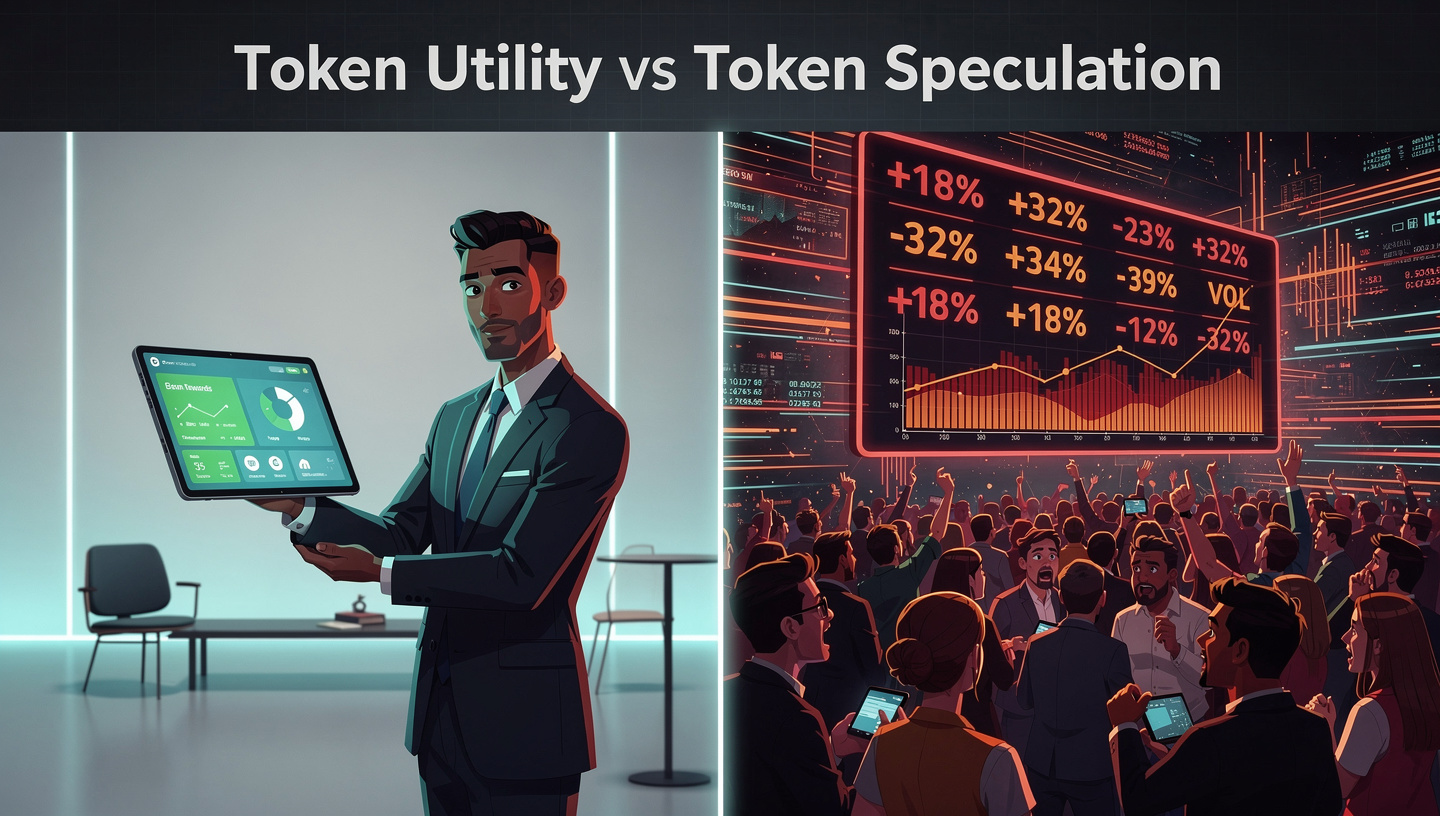
Whitepapers speak of ecosystems, governance, incentives, and disruption. Pitch decks promise alignment between users, builders, and capital. Yet when market cycles compress, liquidity dries up, and speculative excess recedes, a sobering reality emerges: most tokens do not function as productive economic instruments. They function as vehicles of speculation.
This distinction—token utility versus token speculation—is not semantic. It is foundational. It defines whether a crypto asset behaves like digital infrastructure or merely digital inventory. Whether it compounds value over time or relies on the next buyer paying more. Whether it survives hostile market conditions or collapses once narrative momentum fades.
Understanding this difference is no longer optional. It is the dividing line between informed capital allocation and probabilistic gambling in an increasingly complex crypto market.
This article examines that line with precision.
Defining Token Utility: What “Utility” Actually Means (and What It Does Not)
Token utility is frequently misunderstood because it is often described theoretically, not economically.
At its core, true token utility exists when a token is required to perform a non-trivial economic function within a system that would otherwise be inefficient or impossible without it.
That definition immediately eliminates many commonly cited “utilities.”
What Token Utility Is Not
A token does not gain genuine utility simply because it:
- Exists as a medium of exchange inside its own platform
- Grants access to a dashboard, NFT mint, or gated community
- Is used to pay transaction fees that could be paid in another asset
- Is required only because the protocol’s designers decided so
Artificial dependency is not utility. It is design enforcement.
What Token Utility Actually Is
A token demonstrates real utility when it satisfies at least one of the following conditions:
- Economic Necessity
The system cannot function at scale without the token. - Value Capture
Increased network usage directly increases the token’s demand or scarcity. - Non-Substitutability
Replacing the token with another asset degrades the system’s security, efficiency, or trust assumptions. - Irreversibility
The token’s role cannot be removed without collapsing the protocol’s incentive structure.
When these conditions are absent, “utility” is often just branding.
Token Speculation: The Dominant Use Case No One Admits
Speculation is not inherently negative. Markets require speculation to discover price. However, a speculative token is one whose primary demand driver is expectation of future price appreciation rather than present economic function.
In crypto, this category is not marginal—it is dominant.
The Mechanics of Token Speculation
Speculative tokens tend to share common characteristics:
- Narrative-Driven Demand
Price is driven by storytelling, trends, influencers, or sector rotations rather than cash flow or usage metrics. - Reflexive Liquidity Loops
Rising prices attract attention; attention attracts capital; capital drives price higher—until liquidity exits. - Weak Fundamental Anchors
There is no intrinsic mechanism tying token demand to real economic output. - Optional Utility
The token may be usable, but usage is not mandatory or economically meaningful.
Speculation thrives in environments where abundance masquerades as innovation.
Why Most Tokens Fail the Utility Test
The crypto industry has produced millions of tokens, yet only a fraction demonstrate durable economic relevance. This is not accidental.
1. Tokenization Is Easier Than Value Creation
Issuing a token is trivial. Designing a self-sustaining economic system is not.
Many projects invert the process:
- Token first
- Utility later
- Adoption hoped for
This sequence almost always fails.
2. Forced Utility Is Fragile
When a token is artificially inserted into a system, users naturally seek ways around it. They hedge, dump, or minimize exposure. If utility must be mandated, it is usually not compelling.
3. Incentives Replace Demand
Liquidity mining, staking rewards, and emissions often substitute for real demand. When incentives stop, so does usage.
This is not utility. It is subsidized behavior.
A Framework to Distinguish Utility from Speculation
To evaluate a token objectively, ask the following questions:
Question 1: Would the protocol still be valuable if the token price fell 90%?
If the answer is no, the system is price-dependent, not utility-driven.
Question 2: Does increased usage require increased token acquisition?
If users can interact without holding or consuming the token, demand is optional.
Question 3: Is the token a cost or an asset to users?
Utility tokens often behave like productive assets (collateral, security, settlement layers), not consumable fees.
Question 4: Can the token be replaced without breaking the system?
If yes, its role is cosmetic.
Tokens that pass these tests tend to survive cycles. Those that fail tend to rebrand.
Bitcoin as a Benchmark for Non-Speculative Utility
Any serious discussion of token utility must acknowledge Bitcoin—not as a cultural phenomenon, but as an economic construct.
Bitcoin’s utility is not transactional throughput or programmability. Its utility is monetary finality.
- It converts energy into immutable digital property
- It enables censorship-resistant settlement
- It operates without discretionary monetary policy
- It does not rely on narrative reinvention
Bitcoin is often accused of being “pure speculation,” yet its demand persists independently of feature updates or ecosystem incentives. That persistence is not accidental. It reflects a utility that is structural, not promotional.
This does not mean Bitcoin is the only utility-driven asset. It means it is the clearest example of non-optional utility.
The Gray Zone: Tokens with Partial or Emerging Utility
Not all tokens are binary. Some exist in a transitional state.
Examples include:
- Network security tokens (staking-based systems)
- Settlement tokens for high-friction financial processes
- Collateral assets in overcollateralized systems
These tokens may exhibit early-stage utility, but still depend heavily on speculation for valuation. Their long-term survival depends on whether usage eventually dominates narrative.
The critical question is trajectory:
- Is utility increasing relative to speculation?
- Or is speculation merely cycling narratives?
Why Speculation Dominates Crypto Markets
Understanding the dominance of speculation requires understanding incentives.
1. Time Preference Mismatch
Utility compounds slowly. Speculation moves quickly. Markets reward speed.
2. Asymmetric Information
Retail participants often cannot evaluate protocol economics, but they can evaluate price charts.
3. Liquidity Culture
Crypto markets evolved around trading, not infrastructure financing. Tokens became liquidity instruments before they became economic ones.
This does not invalidate the space. It contextualizes it.
The Long-Term Convergence: Where Utility Absorbs Speculation
Over time, markets tend to converge toward economic gravity.
Speculative assets without utility decay.
Utility-driven assets absorb speculation and stabilize.
This process is slow, painful, and non-linear. It is also inevitable.
The future of crypto will not be decided by how many tokens exist, but by how few remain economically necessary.
Conclusion: Capital Allocation in an Era of Token Abundance
Token utility and token speculation are not moral categories. They are economic realities.
Speculation provides liquidity, discovery, and momentum. Utility provides durability, relevance, and survival.
The mistake is not participating in speculation. The mistake is confusing speculation for utility and assuming narrative can permanently replace economic function.
In a world of infinite tokens, scarcity of necessity becomes the ultimate filter.
The investors, builders, and thinkers who understand this distinction early will not need to chase cycles. They will stand on structures that endure when cycles end.