Most investors believe numbers are objective.
In crypto, numbers are persuasive.
They do not merely describe reality — they shape perception, guide capital allocation, and quietly determine who exits early, who holds too long, and who never understands why the chart betrayed them.
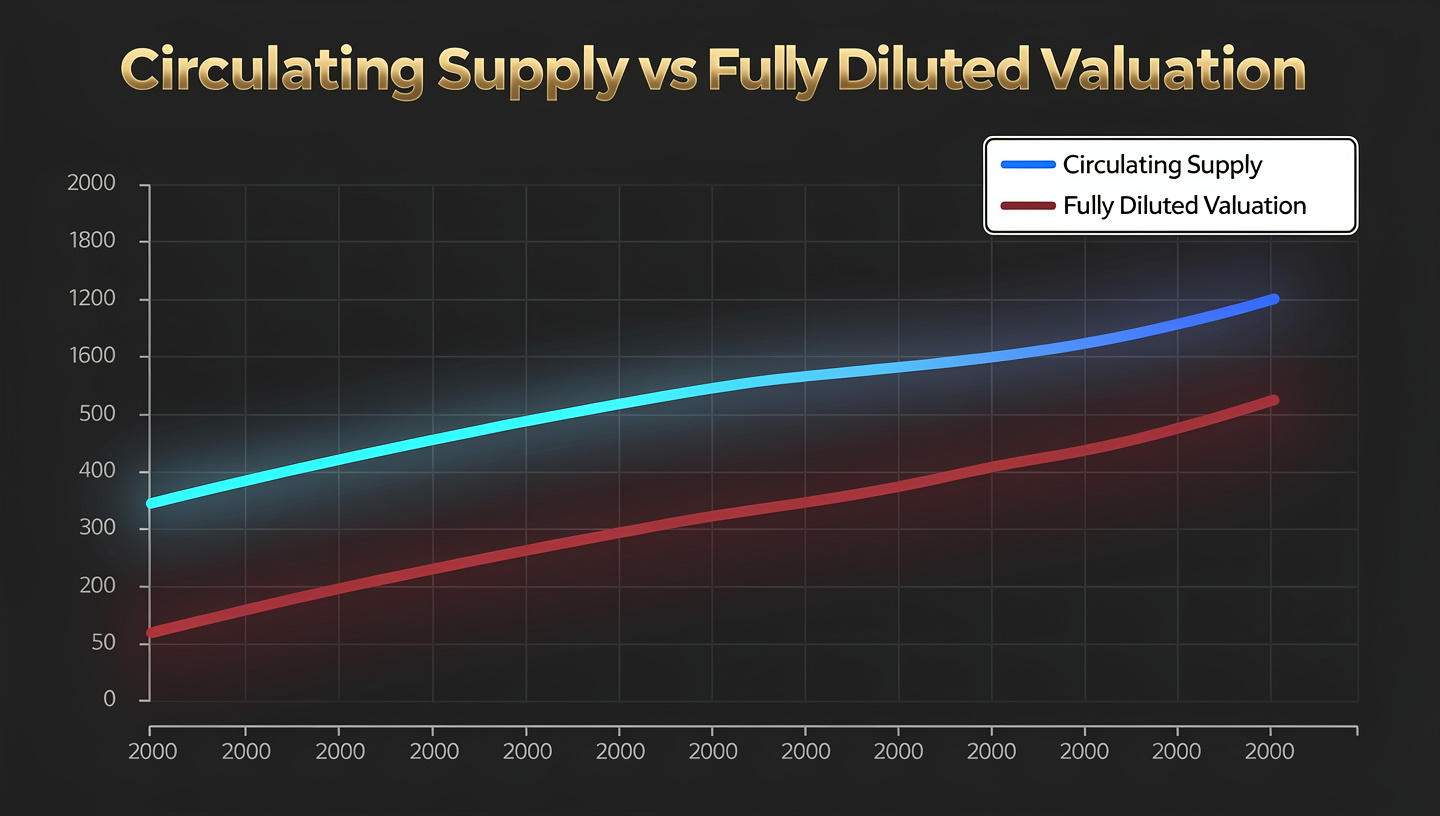
Two of the most powerful numbers in this illusion are Circulating Supply and Fully Diluted Valuation (FDV).
They appear simple.
They are not.
They look like accounting metrics.
They behave like psychological weapons.
If you do not understand the structural tension between circulating supply and FDV, you are not investing — you are speculating inside someone else’s incentive system.
Defining the Terms (Without Oversimplifying Them)
Circulating Supply: What the Market Can Actually Trade
Circulating Supply represents the number of tokens currently available for public trading.
These tokens can be bought, sold, transferred, or used without restrictions.
Key characteristics:
- Excludes locked tokens
- Excludes vesting allocations
- Excludes team, foundation, or ecosystem reserves that cannot yet enter the market
Circulating supply answers one narrow question:
How many tokens can affect price today?
That is all it answers — and that limitation matters.
Fully Diluted Valuation (FDV): The Market Capitalization of the Future
FDV assumes that every token that will ever exist is already in circulation, priced at today’s market price.
Formula:
FDV = Token Price × Max Supply
FDV does not care:
- When tokens unlock
- Who receives them
- Whether demand will exist later
- Whether the network will still be relevant
FDV answers a very different question:
What is this network worth if every promised token is released at the current price?
That question is hypothetical — but the consequences are real.
Why This Distinction Matters More Than Almost Any Other Metric
In traditional equity markets, dilution is slow, regulated, and visible.
In crypto, dilution is:
- Programmatic
- Relentless
- Often underestimated
- Emotionally invisible
Circulating supply creates short-term scarcity.
FDV reveals long-term gravity.
Price lives in the present.
Valuation lives in the future.
And markets eventually reconcile the two.
The Optical Illusion of Low Circulating Supply
Many tokens launch with:
- 5–15% circulating supply
- Aggressive marketing
- High-profile investors
- A narrative of “early opportunity”
This creates a deceptively low market cap.
Example:
- Circulating supply: 100 million tokens
- Price: $2
- Market cap: $200 million
This feels “cheap.”
But if max supply is 1 billion tokens, FDV is $2 billion.
The market is not buying a $200 million network.
It is implicitly underwriting a $2 billion future — whether it realizes it or not.
Token Unlocks: The Silent Supply Shock
FDV becomes dangerous when paired with vesting schedules.
Token unlocks are not hypothetical.
They are scheduled liquidity events.
Every unlock introduces:
- New sell pressure
- Asymmetric incentives
- Capital extraction risk
Early investors, teams, and foundations often acquired tokens at:
- Near-zero cost
- Private valuations far below public price
- Long before retail liquidity existed
Their incentives are rational:
- De-risk
- Rotate capital
- Realize gains
Your incentive is different:
- Preserve purchasing power
- Avoid dilution
- Stay solvent
FDV tells you whether those incentives are aligned — or adversarial.
High FDV, Low Circulating Supply: Who Benefits?
This structure benefits:
- Venture capital
- Early insiders
- Foundations
- Ecosystem treasuries
It disadvantages:
- Late entrants
- Passive holders
- Long-term believers without capital rotation strategies
A token with:
- 10% circulating supply
- 90% locked
- Multi-year vesting
Is not “early.”
It is pre-dilution.
When FDV Actually Matters — and When It Doesn’t
FDV is not inherently bad.
It becomes meaningful when:
- Token unlocks are large relative to current volume
- Demand growth is uncertain
- Token utility is weak or indirect
- Inflation is front-loaded
FDV matters less when:
- Tokens are burned
- Supply is deflationary
- Network usage creates organic demand
- Token captures real economic value
Bitcoin, for example, has an FDV close to its market cap — not because it is fully issued, but because future supply is predictable, capped, and asymptotically small.
That distinction is everything.
Circulating Supply Without Context Is a Trap
A growing circulating supply is not always bearish.
A static circulating supply is not always bullish.
What matters is supply growth relative to demand growth.
If:
- Supply grows 20% annually
- Demand grows 5%
Price pressure is structural.
If:
- Supply grows 2%
- Demand grows 20%
Price appreciation is inevitable.
Circulating supply is a snapshot.
FDV is a trajectory.
The Psychological Role of FDV in Market Cycles
During bull markets:
- FDV is ignored
- Narratives dominate
- Liquidity masks dilution
During bear markets:
- FDV becomes unavoidable
- Unlocks feel heavier
- Price compression accelerates
Most investors only discover FDV after it harms them.
Professionals price it in before capital is deployed.
Tokenomics Is Monetary Policy, Not Marketing
Every token has:
- Issuance policy
- Distribution schedule
- Incentive design
These are not branding choices.
They are monetary policy decisions.
FDV is the balance sheet.
Circulating supply is the money in circulation.
If you would not invest in a country with reckless monetary expansion, you should not invest in a token with uncontrolled dilution — regardless of how compelling the roadmap appears.
How to Analyze Circulating Supply vs. FDV Correctly
A serious analysis requires more than a chart.
You must examine:
- Unlock schedule cadence
- Recipient behavior history
- Token utility vs. speculative demand
- Treasury transparency
- Burn mechanisms (if any)
- Revenue capture, not just usage
FDV is not a number to fear.
It is a number to interrogate.
The Strategic Investor’s Perspective
Short-term traders can ignore FDV.
Long-term allocators cannot.
If you plan to hold through multiple cycles, FDV determines:
- Your dilution risk
- Your opportunity cost
- Your capital efficiency
Markets reward patience — but only when patience is aligned with sound monetary architecture.
Final Thought: Numbers Do Not Lie, But They Do Distract
Circulating supply tells you what the market sees.
FDV tells you what the market will eventually confront.
Between those two numbers lies:
- Time
- Incentives
- Human behavior
Crypto does not punish ignorance immediately.
It punishes it eventually — and without apology.
If you understand the tension between circulating supply and FDV, you are no longer reacting to price.
You are evaluating structure.
Structure, in the end, always wins.