Bitcoin was never meant to be obvious.
If it were, it wouldn’t have spent its first decade being laughed at, ignored, misunderstood, declared dead hundreds of times, and written off as a toy for nerds, criminals, and dreamers with too much time on their hands. Bitcoin’s true proposition only reveals itself slowly—over years, not months; over cycles, not headlines.
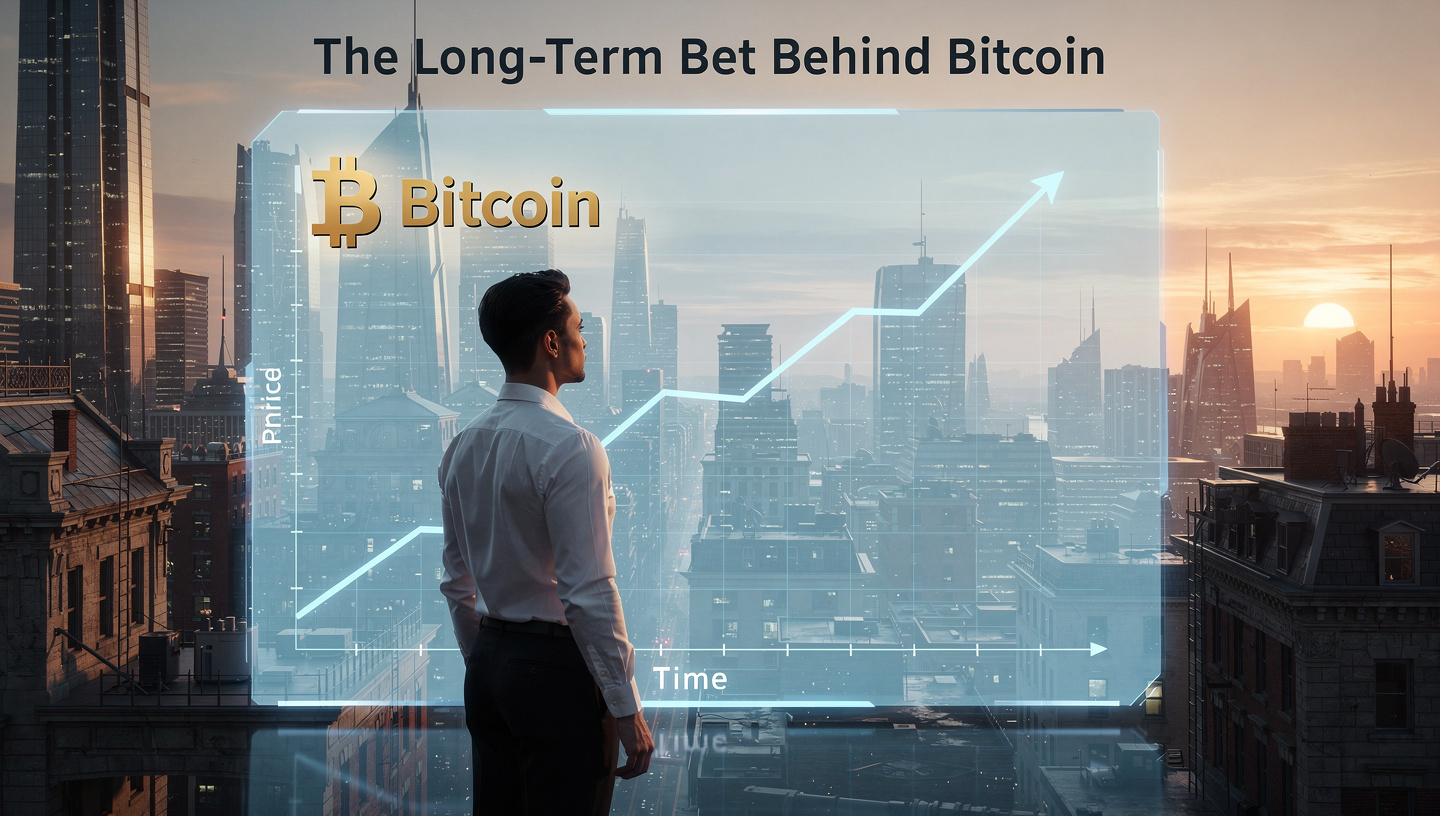
Bitcoin is not a short-term trade. It is a long-term bet.
And not just a bet on price—but on people, systems, incentives, and the future shape of money itself.
To understand Bitcoin, you have to stop asking “What is it worth right now?” and start asking “What problem does it still solve if everything else changes?”
1. Bitcoin Is a Bet Against Human Nature—And Also On It
At first glance, Bitcoin looks like a bet against human nature.
It assumes:
- Institutions will abuse power if given enough time
- Money will be over-issued when it can be
- Rules will be bent under political pressure
- Trust will eventually be betrayed
History overwhelmingly supports these assumptions.
Every fiat currency ever created has eventually been debased. Every monetary system that relied on discretion rather than rules drifted toward excess. Inflation is not a bug—it’s the most predictable outcome of centralized control.
Bitcoin doesn’t try to fix human nature.
It routes around it.
Instead of asking leaders to be disciplined, Bitcoin removes their ability to cheat. Instead of trusting good intentions, it enforces hard constraints. Instead of relying on morality, it relies on math.
But here’s the paradox: Bitcoin is also a bet on human nature.
It assumes:
- People will choose systems that are fair over time
- People will coordinate around neutral rules
- People will value sovereignty when they understand it
- People will protect something that protects them
Bitcoin works because humans, when given a credible alternative, will migrate. Slowly. Reluctantly. Then all at once.
2. The Real Innovation Wasn’t Blockchain—It Was Finality
Most people think Bitcoin’s innovation was “blockchain.”
It wasn’t.
The real breakthrough was credible finality without trust.
Before Bitcoin, digital systems always required someone in charge:
- A bank to settle
- A company to approve
- A government to enforce
Bitcoin changed that by answering a previously unsolved question:
How do you agree on truth in a digital system with no central authority?
Bitcoin’s answer—Proof of Work—was expensive, inefficient, and controversial by design. That wasn’t a flaw. It was the cost of independence.
Proof of Work makes rewriting history economically irrational. It ties digital truth to real-world energy and time. It makes lies expensive and honesty cheap.
That’s the long-term bet:
That settlement certainty is more valuable than speed, convenience, or aesthetics.
In a world drowning in reversible transactions, chargebacks, censorship, frozen accounts, and arbitrary rule changes—Bitcoin offers something radical:
When a transaction is final, it is final.
No appeals. No exceptions. No special permissions.
That kind of finality ages extremely well.
3. Bitcoin Is Not Competing With Visa—It’s Competing With Gold and Sovereignty
Bitcoin skeptics often ask the wrong question:
“How can Bitcoin replace Visa if it’s slow and expensive?”
It’s not trying to.
Bitcoin doesn’t compete with payment rails.
It competes with base layers of value.
Bitcoin is closer to:
- Gold than PayPal
- Land than credit cards
- Central bank reserves than Venmo
Visa moves money within a system.
Bitcoin exists outside the system.
That distinction matters more every year.
Gold’s role has always been clear:
- Hard to produce
- Hard to fake
- Politically neutral
- Globally recognized
Bitcoin offers the same properties—but with digital portability, verifiability, and absolute scarcity.
The long-term bet is not that everyone uses Bitcoin daily.
The bet is that every system eventually references it.
4. Scarcity Is Easy to Say, Hard to Maintain
Anyone can say something is scarce.
Very few things remain scarce under pressure.
Governments inflate.
Companies dilute.
Protocols change rules.
Founders break promises.
Communities compromise “just this once.”
Bitcoin didn’t just promise scarcity.
It removed the mechanism to undo it.
- No founder keys
- No supply committee
- No emergency mint button
- No governance vote to change 21 million
Bitcoin’s supply schedule is boring—and that’s the point.
The long-term bet is that boring beats clever.
Over decades, not quarters, people learn to trust systems that don’t surprise them. Bitcoin’s predictability is its greatest strength, even if it feels unexciting.
Especially when everything else feels unstable.
5. Bitcoin Is a Hedge Against Unknown Unknowns
Most people try to predict specific futures.
Bitcoin doesn’t.
Bitcoin is a hedge against:
- Political instability
- Monetary mismanagement
- Capital controls
- Financial repression
- Institutional decay
- Technological surveillance
Not because it predicts which will happen—but because it remains useful if any of them do.
This is crucial.
Bitcoin doesn’t require:
- A specific country to fail
- A specific currency to collapse
- A specific ideology to win
It only requires that some systems, somewhere, eventually break trust.
That’s not a radical assumption.
It’s a historical constant.
6. Time Is Bitcoin’s Secret Weapon
Bitcoin looks weak in the short term because it refuses to optimize for short-term success.
It doesn’t:
- Change monetary policy to attract users
- Add features to chase hype
- Compromise principles for adoption
- Move fast and break things
Bitcoin just keeps producing blocks.
Every 10 minutes.
For over 15 years.
Through bull markets, bear markets, bans, forks, attacks, scandals, and ridicule.
Time filters noise.
The longer Bitcoin survives:
- The harder it is to dismiss
- The more expensive it is to attack
- The more credible it becomes
- The more conservative it gets
Bitcoin doesn’t need to win arguments.
It just needs to outlast critics.
7. The Network Effects Are Subtle—but Relentless
Bitcoin’s network effects aren’t flashy.
They don’t show up as:
- DAU charts
- Viral growth curves
- Social media hype
They show up as:
- Hashrate distribution
- Node count
- Geographic dispersion
- Institutional custody standards
- Legal recognition
- Balance sheet adoption
Every year Bitcoin becomes:
- Harder to ban
- Harder to replace
- Harder to ignore
And because Bitcoin changes slowly, competitors can’t easily copy its credibility. You can fork the code. You can’t fork history.
8. Bitcoin Is a Moral System Disguised as a Technical One
At its core, Bitcoin encodes values:
- Equality: Same rules for everyone
- Transparency: Rules visible to all
- Consent: Participation is voluntary
- Self-responsibility: No bailouts
- Neutrality: No discrimination
These are not political values.
They are civilizational values.
Bitcoin doesn’t enforce morality.
It enforces consistency.
And consistency, over time, becomes trust.
9. The Long-Term Bet Isn’t That Bitcoin Wins—It’s That It Survives
Bitcoin doesn’t need to replace everything.
It just needs to:
- Remain censorship-resistant
- Remain scarce
- Remain neutral
- Remain operational
That’s it.
Even if Bitcoin:
- Never becomes a daily currency
- Never reaches universal adoption
- Never replaces banks
It still succeeds if it remains a credible exit.
An exit from bad money.
An exit from broken systems.
An exit from trust failures.
The existence of an exit changes behavior—even for those who never take it.
10. Why Bitcoin Feels Uncomfortable—and Why That Matters
Bitcoin is uncomfortable because it removes illusions.
It doesn’t promise safety.
It doesn’t promise convenience.
It doesn’t promise someone else will fix your mistakes.
Bitcoin hands you freedom—and responsibility—with the same gesture.
That’s why it attracts critics.
That’s why it attracts believers.
That’s why it refuses to die.
Conclusion: Bitcoin Is a Bet on the Long Arc of History
Bitcoin is not betting on next year.
It’s betting on the next 50 years.
It’s betting that:
- Rules beat rulers
- Scarcity beats abundance
- Neutrality beats favoritism
- Time beats marketing
- Systems that don’t bend don’t break
Bitcoin doesn’t ask to be believed.
It asks to be tested.