If you’ve spent more than five minutes in crypto Twitter, a whitepaper, or a late‑night Discord debate, you’ve probably heard it:
“You can’t have decentralization, security, and scalability at the same time.”
This idea—known as the Blockchain Trilemma—has become one of the most repeated truths in the industry. It’s quoted like a law of physics. It’s used to justify trade‑offs, defend design decisions, and explain why every new chain is either slow, centralized, or insecure.
But here’s the uncomfortable question:
Is the blockchain trilemma a fundamental law… or just a very persuasive myth?
In this article, we’ll unpack where the trilemma came from, what it actually means, why it keeps resurfacing, and whether modern blockchain architectures are genuinely breaking it—or just bending it in clever ways.
No math. No hype. Just clear thinking, real trade‑offs, and a human‑level explanation.
What the Blockchain Trilemma Actually Says (Without the Buzzwords)
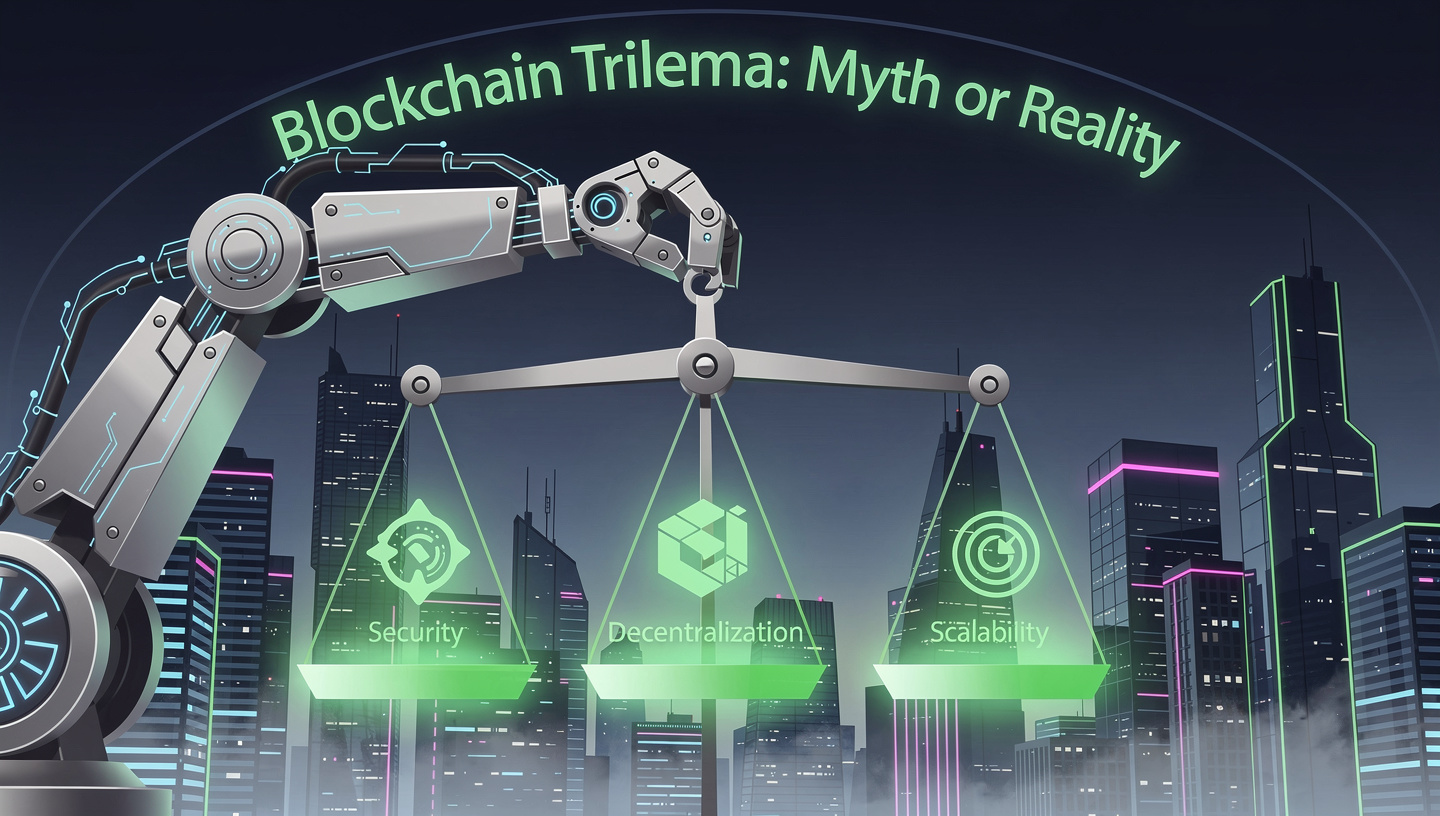
The trilemma claims that a blockchain system can optimize only two of the following three properties at the same time:
- Decentralization – No single party controls the network. Anyone can participate, validate, or verify.
- Security – The network resists attacks, censorship, fraud, and manipulation.
- Scalability – The system can handle high transaction throughput with low fees and fast confirmation times.
According to the trilemma:
- Prioritize decentralization + security → the network becomes slow and expensive.
- Prioritize security + scalability → you sacrifice decentralization.
- Prioritize decentralization + scalability → security weakens.
Bitcoin and Ethereum (Layer 1) are often cited as examples of strong decentralization and security, but weak scalability.
High‑performance chains are often accused of scaling by quietly centralizing validator sets.
So far, the trilemma seems… accurate.
But accuracy doesn’t automatically mean inevitability.
Where Did the Trilemma Come From?
Interestingly, the blockchain trilemma is not a formal theorem. It’s not proven like the CAP theorem in distributed systems. It’s more of an empirical observation that emerged from early blockchain experiments.
Vitalik Buterin popularized the idea around 2017–2018, when Ethereum’s limitations became impossible to ignore. The term gave language to something builders already felt:
Every optimization seemed to come with a painful cost somewhere else.
Early blockchains were monolithic:
- One layer handled execution, consensus, data availability, and settlement.
- Every node had to do everything.
Under that design, trade‑offs were brutal and unavoidable.
So the trilemma wasn’t invented out of thin air—it described a real pattern. But it also reflected a specific design era.
And that detail matters.
Why the Trilemma Feels So Convincing
The trilemma sticks because it aligns with intuition.
1. Decentralization Is Expensive
The more people who can participate:
- The slower coordination becomes
- The harder it is to upgrade
- The more redundancy exists
Decentralization is inefficient by design. That inefficiency is the price of trustlessness.
2. Security Thrives on Redundancy
Security comes from:
- Many independent validators
- Conservative assumptions
- Slow, deliberate changes
All of these reduce raw performance.
3. Scalability Loves Control
High throughput systems usually rely on:
- Fewer decision‑makers
- Faster finality assumptions
- Optimized hardware
Which starts to look suspiciously like centralization.
So when someone claims they’ve “solved” the trilemma, skepticism is healthy.
But skepticism shouldn’t turn into dogma.
The Hidden Assumption Behind the Trilemma
The trilemma quietly assumes something very important:
Everything must be optimized in a single layer, at the same time, by the same actors.
This assumption held true for early blockchains.
But modern blockchain design no longer accepts it.
Once you relax that assumption, the trilemma starts to crack.
Modular Blockchains: Splitting the Triangle
One of the biggest shifts in blockchain thinking is modularity.
Instead of one chain doing everything, responsibilities are separated:
- Execution – Running transactions and smart contracts
- Consensus – Agreeing on the order of transactions
- Data Availability – Ensuring transaction data is accessible
- Settlement – Final dispute resolution and state anchoring
By splitting these roles across layers, systems can:
- Keep the base layer highly decentralized and secure
- Push scalability to upper layers
This doesn’t destroy the trilemma—it rearranges it.
Layer 1 focuses on security and decentralization.
Layer 2 focuses on scalability.
Suddenly, the trade‑offs are no longer mutually exclusive at the system level.
Rollups: The Most Serious Trilemma Challenger So Far
Rollups are often described as Ethereum’s scaling solution—but conceptually, they’re a challenge to the trilemma itself.
Here’s the key insight:
Execution does not need the same trust assumptions as settlement.
Rollups:
- Execute transactions off‑chain
- Publish data on‑chain
- Inherit security from the base layer
This allows:
- Massive scalability gains
- Strong security guarantees
- Preservation of decentralization at the base layer
Are rollups perfect? No.
They introduce:
- New trust assumptions (sequencers, provers)
- UX complexity
- Fragmentation
But they demonstrate something crucial:
The trilemma is not absolute—it’s architectural.
Is Decentralization a Spectrum, Not a Switch?
One reason trilemma debates go nowhere is that people treat decentralization as binary.
It isn’t.
Decentralization exists on multiple axes:
- Validator diversity
- Geographic distribution
- Client diversity
- Governance control
- Economic accessibility
A system can be decentralized in some dimensions and weak in others.
So when critics say:
“This chain is centralized.”
The honest response is:
“Compared to what—and along which axis?”
The trilemma oversimplifies a multidimensional reality into a triangle that feels clean but hides nuance.
High‑Performance Chains: Breaking the Trilemma or Redefining It?
Some modern Layer 1s claim to beat the trilemma directly by:
- Using optimized consensus
- Relying on powerful hardware
- Reducing validator counts
Do they scale? Often, yes.
Are they secure? Sometimes.
Are they decentralized?
That depends on your definition.
If decentralization means:
- Anyone with a laptop can validate → probably not.
- No single entity controls the network → maybe.
These systems don’t ignore the trilemma. They reinterpret decentralization.
Whether that’s acceptable is a social and philosophical question, not just a technical one.
The Social Layer: The Fourth Vertex No One Talks About
Here’s a hot take:
The blockchain trilemma ignores the most important layer of all—the social layer.
Human coordination:
- Determines governance outcomes
- Resolves crises
- Applies norms and values
Bitcoin survived not just because of code, but because of social consensus around what Bitcoin is.
Ethereum evolved because its community tolerated complexity in exchange for flexibility.
No trilemma diagram includes:
- Culture
- Values
- Community resilience
But in practice, these often matter more than raw TPS.
So… Myth or Reality?
The honest answer is uncomfortable:
The blockchain trilemma is real—but incomplete.
It accurately describes the constraints of:
- Single‑layer systems
- Homogeneous trust assumptions
- Early blockchain architectures
It fails to fully describe:
- Modular systems
- Layered security models
- Evolving definitions of decentralization
The trilemma isn’t a law of nature.
It’s a warning label.
It says:
“Every design choice has a cost. Be explicit about which one you’re paying.”
Final Thoughts
The blockchain trilemma has done its job.
It forced the industry to confront reality.
But clinging to it as an unbreakable law risks blinding us to progress.
Blockchains are no longer experiments.
They’re evolving systems.
And evolution doesn’t eliminate constraints—it learns how to live with them.
The triangle still exists.
We’re just learning how to build around it.