For all its innovation, crypto has always had an identity problem.
Blockchains can tell us what happened, when it happened, and which wallet did it — but not who that wallet is. Not in any meaningful human sense.
A wallet today is just a mask:
- A string of characters
- A temporary persona
- A disposable identity
You can be a DeFi whale in the morning, a DAO voter in the afternoon, and a scammer at night — all without carrying any persistent reputation between roles.
That flexibility gave crypto its early power.
But it also became its biggest weakness.
Soulbound Tokens (SBTs) are an attempt to fix that — not by doxxing users, but by giving blockchains something they’ve never had before:
Memory. Identity. Reputation.
This is the story of how crypto is trying to grow up.
1. What Are Soulbound Tokens (SBTs)?
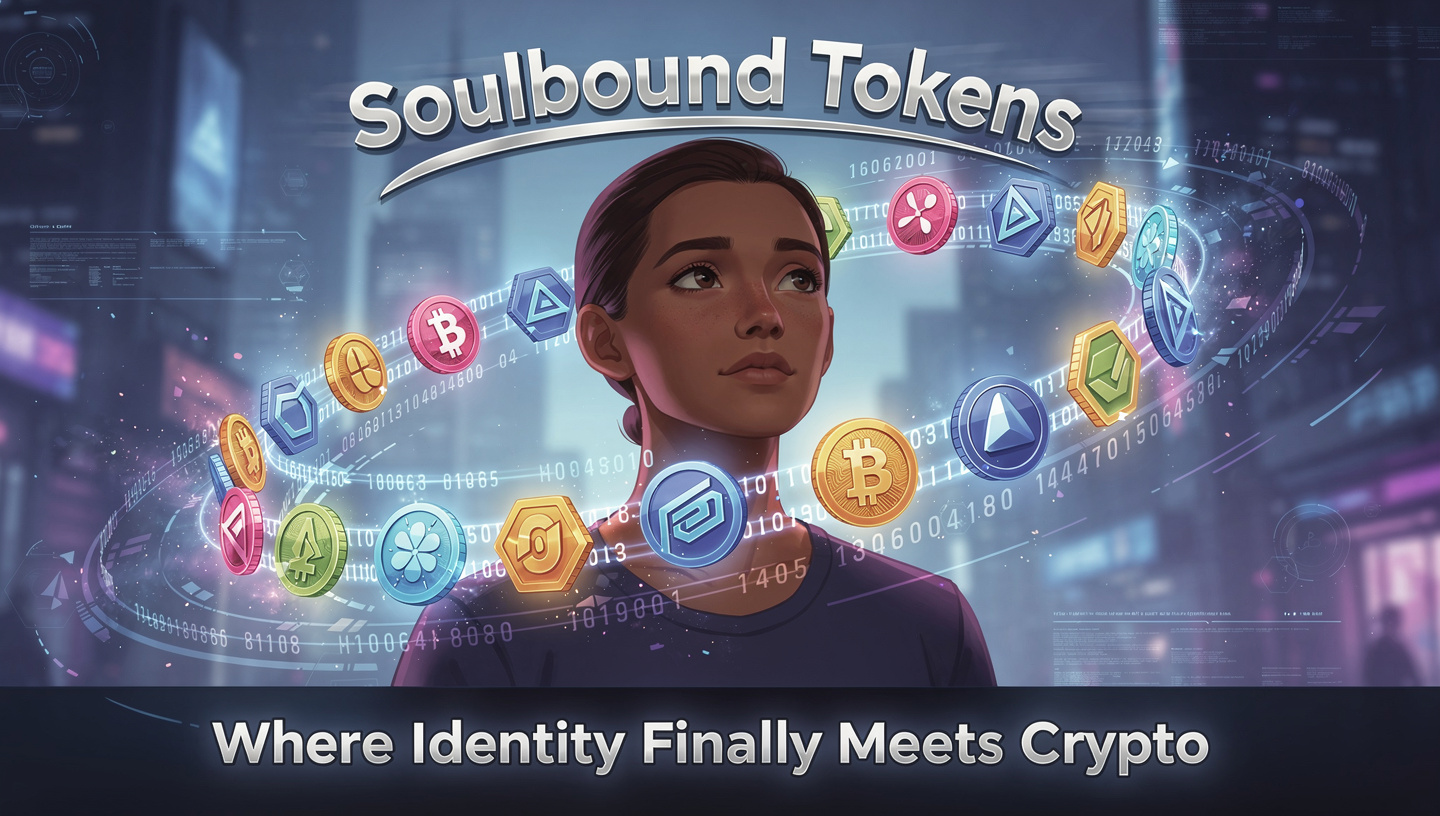
A Soulbound Token is a non-transferable token that is permanently tied to a wallet — or “soul.”
Unlike NFTs:
- ❌ You cannot sell it
- ❌ You cannot transfer it
- ❌ You cannot trade it
Once issued, it stays with you.
Think of SBTs as:
- Digital diplomas
- Verifiable credentials
- On-chain resumes
- Reputation badges
If NFTs are property, SBTs are identity.
A Simple Mental Model
| NFTs | SBTs |
|---|---|
| Assets you own | Credentials you are |
| Transferable | Non-transferable |
| Market-driven | Reputation-driven |
| Financial value | Social value |
You don’t sell your university degree.
You don’t trade your reputation.
You carry them.
That’s the soulbound idea.
2. Where the Idea Came From
The concept gained mainstream attention in 2022 through a paper by:
- Vitalik Buterin
- E. Glen Weyl
- Puja Ohlhaver
The paper proposed a vision of “Decentralized Society (DeSoc)”, where:
- Identity is plural
- Reputation is earned
- Trust is composable
- Power isn’t concentrated in capital alone
Instead of “you are what you own,” the idea becomes:
You are what you’ve done.
3. Why Crypto Needs Identity (But Not Doxxing)
Let’s be honest: anonymity in crypto is both a feature and a bug.
What Anonymity Gave Us
- Permissionless access
- Protection from censorship
- Financial freedom
What It Took Away
- Trust
- Accountability
- Reputation
- Social coordination
This leads to systemic problems:
- Sybil attacks (one person = 1,000 wallets)
- DAO governance manipulation
- Fake community engagement
- “Rug and disappear” founders
- Zero-cost scams
TradFi solved this with:
- Legal identities
- Institutions
- Courts
Crypto can’t use those tools.
So SBTs propose a third path:
Persistent identity without revealing who you are.
4. What Can Soulbound Tokens Represent?
This is where SBTs become powerful.
1. Education & Skills
- University degrees
- Online course certifications
- Coding bootcamp completions
- Skill assessments
Imagine a developer wallet where:
- Solidity level is verifiable
- Experience is on-chain
- Fake resumes are impossible
2. Work & Contribution
- DAO memberships
- Bounties completed
- Grants received
- Community leadership roles
Your wallet becomes a living work history.
3. Reputation & Trust
- No-scam history
- Long-term protocol participation
- Governance engagement
- Social contributions
Over time, trust becomes earned, not assumed.
4. Access & Permissions
- Event attendance
- Private communities
- Governance rights
- Feature access
Instead of selling access, projects can recognize participation.
5. How SBTs Change Web3 Governance
DAO governance today is deeply flawed.
Token-based voting assumes:
“More tokens = more legitimacy.”
Reality:
- Tokens are bought, borrowed, or farmed
- Votes are financial, not social
- Long-term contributors are often ignored
Enter SBT-Based Governance
Imagine a DAO where:
- Voting power depends on participation history
- Reputation matters more than capital
- Sybil attacks are economically useless
Examples:
- Core contributors have higher voting weight
- Long-term members matter more than whales
- Newcomers gain influence gradually
This aligns incentives toward building, not extracting.
6. Soulbound Tokens vs NFTs: A Deeper Contrast
NFTs are about market value.
SBTs are about social value.
NFTs:
- Thrive on speculation
- Encourage flipping
- Reward early access
SBTs:
- Reward consistency
- Encourage contribution
- Discourage manipulation
In a way:
- NFTs reflect capitalism
- SBTs reflect meritocracy (ideally)
Neither replaces the other.
They complete the picture.
7. Privacy: The Biggest Challenge
Let’s address the elephant in the room.
If SBTs represent identity, isn’t that dangerous?
The Risk
- Permanent mistakes
- Social scoring dystopias
- On-chain discrimination
- Reputation lock-in
These are real concerns — and ignoring them would be irresponsible.
Possible Solutions
- Selective disclosure (zero-knowledge proofs)
- Expiring or revocable SBTs
- Community-based issuance
- Multiple “souls” per person
The goal is not a single global identity — but many overlapping reputations.
Just like real life.
8. Recovery: What Happens If You Lose Your Wallet?
If your identity lives in your wallet, losing it becomes catastrophic.
This forces crypto to confront something it has avoided for years:
Social recovery.
Possible models:
- Multi-sig recovery with trusted peers
- DAO-based identity recovery
- Institutional guardians
- Time-locked restoration
SBTs push crypto toward human-centered security, not just cryptography.
9. Real-World Use Cases Emerging Today
SBTs aren’t science fiction.
They are already appearing in:
- DAO contribution tracking
- Conference attendance badges
- GitHub-linked developer credentials
- Community reputation systems
Many are primitive.
Most are experimental.
But so were NFTs in 2017.
10. The Philosophical Shift: From Money to Meaning
Crypto started with money.
Then assets.
Then culture.
SBTs represent the next leap:
From financial coordination to social coordination.
They ask deeper questions:
- Who deserves trust?
- How is reputation earned?
- Can systems reward contribution without commodifying everything?
This is not just a technical upgrade.
It’s a moral one.
11. The Dark Side: What Could Go Wrong
No honest analysis avoids risk.
SBTs could enable:
- Social credit systems
- Irreversible stigma
- Power concentration via reputation
- New forms of exclusion
If poorly designed, they could recreate the worst parts of Web2 — but on-chain and permanent.
The difference?
This time, the code is open.
And the choices are ours.
12. Why SBTs Might Be Inevitable
As crypto scales, it must answer:
- Who can be trusted?
- Who deserves influence?
- Who is accountable?
Markets alone cannot answer these questions.
Identity will emerge — either:
- Through centralized platforms
- Or through decentralized primitives like SBTs
There is no neutral option.
Conclusion: Identity Is the Final Frontier
Soulbound Tokens are not flashy.
They don’t pump.
They don’t flip.
But they quietly solve something crypto desperately needs:
Continuity of self.
They turn wallets from masks into mirrors.
From tools of extraction into vessels of meaning.
If crypto is to become more than a casino —
If it’s to support real communities, real governance, and real trust —
Then identity must exist.
Not owned.
Not sold.
But earned.