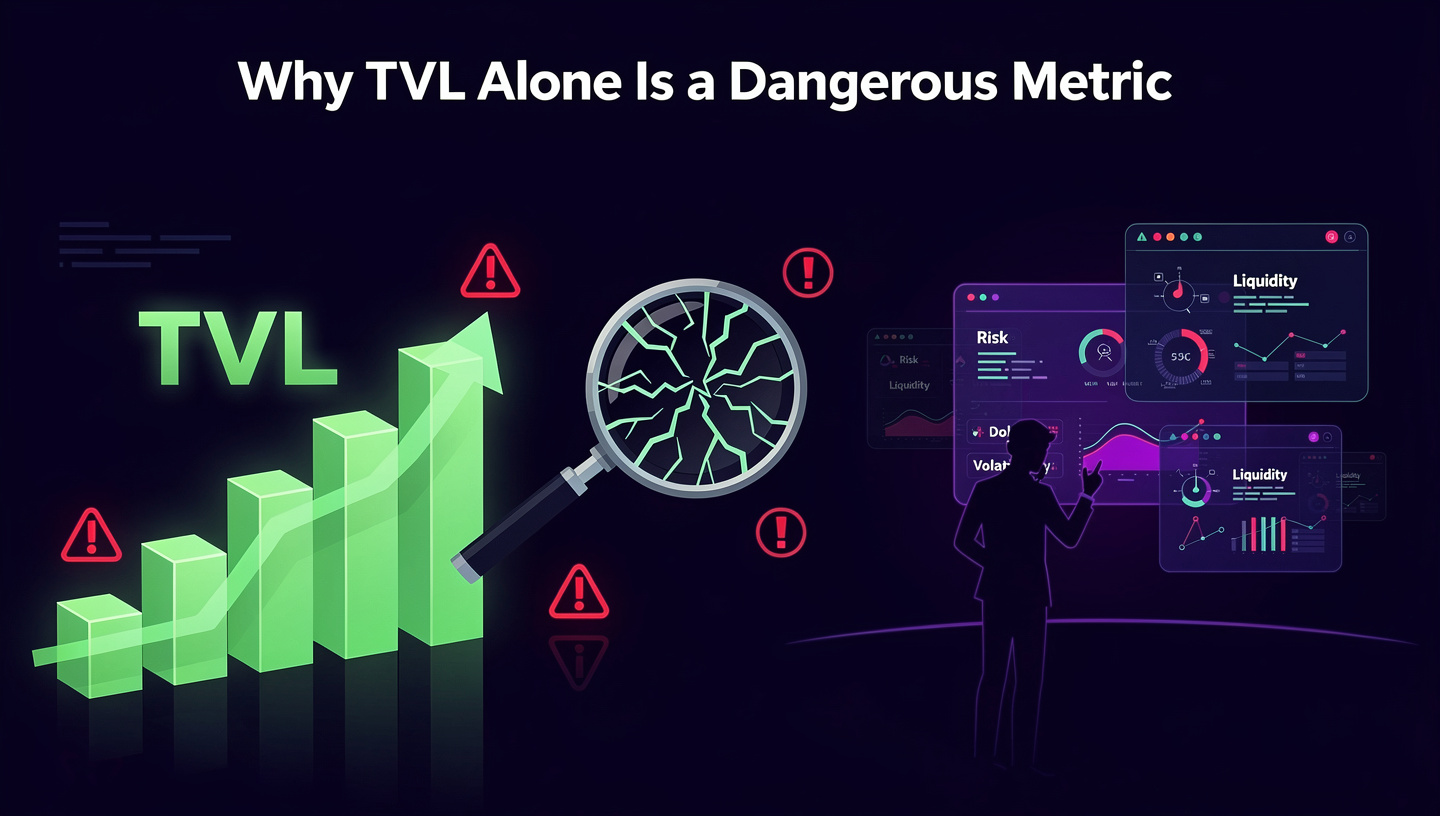
In DeFi, there is one number that dominates dashboards, headlines, and Twitter debates like a god among mortals.
TVL — Total Value Locked.
A protocol with high TVL is considered “safe.”
A protocol with rising TVL is “winning.”
A protocol with falling TVL is “dying.”
Investors chase it.
Founders flex it.
Analysts obsess over it.
But here’s the uncomfortable truth most people don’t want to admit:
TVL alone is one of the most misleading metrics in crypto.
Not “imperfect.”
Not “incomplete.”
Dangerous.
Because when you trust TVL blindly, you confuse deposits with value, liquidity with health, and short-term incentives with long-term sustainability.
This article is not about dismissing TVL entirely.
TVL does matter.
But if TVL is the only thing you look at, you are flying blind — and DeFi history is littered with the wreckage of protocols that looked unstoppable… until they weren’t.
Let’s break down why TVL lies, how it gets gamed, and what you should look at instead.
1. What TVL Actually Measures (And What It Doesn’t)
At its core, TVL is simple:
TVL = the total dollar value of assets deposited into a protocol.
That’s it.
No nuance.
No context.
No quality check.
TVL does not measure:
- Profitability
- Sustainability
- User loyalty
- Risk exposure
- Revenue
- Token economics
- Capital efficiency
It merely answers one question:
“How much money is sitting here right now?”
And even that answer is shakier than most people realize.
2. TVL Is a Snapshot, Not a Story
TVL is a static snapshot in a hyper-dynamic system.
Imagine judging a company’s health by how much cash is sitting in its bank account — without knowing:
- Where the cash came from
- How fast it’s leaving
- Whether it belongs to customers or investors
- Whether it’s borrowed
That’s TVL.
A protocol can show massive TVL:
- Right before incentives end
- Right before an exploit
- Right before a governance attack
- Right before liquidity vanishes
TVL doesn’t warn you.
It smiles politely while the building is on fire.
3. Incentives: The Great TVL Illusion Machine
One of the biggest reasons TVL is dangerous is how easily it can be manufactured.
The Incentive Loop
Here’s the classic playbook:
- Protocol launches
- Offers insane APYs (often triple or quadruple digits)
- Capital floods in
- TVL skyrockets
- Twitter celebrates
- Dashboards glow green
But what’s actually happening?
Users are not investing.
They’re renting yield.
The moment incentives drop:
- Liquidity leaves
- TVL collapses
- The protocol looks “dead” overnight
High TVL didn’t indicate real demand.
It indicated temporary bribery.
In extreme cases, TVL becomes a liquidity mirage — capital that never intended to stay.
4. Mercenary Capital vs. Sticky Capital
TVL treats all capital as equal.
But in reality, capital comes in different flavors.
Mercenary Capital
- Chases the highest APY
- Zero loyalty
- Leaves instantly when incentives change
Sticky Capital
- Uses the product
- Generates fees
- Stays through market cycles
TVL doesn’t distinguish between them.
A protocol with:
- $1B of mercenary capital
- $100M of sticky capital
can look “bigger” than a protocol with:
- $300M of deeply loyal users
But which one survives a bear market?
History answers that question brutally.
5. TVL Can Be Self-Referential (And That’s Terrifying)
In DeFi, assets often come from… other DeFi protocols.
This leads to recursive TVL.
Example:
- ETH is deposited into Protocol A
- Protocol A issues a derivative token
- That token is deposited into Protocol B
- Protocol B issues another derivative
- That derivative goes into Protocol C
Each protocol counts TVL.
But how much real value entered the system?
Often far less than reported.
TVL gets counted multiple times, creating the illusion of deep liquidity while actual exit liquidity is thin.
When confidence breaks, this stacked house of cards collapses fast.
6. TVL Ignores Capital Efficiency
Two protocols can have the same TVL — and wildly different outcomes.
Protocol X
- $500M TVL
- Generates $200k/month in fees
Protocol Y
- $500M TVL
- Generates $10M/month in fees
TVL treats them as equals.
Markets should not.
Capital efficiency matters:
- How much value does each dollar locked actually produce?
- Is capital working or just sitting?
High TVL with low fee generation is often a warning sign, not a flex.
7. TVL Says Nothing About Risk Concentration
TVL is an aggregate number.
It hides:
- Whale dominance
- Asset concentration
- Correlated risk
A protocol with $1B TVL where:
- 70% comes from one wallet
- 80% is a single volatile asset
is fragile, not strong.
TVL doesn’t show you:
- How fast capital can exit
- Who controls liquidity
- What happens in stress scenarios
When a whale sneezes, TVL catches pneumonia.
8. TVL and Token Price: A Dangerous Feedback Loop
TVL is often denominated in USD.
This creates a subtle but deadly loop:
- Token price rises
- USD TVL rises (even if asset quantity stays flat)
- People perceive growth
- More capital enters
- Token price rises further
This is not organic growth.
It’s price reflexivity.
When price falls, the loop reverses violently:
- TVL drops
- Confidence breaks
- Liquidity exits
- Price collapses further
TVL amplifies both illusions and panic.
9. TVL Fails in Stress Tests
TVL looks best in bull markets.
But real metrics prove themselves in stress.
Ask these questions:
- How did TVL behave during market crashes?
- How quickly did liquidity leave?
- Did users return afterward?
A protocol that survives drawdowns with a smaller but loyal TVL is often healthier than one that briefly touched astronomical numbers.
Resilience beats raw size.
10. What You Should Look at Instead (Or Alongside TVL)
TVL isn’t useless — it’s just incomplete.
Here’s what actually matters:
1. Fee Revenue
- Who is paying to use the protocol?
- Are fees organic or subsidized?
2. Revenue-to-TVL Ratio
- How productive is locked capital?
3. User Retention
- Are users coming back?
- Do they use multiple features?
4. Liquidity Stickiness
- How much TVL remains when incentives drop?
5. Risk Distribution
- Wallet concentration
- Asset diversity
6. Governance Quality
- Can rules be changed safely?
- Who holds power?
7. Time
- Has the protocol survived multiple market regimes?
Time is the ultimate filter TVL cannot fake.
Conclusion: TVL Is a Number, Not the Truth
TVL is seductive because it’s simple.
One number.
One ranking.
One leaderboard.
But DeFi is not simple — and pretending it is has cost people billions.
TVL can:
- Be bought
- Be gamed
- Be recycled
- Be inflated
- Disappear overnight
Treating TVL as a proxy for safety is like judging a bridge by how many people are standing on it — without checking the steel.
The smartest DeFi participants don’t ignore TVL.
They interrogate it.
Because in crypto, the most dangerous lies are not the obvious scams —
they’re the numbers that look reassuring while quietly telling half the story.
And TVL, on its own, is exactly that.