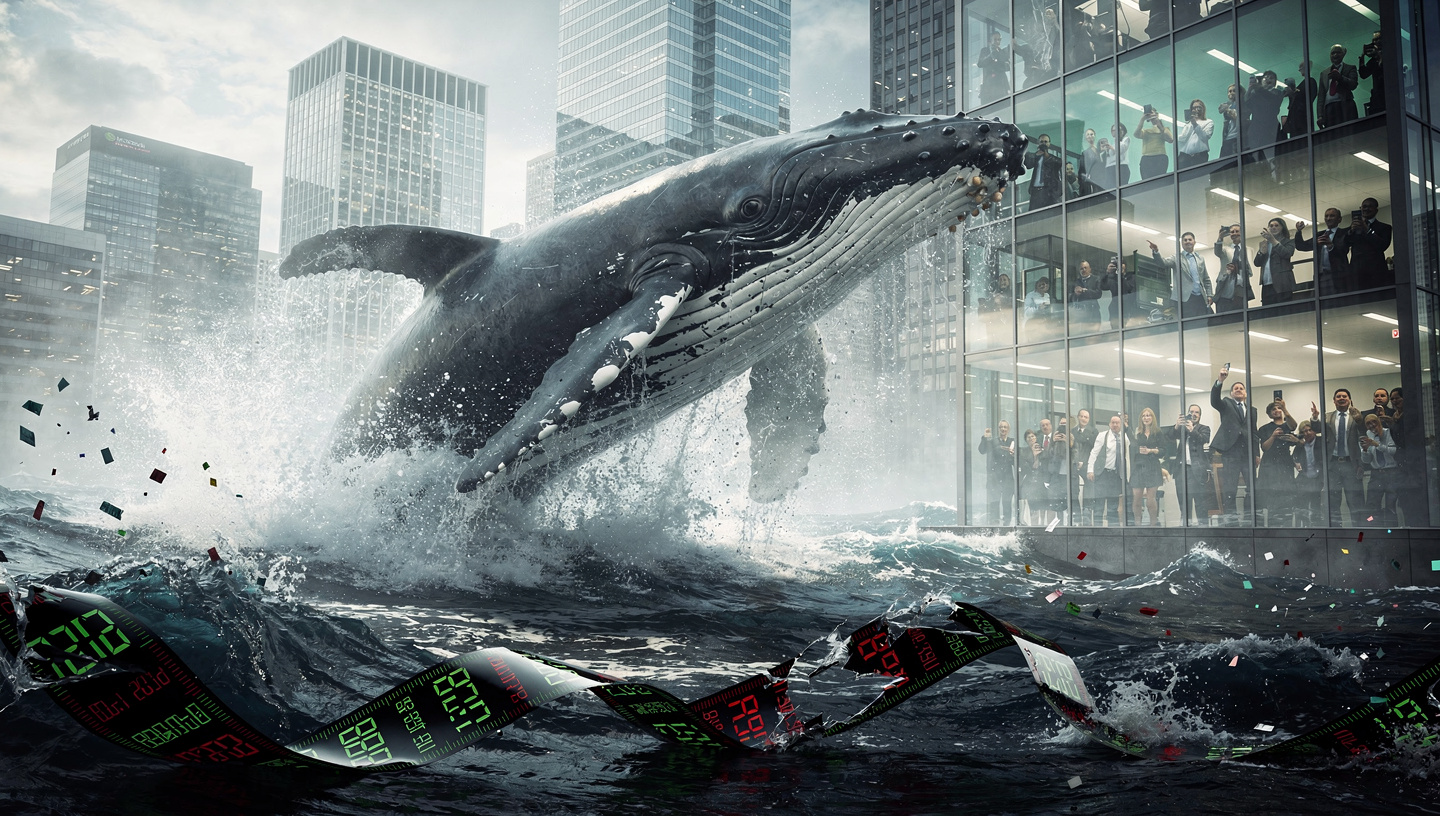
Most crypto traders believe whales move the market by doing one simple thing:
buy big → price goes up, sell big → price goes down.
That belief is comforting.
It’s also dangerously wrong.
If whales really traded like that, they would lose money fast. They would expose themselves, spike volatility against their own positions, and gift free profits to smarter players.
Real whales don’t push the market.
They shape behavior — and let the crowd move price for them.
This article is about how that actually happens.
Not theory.
Not conspiracy.
Not Twitter folklore.
This is how large capital enters, exits, hides, manipulates liquidity, weaponizes psychology, and quietly transfers wealth from the impatient to the disciplined.
Once you understand this, you’ll never look at a chart the same way again.
First: Who (and What) Are Whales, Really?
A whale is not just “someone with a lot of money.”
A whale is an entity whose orders are large enough to meaningfully impact liquidity.
That could be:
- Early Bitcoin holders
- Funds managing hundreds of millions
- Market makers
- Exchanges
- Venture capital firms
- Foundations controlling token supply
- Protocol treasuries
- Even coordinated desks acting as one
What defines a whale isn’t size — it’s market influence.
And here’s the key truth:
Whales do not trade for excitement.
They trade for execution quality.
Their #1 enemy is not being wrong.
It’s slippage.
Why Whales Can’t Trade Like You
Retail traders can smash market buy.
Whales cannot.
If a whale tries to buy $50M of a mid-cap token at market:
- Price explodes upward
- Order books thin out
- Other traders front-run them
- Average entry becomes terrible
So whales face a paradox:
They need liquidity — but liquidity only appears when the crowd believes price should move the opposite way.
This is where the real game begins.
Whales Don’t Chase Price — They Manufacture Liquidity
Liquidity is created by belief.
When traders believe price will fall, they:
- Sell
- Short
- Place stop losses below support
- Remove buy orders
That’s exactly when whales want to buy.
When traders believe price will rise, they:
- Buy
- FOMO
- Place leverage longs
- Stack stop losses above resistance
That’s exactly when whales want to sell.
So whales don’t follow trends.
They engineer emotional environments.
Phase 1: Accumulation (The Boring, Painful Part)
Accumulation almost never looks bullish.
Price:
- Moves sideways
- Feels heavy
- Breaks support repeatedly
- Recovers slowly
- Frustrates everyone
Retail thinks:
“This coin is dead.”
Whales think:
“Perfect.”
How Accumulation Really Works
Whales use:
- Limit orders
- Iceberg orders
- OTC deals
- TWAP/VWAP execution
- Dark pools
- Time-based buying
They buy slowly — sometimes over weeks or months.
Price is kept intentionally boring.
Why?
Because excitement attracts competition.
Boredom scares it away.
Fake Breakdowns: The Liquidity Harvest
One of the most misunderstood whale tactics is the fake breakdown.
Price breaks below support.
Retail panics.
Stop losses trigger.
Shorts pile in.
Volume spikes — but price doesn’t collapse.
Who’s buying that sell pressure?
The whale.
By the time price reclaims the level:
- Retail is shaken out
- Shorts are trapped
- Liquidity is absorbed
This is not random volatility.
It’s inventory acquisition.
Phase 2: Narrative Construction
Whales don’t pump charts.
They pump stories.
Narratives are how liquidity scales.
Before a major move, you’ll often see:
- Influencers “discover” the project
- Old news suddenly recycled
- Partnerships teased
- Roadmaps resurfacing
- Vague but bullish announcements
Nothing fundamentally changed.
What changed is attention.
Attention creates participation.
Participation creates liquidity.
Liquidity allows distribution.
Phase 3: Markup (The Illusion of Strength)
Once enough inventory is accumulated, price begins to rise.
But notice:
- Pullbacks are shallow
- Dips are aggressively bought
- Support levels feel “magnetic”
- Bad news stops working
Retail thinks:
“This is organic growth.”
It’s not.
It’s controlled expansion.
Whales are not buying aggressively here — they already bought.
They are defending structure while letting FOMO do the heavy lifting.
Why Whales Love Leverage (But Never Use It Like You Do)
Leverage is retail’s weakness.
It’s whale fuel.
When open interest spikes:
- Whales know liquidation levels
- They know where pain is clustered
- They know where forced buying/selling will occur
Price moves toward maximum discomfort, not technical beauty.
This is why:
- Perfect setups fail
- Obvious patterns break
- Clean breakouts reverse violently
It’s not manipulation for chaos — it’s liquidity engineering.
Phase 4: Distribution (The Exit No One Notices)
Distribution never looks like a top.
It looks like:
- Strong price
- High volume
- Endless bullish tweets
- “This time is different”
Whales sell into:
- Breakouts
- Retests
- Good news
- Retail confidence
They don’t dump.
They hand inventory to believers.
The best tops feel safe.
The worst bottoms feel hopeless.
The Final Act: The Trap
Once distribution is complete:
- Support weakens
- Dips stop getting bought
- Rallies fail faster
- Volatility increases
Retail argues:
“Healthy correction.”
Whales are already gone.
Then comes:
- The sharp move
- The cascade
- The liquidation
- The silence
By the time retail realizes what happened, the cycle has reset.