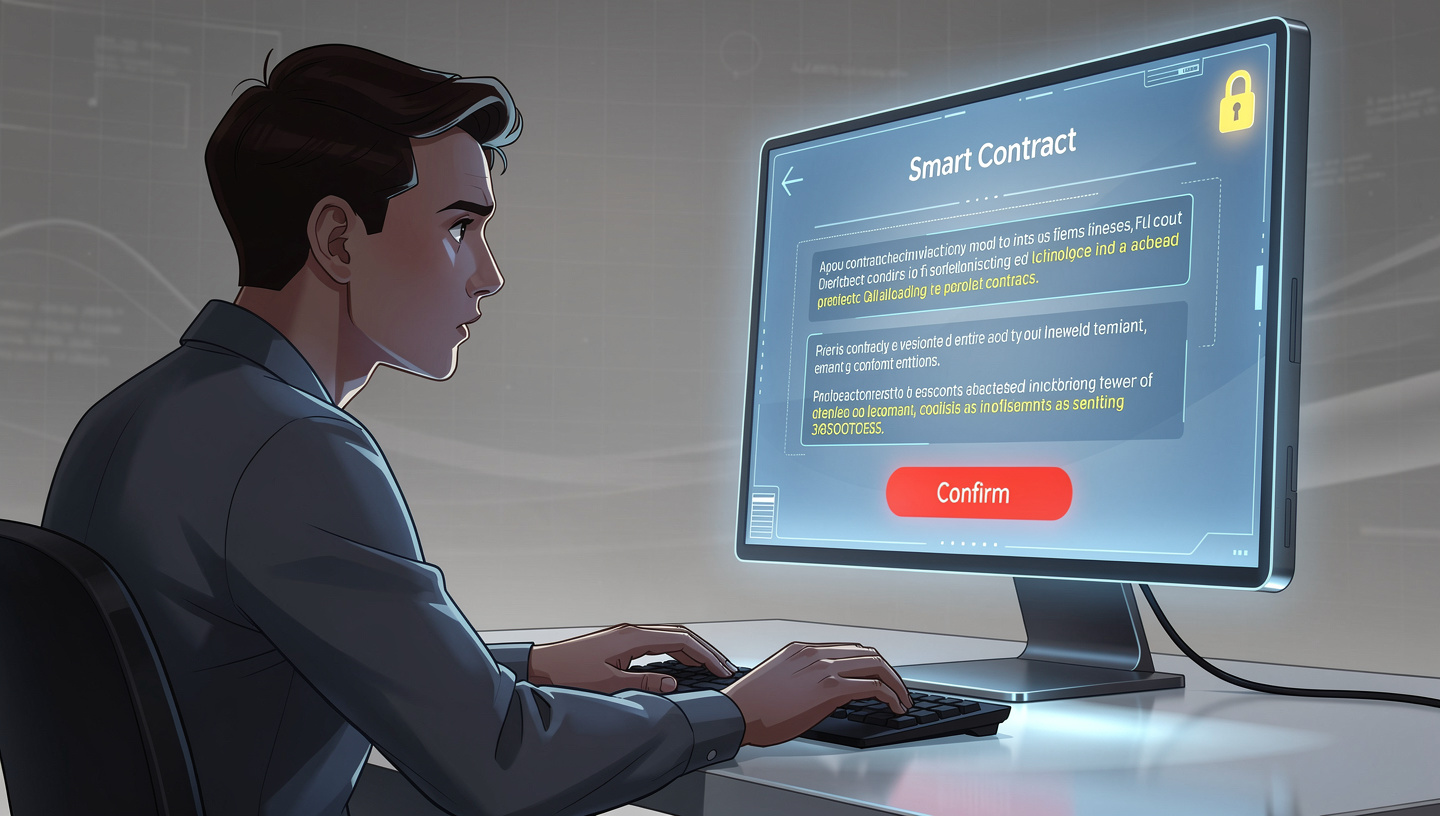
A button.
A short line of text.
A familiar wallet popup.
“Do you want to confirm this transaction?”
Your heart barely reacts. Your brain says, I’ve done this a hundred times.
And with one click, value moves forever.
No undo.
No customer support.
No “Oops, my bad.”
Smart contracts are often marketed as trustless, unstoppable, mathematical perfection. And in a narrow sense, that’s true. They execute exactly as written.
But that’s also the problem.
Because humans don’t think like compilers.
And reality doesn’t behave like a whitepaper.
This article is about the less obvious risks—the ones that don’t show up in marketing diagrams or tutorial videos. The risks that don’t require hackers, malware, or genius-level exploits. The risks that exist between your intention and the code you approve.
Let’s talk about what really happens before you click “Confirm.”
1. Smart Contracts Don’t Understand Intent—Only Instructions
This is the most fundamental risk, and almost no one truly internalizes it.
A smart contract does not know what you meant to do.
It does not know:
- You thought you were approving a swap
- You assumed limits existed
- You believed “approve” meant “this one time”
The contract only knows what permissions you granted.
If the code says:
“This address can move all your tokens, anytime, forever”
Then congratulations—that is now true.
The Illusion of Common Sense
Humans assume guardrails exist because every other system has them:
- Banks have fraud detection
- Apps have confirmation screens
- Companies have customer support
Smart contracts have none of that.
They are closer to signing a legal document written in a foreign language where:
- Every word is binding
- No one explains the consequences
- And enforcement is instant
The contract will not stop and ask:
“Are you sure you want to give unlimited access?”
It already asked.
You already said yes.
2. “Approve” Is Often More Dangerous Than “Transfer”
Most users fear the wrong button.
They worry about the transaction that moves tokens immediately.
But the most dangerous action in DeFi is usually the quiet one:
Approve
An approval doesn’t take your money now.
It sets up the conditions for your money to be taken later.
Unlimited Approvals: A Loaded Gun on the Table
Many dApps request:
- Infinite token allowance
- No expiration
- No usage limits
Why? Convenience.
But from a security perspective, you just handed someone:
- A permanent debit card
- With no spending cap
- That works even when you’re offline
If the contract:
- Gets upgraded
- Has a hidden function
- Is later exploited
Your funds are no longer protected by your wallet.
They are protected by hope.
3. Contract Upgrades: The Trojan Horse of “Trusted” Protocols
Some smart contracts are immutable.
Others are not.
Upgradeable contracts introduce a subtle risk most users never consider:
The code you approved may not be the code that runs tomorrow.
Proxy Contracts: Same Address, Different Brain
Upgradeable contracts often use proxy patterns:
- The contract address stays the same
- The logic behind it can change
From your wallet’s perspective:
“This is the same contract you trusted before.”
From reality’s perspective:
“This is a completely new system wearing the old skin.”
That means:
- New bugs can be introduced
- New permissions can be added
- New attack surfaces can appear
And your old approvals?
They still apply.
4. Interface Lies: You Sign Code, Not UI
This one hurts because it feels unfair.
You don’t interact with smart contracts directly.
You interact with interfaces.
Websites.
Buttons.
Friendly language.
But the interface is not the contract.
When the UI Says One Thing—and the Transaction Does Another
Common scenarios:
- UI shows a swap, transaction grants approval
- UI says “Stake”, transaction transfers ownership
- UI hides secondary actions in batch transactions
Wallets often display:
- Long hex data
- Obscure method names
- No human-readable explanation
So users rely on trust:
- Trust in the site
- Trust in the brand
- Trust in familiarity
This creates a dangerous gap:
You approve what the interface claims, not what the contract executes.
And attackers love that gap.
5. Batch Transactions: When One Click Means Ten Actions
Modern dApps optimize for gas and UX.
So they bundle multiple actions into one transaction:
- Approve
- Transfer
- Stake
- Delegate
- Set permissions
All in one click.
The Problem with “One-Click Convenience”
When everything happens at once:
- You can’t inspect each step easily
- Wallets show partial information
- Dangerous permissions hide inside “helpers”
It’s like signing:
- Ten contracts
- In one envelope
- Without seeing page nine
By the time something goes wrong, the transaction is already final.
6. Reentrancy Isn’t Just a Developer Problem
You’ve probably heard of reentrancy attacks as a technical vulnerability.
But here’s the uncomfortable truth:
Users suffer from them just as much as developers.
If a contract you interact with:
- Calls external contracts
- Handles callbacks improperly
- Assumes good behavior
Then your assets can become collateral damage—even if you did everything “right.”
Smart contracts don’t isolate risk.
They share it across every user who touches them.
7. Economic Exploits: When the Code Works but the Math Fails
Not all losses come from bugs.
Some come from perfectly functioning logic that behaves badly under pressure.
Examples:
- Flash loan attacks
- Oracle manipulation
- Liquidity imbalance exploitation
The contract executes exactly as designed.
The outcome is just catastrophic.
And users often discover this:
- Mid-transaction
- During congestion
- While gas prices spike
Your funds may not be stolen—but they can be:
- Permanently devalued
- Trapped in illiquid pools
- Converted at absurd prices
All without a single line of “malicious” code.
8. Time-Based Risks: What Happens While You’re Sleeping
Crypto never closes.
Contracts don’t pause.
Markets don’t wait.
If you leave:
- Approvals active
- Positions open
- Assets staked in fragile systems
Then risk accumulates even when you’re inactive.
The most painful losses often happen:
- Overnight
- During holidays
- When users are offline
Because smart contracts don’t care if you’re awake.
9. Permission Stacking: Death by a Thousand Yeses
One approval feels harmless.
Ten feels normal.
Fifty feels invisible.
Over time, wallets accumulate:
- Old DeFi approvals
- Abandoned NFT permissions
- Forgotten experimental protocols
Each one is:
- A potential exploit vector
- A silent liability
- A future regret
The danger is not any single contract.
It’s the aggregate risk of everything you ever trusted.
10. The Psychological Trap: Familiarity Breeds Blindness
Perhaps the biggest risk is not technical at all.
It’s emotional.
When users:
- Use the same wallet daily
- Visit the same dApps
- Repeat the same actions
Their brain switches to autopilot.
They stop reading.
They stop verifying.
They stop questioning.
And that’s when mistakes slip through.
Not because users are stupid.
But because humans optimize for efficiency.
Smart contracts exploit consistency.
Attackers exploit habit.
So What Should You Do Before Clicking “Confirm”?
Not paranoia.
Not fear.
Just awareness.
A few grounding principles:
- Treat approvals like permanent power of attorney
- Assume interfaces can lie—intentionally or accidentally
- Periodically revoke unused permissions
- Separate wallets by risk (daily use vs long-term storage)
- Slow down when something feels “too smooth”
Most importantly:
Remember that “Confirm” is not a button.
It’s a decision.
One that collapses:
- Code
- Trust
- Risk
- And consequence
Into a single click.
Final Thought: Smart Contracts Are Honest—but Not Kind
They won’t scam you.
They won’t trick you.
They won’t feel bad.
They will simply do exactly what you allowed them to do—forever, publicly, and without appeal.
In a world where money moves at the speed of thought, wisdom is not about moving faster.
It’s about pausing just long enough before clicking “Confirm.”
Because in crypto, the most expensive mistakes are often made in silence.