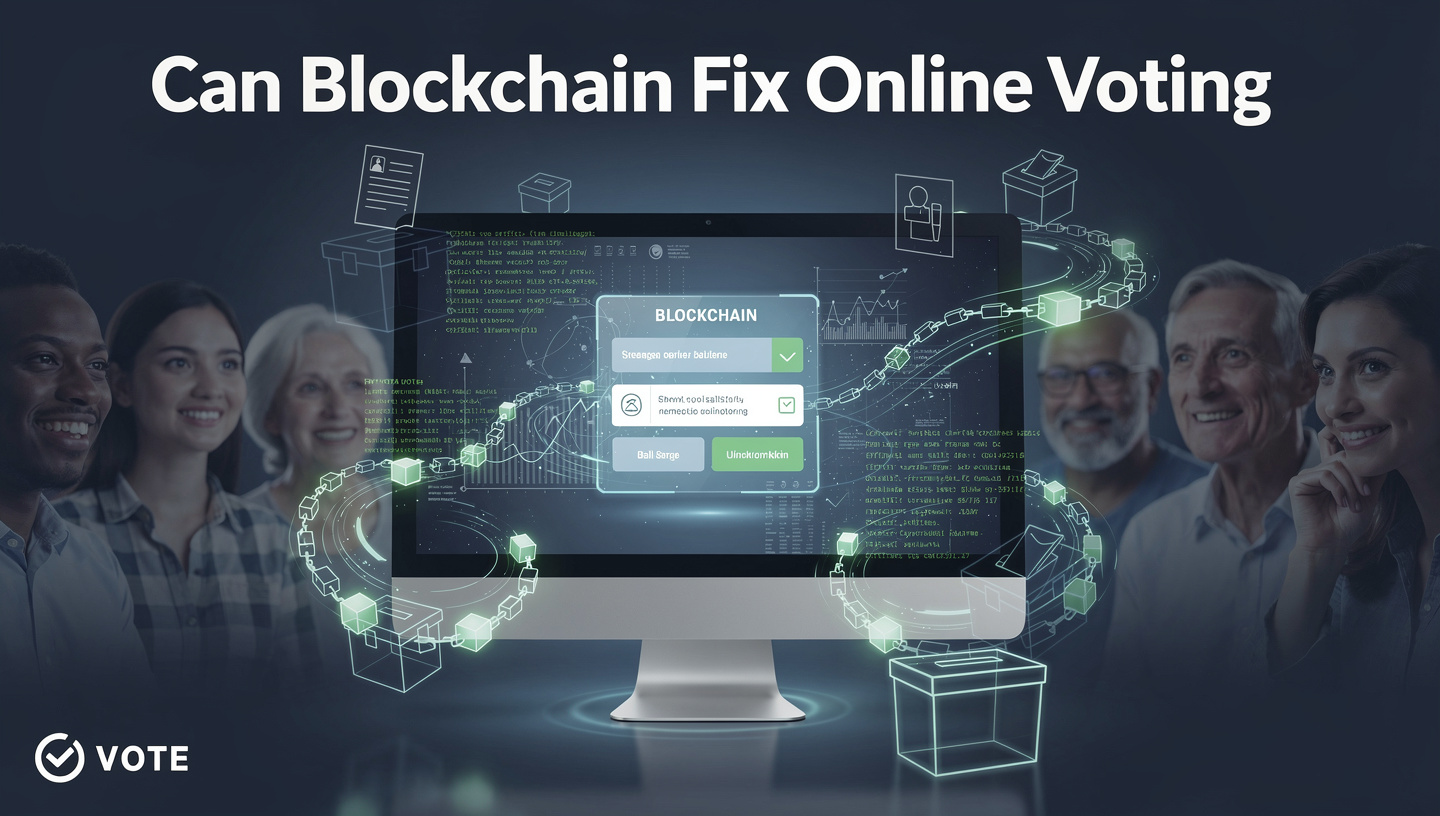
Few institutions matter more to modern society than voting. It is the quiet mechanism through which power changes hands, voices are counted, and legitimacy is earned. Yet despite its importance, voting systems around the world remain fragile—plagued by low turnout, logistical inefficiencies, mistrust, and persistent fears of fraud or manipulation.
As governments digitize everything from tax filings to healthcare records, a natural question arises: why not voting? And more specifically, can blockchain technology fix online voting?
To some, blockchain-based voting sounds like a silver bullet: transparent, tamper-proof, and decentralized. To others, it feels like a dangerous experiment—mixing immature technology with the most sensitive democratic process imaginable.
The truth lies somewhere in between.
This article takes a deep, honest look at blockchain voting: how it works, what problems it could solve, what risks it introduces, and whether it can realistically support democracy rather than undermine it.
The Broken State of Modern Voting
Before evaluating blockchain, it’s worth understanding what is actually broken in current voting systems.
1. Accessibility and Participation
Millions of citizens struggle to vote due to:
- Long distances to polling stations
- Physical disabilities
- Overseas residence
- Work constraints
- Lack of proper documentation
Even in advanced democracies, voter turnout often hovers between 50–70%, with some elections far lower. Voting is still inconvenient for many, and inconvenience erodes participation.
2. Trust Deficits
Public trust in elections is declining worldwide. Allegations of vote tampering, ballot stuffing, suppression, and opaque counting processes—whether true or exaggerated—damage confidence.
Importantly, perception matters as much as reality. Even a fair election can fail if citizens don’t believe it was fair.
3. Centralized Points of Failure
Traditional voting systems rely on centralized authorities:
- Central voter databases
- Central counting centers
- Centralized result reporting
These systems are efficient but vulnerable. A single breach, insider threat, or administrative failure can have disproportionate consequences.
4. The Limits of Existing E‑Voting
Electronic voting machines and online voting portals already exist, but they face serious criticism:
- Proprietary software that cannot be independently audited
- Susceptibility to hacking
- Lack of end-to-end verifiability
In many countries, electronic voting experiments have been rolled back rather than expanded.
What Blockchain Brings to the Table
Blockchain is not magic. But it does introduce several properties that are particularly interesting for voting.
1. Immutability
Once data is written to a blockchain, altering it retroactively is extremely difficult—often practically impossible without detection.
In voting terms, this means:
- Votes cannot be quietly changed after being cast
- Historical records remain intact
- Tampering attempts leave visible traces
2. Transparency and Auditability
Public blockchains allow anyone to:
- Verify that votes were recorded
- Confirm that totals match the underlying data
- Audit the process independently
This transparency could reduce reliance on blind trust in election authorities.
3. Decentralization
Instead of a single central server, blockchain distributes data across many nodes.
This:
- Reduces single points of failure
- Makes large-scale attacks more difficult
- Limits the power of any one institution to manipulate results
4. Cryptographic Security
Blockchain relies heavily on cryptography:
- Digital signatures
- Hashing
- Zero-knowledge proofs
These tools enable identity verification, data integrity, and—critically—privacy when designed correctly.
How Blockchain Voting Actually Works
A typical blockchain voting system includes several stages.
1. Voter Registration
Voters must prove eligibility through a trusted process—often still involving government authorities.
Blockchain does not eliminate the need for trusted identity verification; it simply records the outcome.
2. Vote Casting
Each voter submits a cryptographically signed vote from a device (phone, computer, kiosk).
The vote is:
- Encrypted
- Timestamped
- Recorded as a transaction on the blockchain
3. Vote Verification
Voters may receive a receipt or cryptographic proof allowing them to verify that:
- Their vote was recorded
- It was not altered or deleted
Crucially, the system must ensure voters cannot prove how they voted to others, to prevent coercion.
4. Tallying and Results
Votes are counted automatically using smart contracts or off-chain computation with on-chain verification.
Results can be independently audited in real time.
The Potential Benefits of Blockchain Voting
1. Increased Transparency
Instead of trusting closed systems, citizens could independently verify election integrity.
Transparency doesn’t guarantee trust—but opacity almost guarantees suspicion.
2. Faster Results
Blockchain-based tallies could produce near-instant results while maintaining auditability.
This reduces uncertainty and the window for misinformation to spread.
3. Reduced Administrative Costs
Over time, digital voting systems could reduce:
- Paper handling
- Staffing needs
- Physical infrastructure costs
Though initial implementation would be expensive, long-term savings are possible.
4. Improved Accessibility
Remote, secure voting could empower:
- Citizens abroad
- Disabled voters
- Rural populations
Participation could rise if voting becomes as easy as sending a secure message.
The Hard Problems Blockchain Does NOT Automatically Solve
This is where hype meets reality.
1. The Identity Problem
Blockchain answers how to store votes, not who gets to vote.
If identity verification is compromised:
- Blockchain will faithfully record fraudulent votes
- Immutability becomes a liability, not a feature
Secure digital identity remains one of the hardest unsolved problems in governance.
2. Voter Coercion and Vote Buying
Remote voting introduces risks that paper ballots avoid:
- Employers pressuring employees
- Family members coercing votes
- Vote buying with proof of compliance
Blockchain can verify votes—but it struggles to ensure free choice.
3. Device Security
A blockchain may be secure while voters’ devices are not.
Malware could:
- Alter votes before submission
- Prevent voting altogether
- Leak voting choices
A secure backend cannot compensate for insecure endpoints.
4. Complexity and Exclusion
Advanced cryptography can alienate non-technical voters.
If citizens don’t understand the system, trust may actually decline—even if the system is mathematically sound.
Privacy: The Most Delicate Balance
Voting demands two conflicting properties:
- Transparency (to ensure integrity)
- Secrecy (to protect voters)
Blockchain’s transparency makes privacy exceptionally challenging.
Modern proposals rely on:
- Zero-knowledge proofs
- Homomorphic encryption
- Mixnets
These techniques are powerful but complex—and mistakes can be catastrophic.
A single privacy flaw could expose voting patterns at scale.
Real-World Experiments and Lessons Learned
Estonia: A Cautionary Inspiration
Estonia operates one of the world’s most advanced online voting systems—but notably not on blockchain.
Their experience highlights:
- Strong digital identity infrastructure matters more than ledger technology
- Transparency and audits are critical
- Even successful systems face constant scrutiny
Blockchain Pilots
Several blockchain voting pilots have occurred:
- Municipal elections
- Shareholder votes
- Student governments
Results are mixed. While technical feasibility is proven, scalability, security, and public trust remain unresolved.
Notably, many cybersecurity experts remain skeptical of nationwide deployment.
Can Blockchain Fix Online Voting?
The honest answer is: not by itself.
Blockchain can improve:
- Auditability
- Transparency
- Data integrity
But it cannot magically solve:
- Identity verification
- Coercion
- Device security
- Political manipulation
Voting is not just a technical system—it is a social contract.
A More Realistic Path Forward
Instead of asking whether blockchain can replace voting systems, a better question is:
Where can blockchain responsibly augment them?
Promising use cases include:
- Audit layers for existing systems
- Transparent result reporting
- Verifiable absentee or overseas voting
- Internal party or organizational elections
Gradual integration beats radical replacement.
The Deeper Question: What Do We Want from Democracy?
Technology can strengthen democracy—but it can also weaken it if deployed recklessly.
The goal of voting is not efficiency alone. It is legitimacy, inclusion, and trust.
Blockchain offers powerful tools, but power demands restraint.
The future of voting will likely blend:
- Traditional safeguards
- Digital convenience
- Cryptographic verification
- Human oversight
Not because any single technology is perfect—but because democracy deserves layered protection.
Final Thoughts
Blockchain will not fix online voting overnight.
But dismissing it entirely would be a mistake.
Used carefully, transparently, and humbly, blockchain could become one piece of a stronger democratic infrastructure—not a replacement for trust, but a framework that helps rebuild it.
The real challenge is not whether the technology works.
It is whether society is ready to use it wisely.