In the early days of cryptocurrency, anonymity wasn’t a feature — it was the philosophy.
Bitcoin emerged from a world shaken by financial crises, mistrust of banks, and centralized power. The promise was simple but radical: be your own bank. No middlemen. No paperwork. No questions asked.
Fast forward to today, and the crypto landscape looks very different.
You’re asked to upload your passport.
You take a selfie holding your ID.
Your transaction gets flagged.
Your account is temporarily frozen.
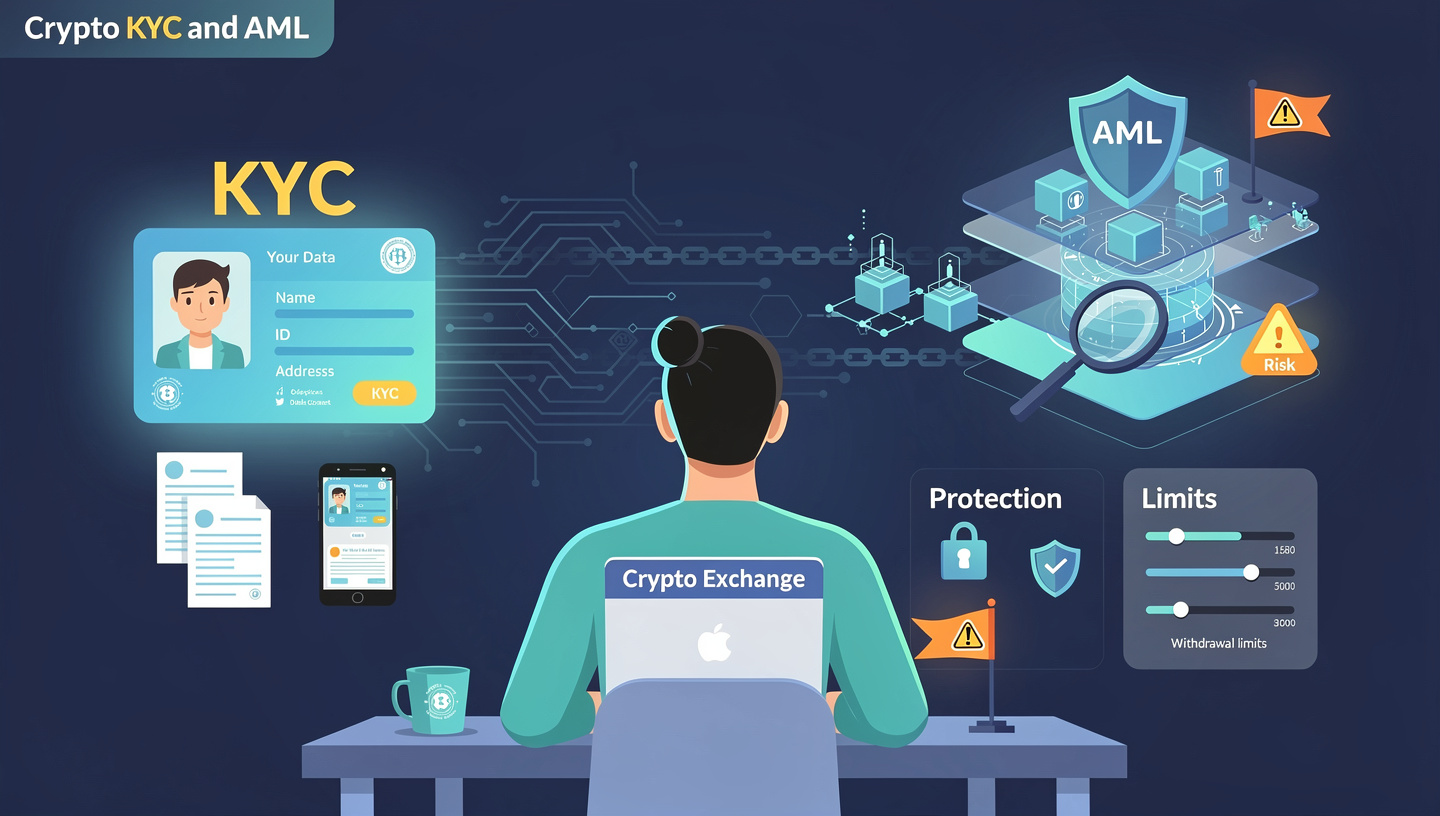
Welcome to the era of KYC and AML in crypto.
For many users, these terms feel confusing, intrusive, or even contradictory to the spirit of decentralization. For others, they represent maturity, legitimacy, and mainstream adoption. So what do KYC and AML really mean for crypto users — not in theory, but in everyday reality?
Let’s break it down.
1. What Are KYC and AML, Really? (Beyond the Buzzwords)
KYC – Know Your Customer
KYC is a process that requires platforms to verify the identity of their users. In crypto, this typically includes:
- Government-issued ID (passport, national ID, driver’s license)
- Facial verification (selfies or short videos)
- Proof of address
- Sometimes source-of-funds declarations
The goal is simple: prove that you are a real person, not a criminal, bot, or sanctioned entity.
AML – Anti-Money Laundering
AML refers to laws, regulations, and systems designed to detect and prevent illegal financial activities, such as:
- Money laundering
- Terrorist financing
- Fraud
- Sanctions evasion
- Human trafficking and organized crime funding
AML is not a single rule — it’s an ongoing framework involving:
- Transaction monitoring
- Risk scoring
- Reporting suspicious activity
- Freezing or investigating flagged accounts
Important distinction:
👉 KYC identifies who you are.
👉 AML watches what you do.
They work together, but they are not the same thing.
2. Why Crypto Couldn’t Avoid KYC and AML Forever
Many users ask: “If crypto is decentralized, why does it need KYC at all?”
The honest answer is uncomfortable but real.
Crypto Became Too Big to Ignore
Once crypto:
- Reached trillions in market cap
- Attracted institutional investors
- Intersected with fiat banking systems
- Enabled real-world payments and remittances
…it entered the regulatory spotlight.
Governments don’t regulate technology — they regulate money flows, and crypto became a major one.
Exchanges Are the Chokepoints
While blockchains are decentralized, crypto exchanges are not.
Centralized exchanges:
- Hold user funds
- Convert crypto ↔ fiat
- Operate companies with offices, staff, and bank accounts
That makes them legally accountable.
If exchanges want:
- Bank partnerships
- Fiat on-ramps
- Global expansion
They must comply with KYC and AML laws — or be shut down.
3. What KYC Looks Like for the Average Crypto User
For most users, KYC is a one-time hurdle… until it isn’t.
Typical KYC Journey
- Sign up on an exchange
- Trade freely up to a small limit
- Hit a withdrawal or deposit cap
- “Please complete identity verification”
- Upload documents
- Wait for approval
This process can take:
- Minutes on advanced platforms
- Days or weeks on overloaded ones
Why Some Users Get Rejected
Common reasons include:
- Blurry photos
- Mismatched names
- Unsupported countries
- Expired documents
- Sanctions or high-risk jurisdictions
From a user’s perspective, it feels arbitrary.
From a compliance perspective, it’s risk management.
4. AML in Action: The Part Users Rarely See
AML is mostly invisible — until it affects you.
Transaction Monitoring
Exchanges use advanced analytics tools to:
- Trace transaction histories
- Detect links to hacks, scams, or dark markets
- Flag unusual patterns (sudden large transfers, mixing services, etc.)
Your wallet doesn’t need to commit a crime — proximity alone can raise red flags.
When AML Hits Users
You may experience:
- Withdrawal delays
- Requests for additional documents
- Source-of-funds questionnaires
- Temporary or permanent account freezes
Even innocent users can get caught in AML nets — especially if:
- You interacted with DeFi protocols
- You received funds from unknown wallets
- You used privacy tools
This is one of the most controversial aspects of AML enforcement.
5. The Big Trade-Off: Privacy vs Legitimacy
At the heart of the KYC/AML debate lies a fundamental tension.
What Users Lose
- Anonymity
- Pseudonymity
- Control over personal data
- Freedom to transact without oversight
Many crypto users didn’t come for “Web2 with extra steps.”
What Users Gain
- Legal clarity
- Protection from fraud
- Account recovery options
- Mainstream access
- Institutional trust
Without KYC/AML:
- Banks won’t touch crypto
- Large investors stay away
- Adoption stalls
Like it or not, mass adoption demands regulation.
6. Is KYC Anti-Crypto? Or a Necessary Evolution?
This question divides the community.
The Purist View
- KYC contradicts decentralization
- Surveillance undermines financial freedom
- Crypto should resist state control
This camp favors:
- Self-custody
- DEXs
- Privacy coins
- Peer-to-peer trading
The Pragmatic View
- Regulation is inevitable
- Compliance enables scale
- Users want safety and usability
This camp accepts KYC as the cost of global integration.
Reality check:
Crypto today is big enough to support both philosophies — but users must choose consciously.
7. Centralized Exchanges vs DeFi: Two Different Worlds
Centralized Exchanges (CEXs)
- Almost always require KYC
- Strong AML enforcement
- Easier to use
- Fiat access
- Custodial risk
Decentralized Finance (DeFi)
- Usually no KYC
- Smart-contract based
- User controls keys
- Higher technical risk
- Regulatory uncertainty
However, DeFi is not immune forever.
Regulators are increasingly targeting:
- Frontends
- Developers
- Liquidity providers
The line is blurring.
8. Data Security: The Elephant in the Room
One of the biggest user fears is not KYC itself — but what happens to the data.
Real Risks
- Exchange hacks leaking personal documents
- Insider abuse
- Weak data protection standards
- Government data requests
Your passport is far more sensitive than your wallet address.
What Users Should Look For
Before completing KYC, ask:
- Does the platform encrypt data?
- Is it compliant with GDPR or equivalent laws?
- Has it suffered past data breaches?
- Is it transparent about data retention?
Not all exchanges are equal.
9. How KYC and AML Shape the Future of Crypto
Like it or not, KYC and AML are now core infrastructure of the crypto ecosystem.
They will influence:
- Which platforms survive
- Which users feel welcome
- How innovation evolves
- Where crypto draws its ethical lines
We may see:
- Tiered identity systems
- Zero-knowledge KYC
- On-chain compliance proofs
- Privacy-preserving regulation
The future isn’t binary — it’s hybrid.
10. What Crypto Users Should Do Going Forward
Instead of reacting emotionally, users should act strategically.
Know Your Risk Tolerance
- Want privacy? Use self-custody and DeFi carefully.
- Want convenience? Accept KYC on reputable platforms.
Separate Identities
- Don’t mix personal wallets with experimental DeFi activity
- Understand transaction traceability
Stay Informed
- Laws change fast
- Compliance rules evolve
- Ignorance is no defense
Crypto rewards responsibility.
Final Thoughts: Freedom Comes With Trade-Offs
Crypto was never about escaping responsibility — it was about reclaiming choice.
KYC and AML don’t kill crypto.
They reshape it.
The real question for users isn’t “Is KYC good or bad?”
It’s “What kind of crypto user do I want to be?”
In a world where money is code and identity is data, understanding KYC and AML isn’t optional anymore — it’s part of digital literacy.