For decades, games were worlds where people spent money, not made it. Coins collected vanished when the console turned off. Swords earned through countless hours had no value beyond personal pride. Time invested was entertainment — nothing more.
Then Play-to-Earn (P2E) arrived and shattered that assumption.
Suddenly, players were earning real money. NFTs turned digital items into assets. Tokens flowed where high scores once lived. For some, games became jobs. For others, a promise of financial freedom. For skeptics, a ticking time bomb.
So what exactly is Play-to-Earn?
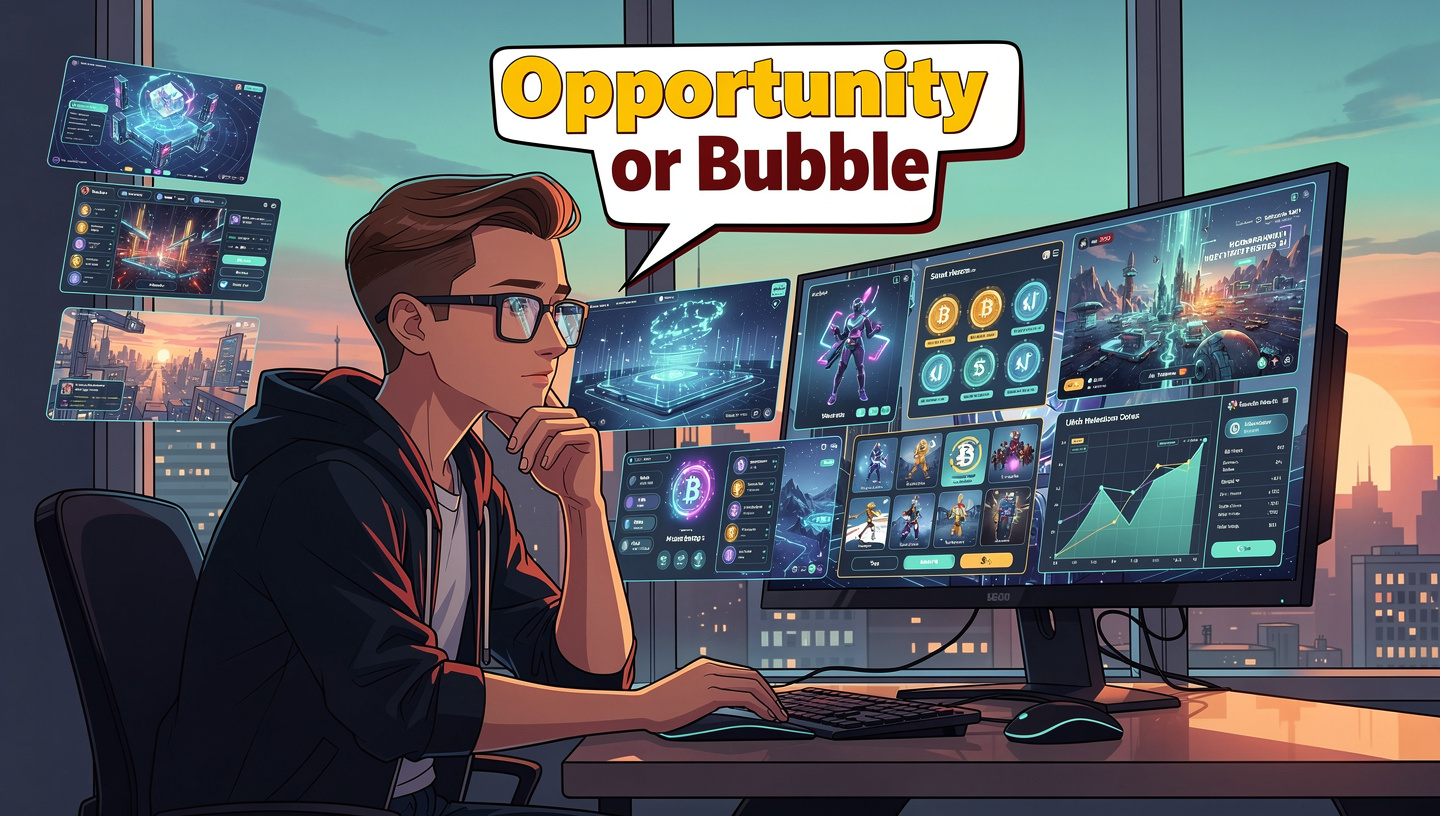
Is it a once-in-a-generation opportunity that rewrites the economics of gaming and labor?
Or is it simply the latest speculative bubble — dressed up as fun, powered by hype, and destined to collapse?
The answer, as with most revolutions, is complicated.
1. What Is Play-to-Earn, Really?
At its core, Play-to-Earn is a gaming model where players receive real, transferable economic value for in-game actions.
Unlike traditional games:
- Assets are owned by players, not publishers
- Items exist as NFTs on a blockchain
- In-game currencies are crypto tokens with market value
- Players can sell, trade, or rent their assets freely
But P2E is not just a technical innovation. It is a philosophical shift.
Traditional games follow a pay-to-play or pay-to-win logic:
Players pay money → publishers profit → players receive entertainment.
P2E flips the flow:
Players contribute time, skill, attention, and liquidity → ecosystems reward participation → value flows back to players.
In theory, everyone wins.
In practice, reality is messier.
2. Why Play-to-Earn Exploded So Fast
The rise of P2E was not accidental. It was the result of several forces colliding at the same time.
2.1 The NFT Ownership Narrative
NFTs introduced a radical idea: digital ownership without permission.
If you own an NFT sword:
- The game studio cannot delete it
- You can sell it outside the game
- Its value is not locked inside a single platform
For gamers long frustrated by centralized control, this was revolutionary.
2.2 Global Economic Inequality
In some regions, especially during and after the pandemic, P2E games became a real income source.
In countries with low wages:
- Earning $5–10 per day through gaming mattered
- Guilds emerged to sponsor players
- “Gaming” became a form of digital labor
For many, P2E was not speculation. It was survival.
2.3 Crypto Bull Market Psychology
Let’s be honest:
P2E rode the wave of a massive crypto bull market.
Token prices rose faster than game design matured.
Speculation arrived before sustainability.
People weren’t just playing games — they were front-running adoption.
3. The Promise: Why Play-to-Earn Could Change Everything
Despite criticism, P2E carries genuine, world-changing potential.
3.1 True Digital Property Rights
For the first time in gaming history:
- Players can own what they earn
- Time investment can compound
- Digital assets can persist beyond a single game
This mirrors real economies more than entertainment products.
3.2 New Forms of Work
P2E blurs the line between:
- Playing
- Working
- Investing
- Creating
Future games may reward:
- Strategists
- Content creators
- Community builders
- Economists
- Story writers
Gaming becomes an ecosystem, not a product.
3.3 Player-Owned Economies
Some P2E worlds aim for decentralized governance:
- Players vote on updates
- Communities manage treasuries
- Economic rules evolve transparently
This is unprecedented in gaming history.
4. The Dark Side: Where the Bubble Narrative Comes From
Now for the uncomfortable truth.
Many Play-to-Earn games failed — spectacularly.
4.1 Unsustainable Tokenomics
A common flaw:
- New players buy assets
- Their money funds rewards for old players
- Growth slows
- Rewards collapse
- Economy dies
This is not innovation.
This is Ponzi-like design, whether intentional or not.
4.2 Games That Aren’t Fun
Too many P2E titles forgot the most important rule:
A game must be enjoyable even if rewards disappear.
Click-to-earn mechanics, repetitive tasks, and shallow gameplay turned players into grinders, not gamers.
When profits dropped, players left — because there was nothing else to stay for.
4.3 Financialization of Fun
When every action has a dollar value:
- Players optimize instead of explore
- Communities turn toxic
- Fun becomes secondary to ROI
The soul of gaming risks being lost.
5. Play-to-Earn vs Play-and-Earn: A Critical Distinction
The industry itself is evolving its language — for a reason.
Play-to-Earn implies:
- You play in order to earn
- Financial motivation dominates
Play-and-Earn suggests:
- You play because it’s fun
- Earning is a bonus, not the purpose
This distinction matters.
The future does not belong to games that feel like spreadsheets.
It belongs to games where earning feels natural, not forced.
6. Who Actually Wins in Today’s P2E Ecosystem?
Let’s strip away the marketing and look at reality.
6.1 Early Entrants
Those who:
- Entered early
- Understood token cycles
- Took profits at the right time
They benefited most.
6.2 Infrastructure Builders
Wallets, marketplaces, chains, analytics tools —
Often more profitable than games themselves.
6.3 Skilled, Strategic Players
In well-designed systems, skill still matters:
- PvP mastery
- Economic optimization
- Community leadership
But these are rare exceptions.
7. Lessons Learned from the First P2E Wave
The first generation of P2E taught the industry hard lessons:
- Speculation cannot replace game design
- Token rewards are not retention
- Fun is non-negotiable
- Economies need sinks, not just faucets
- Players are not infinite liquidity
These lessons are shaping a quieter, smarter second wave.
8. What the Future of Play-to-Earn Might Look Like
The next era will likely look very different.
8.1 Invisible Blockchain
Players won’t need to:
- Understand wallets
- Track gas fees
- Think about tokens constantly
Crypto becomes infrastructure, not the headline.
8.2 Hybrid Monetization Models
Games may combine:
- Cosmetic NFTs
- Skill-based rewards
- Seasonal earning
- Limited economic exposure
Less “get rich quick,” more “own your progress.”
8.3 Creator-Driven Economies
Modders, map designers, storytellers, and streamers may earn directly inside game ecosystems.
This aligns incentives far better than grind-based rewards.
9. Opportunity or Bubble? The Honest Answer
Play-to-Earn is both.
It was a bubble in its first form:
- Overhyped
- Poorly designed
- Financially naive
But the idea itself is not dead.
Just like:
- The dot-com bubble didn’t kill the internet
- Early social media failures didn’t kill platforms
- ICO scams didn’t kill blockchain
The noise fades. The fundamentals remain.
Final Thought: The Question We Should Really Ask
The real question is not:
“Can you make money playing games?”
The real question is:
“Can games respect players’ time, creativity, and contribution as real value?”
If Play-to-Earn evolves to answer that honestly —
not with hype, but with craftsmanship —
then it won’t just survive.
It will redefine what gaming means in the digital age.
And that would be worth playing for —
even without the tokens.